Topic 9.12 Notes – Technology
How Medical Technology Reshaped Life and Human Choice
After 1945, medicine changed what people expected from life. Antibiotics, vaccination, safer surgery, better hospitals, new diagnostic tools, and improved obstetrics meant diseases and childbirth complications that once killed people were more often survivable.
- Alexander Fleming discovered penicillin in 1928, and mass production during World War II turned it into the classic example of modern medicine’s life-saving power.
- These advances raised life expectancy and lowered maternal and infant mortality.
- They also helped create aging populations, which put pressure on pensions, welfare states, and health systems.

Alexander Fleming in his laboratory
Medicine could also keep bodies functioning longer, which made death less simple to define.
- Organ transplants, mechanical ventilation, resuscitation, and life support created debates over brain death, the right to refuse treatment, and assisted dying.
- This is where bioethics grew. It asked whether medicine should do something, who decides, and what counts as valid consent.
- Postwar Europe cared deeply about informed consent and patient autonomy because Nazi racial policy and medical experiments had shown how dangerous unchecked biomedical power could be.
Reproductive Technology and Control over Pregnancy
Birth control and abortion both came down to one question. Who controls reproduction: women, doctors, churches, families, or the state?
Birth control
The oral contraceptive pill, widely available in the 1960s, separated sex from reproduction more reliably than older methods.
- Women could delay marriage or childbirth, limit family size, stay in school, and pursue careers.
- The pill connected directly to feminism, women’s equality, and the sexual revolution of the 1960s and 1970s.
- It also showed secularization. Many Europeans treated contraception as a private choice rather than church-governed morality.
- In Humanae Vitae (1968), Pope Paul VI reaffirmed Catholic opposition to artificial contraception.
- Access usually came earlier in more secular northern and western Europe, and later in Ireland, Italy, Spain, and Portugal.
Abortion
Abortion shifted in many countries from a dangerous clandestine act to a legal, medically regulated service.
| Country | Key law or pattern | What it shows |
|---|---|---|
| Britain | Abortion Act (1967) | Legalized abortion in specified cases |
| France | Veil Law (1975) | Liberalization tied to Simone Veil |
| Ireland | Restrictions lasted much longer; 2018 referendum removed constitutional ban | Strong Catholic influence lasted late |
| Romania | Decree 770 (1966) under Ceaușescu | Communist state control could restrict abortion too |
- Supporters stressed bodily autonomy, privacy, equality, and public health.
- Opponents stressed fetal life and moral limits on medical intervention.
- Romania is a favorite test example because it proves this issue was not just religion versus secularism. States could restrict reproduction for demographic growth.
Fertility Treatments and New Forms of Parenthood
If birth control let people avoid pregnancy, fertility treatment let others pursue it. Main forms included fertility drugs, artificial insemination, sperm and egg donation, and in vitro fertilization.
IVF
IVF fertilizes an egg outside the body, then transfers the embryo into a uterus. The diagram traces that sequence from ovarian stimulation and egg collection to fertilization, embryo culture, and embryo transfer.
- Louise Brown, born in England in 1978, was the first IVF baby.
- Robert Edwards and Patrick Steptoe made that breakthrough possible.
- Infertile couples gained a new route to biological parenthood.
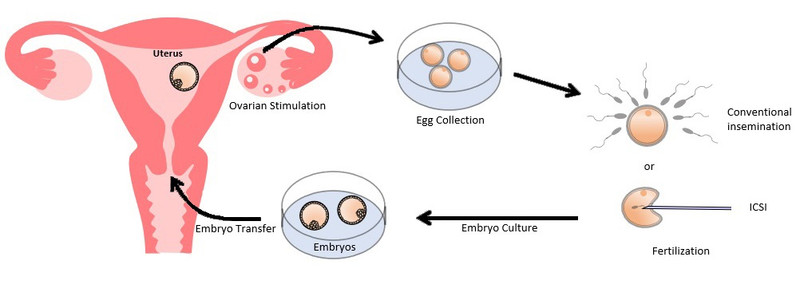
IVF process
Later developments included frozen embryos, donor gametes, surrogacy, and genetic testing. That meant genetic parenthood, pregnancy, childbirth, and child-rearing no longer had to belong to the same two people. Europeans then argued over embryo status, donor anonymity, legal motherhood, access for single people and same-sex couples, and whether public health systems should pay.
Genetics, Genetic Engineering, and the Limits of Scientific Power
Genetics explained heredity. Genetic engineering tried to alter genetic material or use it medically.
Two distinctions matter a lot on tests:
- Therapy means treating or preventing disease.
- Enhancement means selecting preferred traits that are not medically necessary.
- Somatic intervention affects one patient and is not inherited.
- Germline intervention can be passed to future generations, so it is more controversial.
Dolly the sheep, cloned in Scotland at the Roslin Institute in 1996 and announced in 1997, made these fears concrete. Europeans immediately worried about human cloning and scientific overreach.
Genetic screening could reduce inherited disease, but it also raised fears of disability discrimination and revived memories of eugenics. In Europe, that word carried special weight because of early twentieth-century eugenics and Nazi racial policy.
Why Responses Varied Across Europe
Europe never reached one answer because these conflicts cut across religion, politics, and philosophy.
- The Catholic Church generally opposed contraception, abortion, embryo destruction, and many fertility technologies.
- Secularization weakened church authority, but did not erase it.
- Liberal democracies often emphasized privacy, autonomy, and informed consent.
- Communist states often supported public health and women’s employment, but could also impose state demographic goals.
- Feminists, doctors, churches, political parties, and disability-rights activists all shaped policy.
The historical significance is huge. Medical technology helped produce smaller families, expanded women’s opportunities, fueled the sexual revolution, changed family structures, and increased personal autonomy. At the same time, science never settled the moral arguments about life, death, family, disability, and human identity.
Key Takeaways
Penicillin
Antibiotic discovered by Alexander Fleming in 1928 and mass-produced during World War II, demonstrating medicine’s new ability to cure previously fatal bacterial infections
Bioethics
Field applying moral reasoning to medicine and the life sciences, especially questions of consent, autonomy, and the acceptable limits of medical intervention
Informed Consent
Principle that patients must receive and understand relevant risks and alternatives before voluntarily agreeing to treatment or research
Birth Control
Methods intended to prevent conception, giving people greater control over pregnancy, family size, education, employment, and sexual relationships
Oral Contraceptive Pill
Highly effective, woman-controlled contraceptive widely available in the 1960s that separated sex from reproduction more reliably and allowed planned pregnancies
Humanae Vitae
Pope Paul VI’s 1968 encyclical reaffirming the Roman Catholic Church’s opposition to artificial contraception
Abortion
Termination of pregnancy by medical or surgical means; safer methods encouraged legalization debates over bodily autonomy, public health, and fetal life
Abortion Act of 1967
British law legalizing abortion in specified circumstances in Great Britain under medical supervision
Veil Law
French law of 1975, associated with health minister Simone Veil, that liberalized access to abortion
Ireland’s 2018 Abortion Referendum
Vote that removed Ireland’s constitutional prohibition preventing broad legalization of abortion after decades of strong restrictions
Decree 770
Ceaușescu’s 1966 Romanian policy sharply restricting abortion and contraception to raise the birth rate, imposing intrusive state control and contributing to unsafe abortions, maternal deaths, and abandoned children
Fertility Treatments
Medical interventions assisting conception, including fertility drugs, artificial insemination, donated gametes, and in vitro fertilization
In Vitro Fertilization (IVF)
Fertilization of an egg outside the body followed by embryo transfer into a uterus; first successfully produced a child, Louise Brown, in England in 1978
Genetic Engineering
Deliberate alteration or technological use of genetic material to produce desired medical or biological results, including medicines and gene therapies
Therapy vs. Enhancement
Therapy seeks to prevent or cure disease; enhancement seeks nonessential physical or intellectual traits, though the boundary between them remains disputed
Somatic vs. Germline Intervention
Somatic intervention changes a patient’s cells without intended inheritance; germline intervention changes sperm, eggs, or embryos and may affect future generations
Dolly the Sheep
First mammal cloned from an adult somatic cell, born at Scotland’s Roslin Institute in 1996 and announced in 1997, prompting debate over human cloning
Genetic Screening
Testing embryos or fetuses for genetic conditions, potentially preventing inherited disease but also enabling selection against disabilities or unwanted traits
Life Support
Technologies that sustain biological functions, creating disputes over brain death, withdrawal of treatment, patients’ rights, and assisted dying
Notes
Penicillin
Antibiotic discovered by Alexander Fleming in 1928 and mass-produced during World War II, demonstrating medicine’s new ability to cure previously fatal bacterial infections
Bioethics
Field applying moral reasoning to medicine and the life sciences, especially questions of consent, autonomy, and the acceptable limits of medical intervention
Informed Consent
Principle that patients must receive and understand relevant risks and alternatives before voluntarily agreeing to treatment or research
Birth Control
Methods intended to prevent conception, giving people greater control over pregnancy, family size, education, employment, and sexual relationships
Oral Contraceptive Pill
Highly effective, woman-controlled contraceptive widely available in the 1960s that separated sex from reproduction more reliably and allowed planned pregnancies
Humanae Vitae
Pope Paul VI’s 1968 encyclical reaffirming the Roman Catholic Church’s opposition to artificial contraception
Abortion
Termination of pregnancy by medical or surgical means; safer methods encouraged legalization debates over bodily autonomy, public health, and fetal life
Abortion Act of 1967
British law legalizing abortion in specified circumstances in Great Britain under medical supervision
Veil Law
French law of 1975, associated with health minister Simone Veil, that liberalized access to abortion
Ireland’s 2018 Abortion Referendum
Vote that removed Ireland’s constitutional prohibition preventing broad legalization of abortion after decades of strong restrictions
Decree 770
Ceaușescu’s 1966 Romanian policy sharply restricting abortion and contraception to raise the birth rate, imposing intrusive state control and contributing to unsafe abortions, maternal deaths, and abandoned children
Fertility Treatments
Medical interventions assisting conception, including fertility drugs, artificial insemination, donated gametes, and in vitro fertilization
In Vitro Fertilization (IVF)
Fertilization of an egg outside the body followed by embryo transfer into a uterus; first successfully produced a child, Louise Brown, in England in 1978
Genetic Engineering
Deliberate alteration or technological use of genetic material to produce desired medical or biological results, including medicines and gene therapies
Therapy vs. Enhancement
Therapy seeks to prevent or cure disease; enhancement seeks nonessential physical or intellectual traits, though the boundary between them remains disputed
Somatic vs. Germline Intervention
Somatic intervention changes a patient’s cells without intended inheritance; germline intervention changes sperm, eggs, or embryos and may affect future generations
Dolly the Sheep
First mammal cloned from an adult somatic cell, born at Scotland’s Roslin Institute in 1996 and announced in 1997, prompting debate over human cloning
Genetic Screening
Testing embryos or fetuses for genetic conditions, potentially preventing inherited disease but also enabling selection against disabilities or unwanted traits
Life Support
Technologies that sustain biological functions, creating disputes over brain death, withdrawal of treatment, patients’ rights, and assisted dying
