Topic 6.7 Notes – Ideologies of Change and Reform Movements
What the Ideologies of Change Were
After the Congress of Vienna, conservatives tried to restore monarchy, aristocratic privilege, established churches, and limited political participation. That old order never got a quiet Europe, because the French Revolution had made ideas like popular sovereignty and citizenship impossible to erase, and the Industrial Revolution made inequality and class conflict impossible to ignore.
These ideologies all wrestled with 3 questions:
- Political authority: does power come from kings by tradition, or from the people?
- Rights and citizenship: who counts as a citizen, and who gets to vote?
- Property and wealth: should industrial society protect private property above all, or reorganize labor and wealth?
The main ideologies were:
- Liberalism
- Radicalism and republicanism
- Socialism
- Marxism
- Anarchism
They were not one united anti-conservative bloc. That distinction shows up on tests a lot. They agreed less than students sometimes assume, especially on democracy, private property, revolution, and the state.
The Main Ideologies and What Each Wanted
Liberalism
Liberalism wanted government based on law, constitutions, consent, and individual rights, not hereditary privilege. Liberals supported:
- Popular sovereignty and equality before the law
- Private property
- Religious toleration
- Free trade and laissez-faire
- Constitutional government with limited power
Most liberals still stopped short of full democracy. They usually favored voting rights for propertied or educated men, because they feared mass politics.
Jeremy Bentham pushed utilitarianism. Government should aim for “the greatest happiness of the greatest number,” so laws should be judged by usefulness, not tradition.
John Stuart Mill defended liberty in On Liberty. His harm principle said people should be free unless they harm others. He also supported broader suffrage and argued for women’s equality in The Subjection of Women.
The Anti-Corn Law League, led by Richard Cobden and John Bright, shows liberalism in action. It fought tariffs on grain, arguing free trade would lower bread prices and weaken landed aristocratic power. Repeal in 1846 was a major liberal victory.
Radicalism and republicanism
Radicals took liberal ideas further into democracy. They wanted:
- Universal male suffrage
- Full citizenship without property requirements
- Representative government
- On the continent, often republics instead of monarchies
They could still support markets and private property. That is the key distinction from socialism.
Chartism centered on the People’s Charter of 1838. The movement pushed democratic reforms like the ones shown in this 1842 procession to present a mass petition to Parliament. Its 6 demands were:
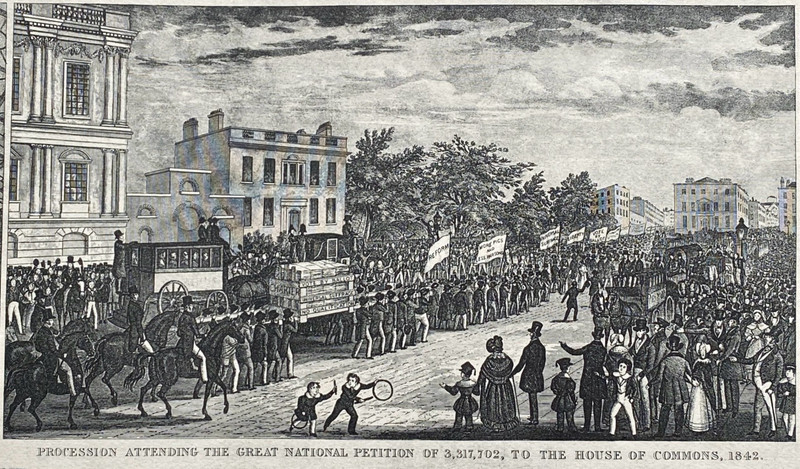
Chartist procession, 1842
- Universal male suffrage
- Equal electoral districts
- Secret ballot
- Annual Parliaments
- Payment of MPs
- End of property qualification for MPs
Flora Tristan, in The Workers’ Union, linked worker organization with women’s emancipation, which made her important across both democratic and socialist politics.
Socialism Before and After Marx
Socialism grew out of industrial capitalism’s inequality and insecurity. Socialists cared less than liberals about just legal rights and more about how wealth, labor, and property were organized.
Utopian socialists
These thinkers imagined cooperative alternatives to capitalism:
- Henri de Saint-Simon wanted society run by productive experts, scientists, and planners.
- Charles Fourier proposed phalansteries, cooperative communities, and criticized competition, boring labor, and women’s subordination.
- Robert Owen reformed New Lanark in Scotland and tried a model community at New Harmony in Indiana.
Marxism and scientific socialism
Karl Marx and Friedrich Engels argued socialism was not just a dream. It was the result of how history works.
- Key works:
- The Communist Manifesto (1848)
- Capital (1867)
Core ideas:
- Historical materialism: economic structures shape society and history.
- Class struggle drives change.
- In capitalism, the bourgeoisie own the means of production, and the proletariat must sell labor.
- Surplus value means workers produce more value than they receive in wages. That gap becomes profit, so exploitation is built into capitalism.
- Capitalism creates crises, wealth concentration, and alienation.
Marx said workers would make a revolution, seize power, abolish private ownership of the means of production, and eventually create classless communism.
Later Marxists split over method:
- Rosa Luxemburg defended revolution and mass action.
- Clara Zetkin tied socialism to working women’s emancipation.
- The major divide was revolution versus gradual reform through parties, unions, and laws.
Anarchism and the Debate Over the State
Anarchists rejected coercive government itself. They wanted voluntary cooperation, local control, and federations of workers or communities.
That is the biggest difference from Marxism. Marxists accepted a temporary workers’ state. Anarchists said any state becomes oppressive.
- Pierre-Joseph Proudhon, in What Is Property?, wrote “property is theft” and supported mutualism.
- Mikhail Bakunin attacked the state, religion, and concentrated property, and clashed with Marx in the First International.
- Peter Kropotkin emphasized mutual aid and decentralized cooperation.
- Georges Sorel promoted revolutionary syndicalism in Reflections on Violence and believed in the mobilizing “myth” of the general strike.
Some anarchists used “propaganda by the deed”, including bombings and assassinations. AP Euro treats that as part of anarchism’s history, not the whole ideology.
The Biggest Differences and Why They Matter
Here’s the cleanest way to separate them:
| Ideology | Main goal | View of property | View of state |
|---|---|---|---|
| Liberalism | rights + constitutional government | protect private property | limited state |
| Radicalism/republicanism | broader democracy | usually keeps private property | representative republic |
| Socialism | economic fairness and cooperation | redistribute or socialize property | often active/planning state |
| Marxism | class revolution | abolish private ownership of means of production | temporary workers’ state |
| Anarchism | freedom from coercion | anti-capitalist, anti-concentrated property | abolish the state |
Women’s rights cut across ideologies. Mill, Fourier, Tristan, and Zetkin all challenged women’s subordination, but for different reasons.
Key Takeaways
Liberalism
Ideology favoring popular sovereignty, constitutional government, individual rights, equality before the law, private property, and generally free markets
Popular Sovereignty
Principle that legitimate political authority comes from the people rather than divine right or dynastic inheritance
Enlightened Self-Interest
Liberal belief that rational individuals pursuing their interests under law can promote the general welfare
Utilitarianism
Reform philosophy judging institutions by whether they produce the greatest happiness for the greatest number
Jeremy Bentham
British thinker who developed utilitarianism and advocated reforming laws and institutions according to their social usefulness
John Stuart Mill
Liberal thinker who defended individual liberty, representative government, expanded suffrage, and women’s legal and political equality
Harm Principle
Mill’s principle that liberty should be restricted only to prevent harm to others
Anti-Corn Law League
British middle-class organization led by Richard Cobden and John Bright that secured repeal of protective grain tariffs in 1846
Chartism
British working-class movement based on the 1838 People’s Charter that demanded universal male suffrage and other democratic parliamentary reforms
Flora Tristan
Socialist and feminist thinker who called for workers’ unity and argued that working-class emancipation required women’s emancipation
Socialism
Ideology seeking social ownership, cooperation, planning, or redistribution to overcome capitalism’s inequality and exploitation
Utopian Socialism
Early socialism seeking peaceful social transformation through ideal cooperative communities, education, reason, and example
Henri de Saint-Simon
Utopian socialist who wanted scientists, engineers, industrialists, and administrators to plan production for social benefit
Charles Fourier
Utopian socialist who proposed voluntary cooperative communities called phalansteries and criticized monotonous labor and women’s subordination
Phalansteries
Fourier’s self-sufficient cooperative communities in which work would match individuals’ interests and inclinations
Robert Owen
Welsh utopian socialist who improved workers’ conditions at New Lanark and attempted a cooperative community at New Harmony
Marxism or Scientific Socialism
Marx and Engels’s systematic theory that capitalism’s material contradictions and class struggle would produce proletarian revolution and socialism
Historical Materialism
Marxist theory that material production and class relationships fundamentally shape institutions, ideas, and historical change
Mode of Production
A society’s combination of productive forces, such as labor and technology, and the property relations controlling production
Class Struggle
Marxist concept that conflict between classes with opposed economic interests drives historical change
Bourgeoisie and Proletariat
Under capitalism, the bourgeoisie own the means of production, while the proletariat own no productive property and must sell their labor
Surplus Value
The value workers create beyond their wages that owners appropriate as profit
Class Consciousness
Workers’ recognition of their shared class position and common interests against the bourgeoisie
Dictatorship of the Proletariat
Marxist transitional period of working-class rule that would abolish private ownership of the means of production
Marxist Revisionism
Eduard Bernstein’s argument that capitalism was adapting and socialism could be achieved gradually through elections, unions, and legislation
Rosa Luxemburg
Revolutionary Marxist who emphasized mass working-class action and opposed replacing revolution with gradual parliamentary reform
Clara Zetkin
Marxist organizer who argued that working-class women’s emancipation required transforming capitalism, not merely gaining formal legal equality
Anarchism
Ideology seeking to abolish the state and coercive hierarchies and replace them with voluntary cooperation and decentralized associations
Pierre-Joseph Proudhon
Early anarchist who declared “property is theft,” targeting property that extracted income from others’ labor, and advocated mutualism
Mutualism
Proudhon’s system of independent producers exchanging goods through voluntary contracts and cooperative credit
Mikhail Bakunin
Revolutionary anarchist who demanded immediate destruction of the state and warned that a Marxist transitional state would become despotic
Peter Kropotkin
Anarchist theorist who argued that mutual aid supported decentralized voluntary communities combining agricultural and industrial work
Mutual Aid
Kropotkin’s principle that cooperation is a major feature of biological and social life and can sustain stateless communities
Direct Action
Political or economic action taken outside parliamentary institutions, especially direct action by organized workers
Propaganda by the Deed
Belief that dramatic attacks on rulers or institutions could reveal state weakness and inspire wider revolt
Revolutionary Syndicalism
Worker-centered ideology seeking to overthrow capitalism through union organization and direct industrial action rather than parliamentary politics
Georges Sorel
Revolutionary syndicalist who argued that the myth of the general strike could unite workers and preserve revolutionary energy
Radicalism
British democratic ideology demanding sweeping parliamentary reform, universal male suffrage, and citizenship regardless of property
Republicanism
Continental democratic ideology seeking universal male suffrage and the replacement of monarchy with government by citizens
Karl Marx
Developer of scientific socialism who explained history through material conditions and class struggle, coauthored The Communist Manifesto, and wrote Capital
Friedrich Engels
Marx’s collaborator and supporter who studied English workers’ conditions and coauthored The Communist Manifesto
Laissez-Faire
Economic liberal policy favoring minimal government interference in exchange while the state protects property and public order
Notes
Liberalism
Ideology favoring popular sovereignty, constitutional government, individual rights, equality before the law, private property, and generally free markets
Popular Sovereignty
Principle that legitimate political authority comes from the people rather than divine right or dynastic inheritance
Enlightened Self-Interest
Liberal belief that rational individuals pursuing their interests under law can promote the general welfare
Utilitarianism
Reform philosophy judging institutions by whether they produce the greatest happiness for the greatest number
Jeremy Bentham
British thinker who developed utilitarianism and advocated reforming laws and institutions according to their social usefulness
John Stuart Mill
Liberal thinker who defended individual liberty, representative government, expanded suffrage, and women’s legal and political equality
Harm Principle
Mill’s principle that liberty should be restricted only to prevent harm to others
Anti-Corn Law League
British middle-class organization led by Richard Cobden and John Bright that secured repeal of protective grain tariffs in 1846
Chartism
British working-class movement based on the 1838 People’s Charter that demanded universal male suffrage and other democratic parliamentary reforms
Flora Tristan
Socialist and feminist thinker who called for workers’ unity and argued that working-class emancipation required women’s emancipation
Socialism
Ideology seeking social ownership, cooperation, planning, or redistribution to overcome capitalism’s inequality and exploitation
Utopian Socialism
Early socialism seeking peaceful social transformation through ideal cooperative communities, education, reason, and example
Henri de Saint-Simon
Utopian socialist who wanted scientists, engineers, industrialists, and administrators to plan production for social benefit
Charles Fourier
Utopian socialist who proposed voluntary cooperative communities called phalansteries and criticized monotonous labor and women’s subordination
Phalansteries
Fourier’s self-sufficient cooperative communities in which work would match individuals’ interests and inclinations
Robert Owen
Welsh utopian socialist who improved workers’ conditions at New Lanark and attempted a cooperative community at New Harmony
Marxism or Scientific Socialism
Marx and Engels’s systematic theory that capitalism’s material contradictions and class struggle would produce proletarian revolution and socialism
Historical Materialism
Marxist theory that material production and class relationships fundamentally shape institutions, ideas, and historical change
Mode of Production
A society’s combination of productive forces, such as labor and technology, and the property relations controlling production
Class Struggle
Marxist concept that conflict between classes with opposed economic interests drives historical change
Bourgeoisie and Proletariat
Under capitalism, the bourgeoisie own the means of production, while the proletariat own no productive property and must sell their labor
Surplus Value
The value workers create beyond their wages that owners appropriate as profit
Class Consciousness
Workers’ recognition of their shared class position and common interests against the bourgeoisie
Dictatorship of the Proletariat
Marxist transitional period of working-class rule that would abolish private ownership of the means of production
Marxist Revisionism
Eduard Bernstein’s argument that capitalism was adapting and socialism could be achieved gradually through elections, unions, and legislation
Rosa Luxemburg
Revolutionary Marxist who emphasized mass working-class action and opposed replacing revolution with gradual parliamentary reform
Clara Zetkin
Marxist organizer who argued that working-class women’s emancipation required transforming capitalism, not merely gaining formal legal equality
Anarchism
Ideology seeking to abolish the state and coercive hierarchies and replace them with voluntary cooperation and decentralized associations
Pierre-Joseph Proudhon
Early anarchist who declared “property is theft,” targeting property that extracted income from others’ labor, and advocated mutualism
Mutualism
Proudhon’s system of independent producers exchanging goods through voluntary contracts and cooperative credit
Mikhail Bakunin
Revolutionary anarchist who demanded immediate destruction of the state and warned that a Marxist transitional state would become despotic
Peter Kropotkin
Anarchist theorist who argued that mutual aid supported decentralized voluntary communities combining agricultural and industrial work
Mutual Aid
Kropotkin’s principle that cooperation is a major feature of biological and social life and can sustain stateless communities
Direct Action
Political or economic action taken outside parliamentary institutions, especially direct action by organized workers
Propaganda by the Deed
Belief that dramatic attacks on rulers or institutions could reveal state weakness and inspire wider revolt
Revolutionary Syndicalism
Worker-centered ideology seeking to overthrow capitalism through union organization and direct industrial action rather than parliamentary politics
Georges Sorel
Revolutionary syndicalist who argued that the myth of the general strike could unite workers and preserve revolutionary energy
Radicalism
British democratic ideology demanding sweeping parliamentary reform, universal male suffrage, and citizenship regardless of property
Republicanism
Continental democratic ideology seeking universal male suffrage and the replacement of monarchy with government by citizens
Karl Marx
Developer of scientific socialism who explained history through material conditions and class struggle, coauthored The Communist Manifesto, and wrote Capital
Friedrich Engels
Marx’s collaborator and supporter who studied English workers’ conditions and coauthored The Communist Manifesto
Laissez-Faire
Economic liberal policy favoring minimal government interference in exchange while the state protects property and public order
