Topic 1.7 Notes – Rivals on the World Stage
How Overseas Expansion Changed European Power Politics
Portugal and Spain got the early jump through 15th- and 16th-century exploration. What matters here is what that did to Europe. Overseas wealth helped states pay for armies, navies, and diplomacy, so colonial success could shift the balance of power back in Europe.
States usually thought in mercantilist terms. Trade looked zero-sum. If one rival controlled a rich colony or a key route, another rival lost profit, customs revenue, and naval advantage.
Empire-building used coercion and negotiation together:
- Coercion included conquest, naval attacks, seizure of ports, armed chartered companies, and forcing rivals out of trade.
- Negotiation included treaties, trade contracts, alliances with indigenous rulers, and deals with merchants or local authorities.
That combination shows up constantly. Cortés conquered by force, but he also needed indigenous allies. Peace treaties ended wars, but those treaties redistributed colonies and trading rights.
The map gives you the big picture. Overseas competition spread across the Americas, parts of Africa, and Asian trade routes, which is why colonial rivalry mattered so much inside Europe itself.
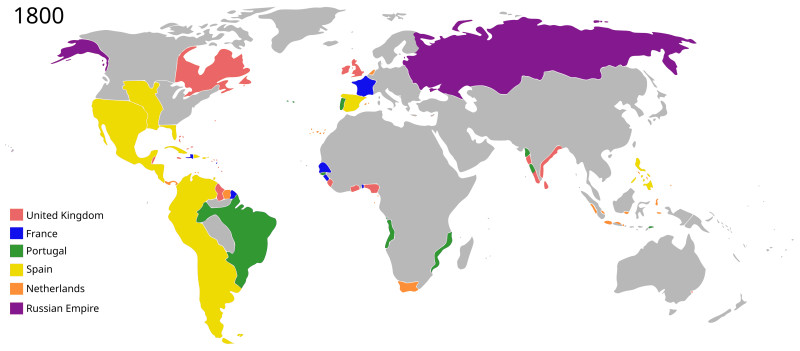
European overseas empires around 1800
The First Overseas Powers and Why Their Lead Did Not Last
Portugal and Spain led first. In the 17th century, France, England, and the Netherlands challenged them.
Treaty of Tordesillas
The Treaty of Tordesillas in 1494 divided overseas claims between Spain and Portugal with papal backing. A line west of the Cape Verde Islands gave Spain lands to the west and Portugal lands to the east.
- Spain got most of the Americas.
- Portugal secured African and Indian Ocean routes and later Brazil.
The map below shows the Tordesillas line and the later line near the Moluccas, which helps you see that Spain and Portugal tried to divide claims on a global scale.
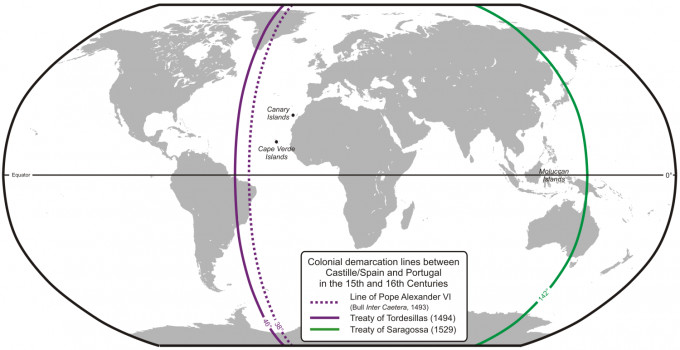
Treaty of Tordesillas and later demarcation lines
This is negotiation in action, but its limits matter. France, England, and the Dutch never accepted that Spain and Portugal could divide the world by themselves.
Spain’s empire and 16th-century dominance
Spain built colonies in the Caribbean, North and South America, and the Pacific.
- Cortés conquered the Aztec Empire.
- Pizarro conquered the Inca Empire.
- Cortés also relied on Tlaxcalan and other indigenous allies, which is a classic coercion-plus-negotiation example.
- Silver from Potosí and Zacatecas gave Spain huge resources.
- The Philippines and Manila galleon trade linked Spanish America to Asia.
Under Charles V and Philip II, that colonial wealth helped make Spain the dominant monarchy of the 16th century. The limit was that silver got drained by wars and debt, and rivals attacked Spanish shipping.
Portugal’s trading-post empire
Portugal built a looser empire of forts, ports, and trading posts in Africa, Brazil, and the Indian Ocean. It was more maritime and commercial than Spain’s big territorial empire in the Americas.
That system was vulnerable because Portugal did not have enough people or power to lock down such a huge network. Dutch and English merchants pushed into Indian Ocean trade and displaced Portuguese positions.
The Atlantic Challengers
France, England, and the Netherlands built colonies, companies, and navies to break Iberian dominance.
France
- Quebec was founded in 1608.
- French influence spread through the St. Lawrence, Great Lakes, and Mississippi Valley.
- French power depended on forts, missions, fur trade, and indigenous alliances.
- In the Caribbean, Saint-Domingue became extremely valuable.
England
- Jamestown 1607 and Plymouth 1620 anchored Atlantic coast settlement.
- England also built Caribbean plantation colonies like Barbados and Jamaica (taken from Spain in 1655).
- Francis Drake attacked Spanish shipping as a privateer.
- England’s growing merchant marine and navy let it challenge Spain, then the Dutch and French.
The Netherlands
- The Dutch Republic rose during its revolt against Spain.
- The VOC was founded in 1602 and the Dutch West India Company in 1621.
- Batavia on Java became a major trade center.
- The Dutch held New Netherland and briefly parts of Brazil.
- The Anglo-Dutch Wars (1652-1674) were fought over shipping and trade. England seized New Netherland and renamed it New York.
The Major Conflicts That Reshaped the Balance of Power
By the 18th century, European war and colonial rivalry were tightly linked. Fighting happened in Europe and overseas at the same time.
The asiento and access to Spanish trade
The asiento was a contract to supply enslaved Africans to Spanish America. It mattered because it gave limited access to Spain’s colonial market. At Utrecht in 1713, Britain gained the asiento and the right to send one trading ship each year.
War of the Spanish Succession
This war lasted from 1701 to 1713 after Charles II of Spain died without an heir. Europe feared a Bourbon union of France and Spain.
The Peace of Utrecht let Philip V keep Spain but renounce any claim to France. Britain gained Gibraltar, Minorca, Newfoundland, Acadia, Hudson Bay, and the asiento. Dynastic politics, trade, and colonial power were all tied together here.
Seven Years’ War
The Seven Years’ War (1756-1763) was the clearest global war of the period.
- Fighting spread across Europe, North America, the Caribbean, West Africa, India, and the seas.
- In North America, the French and Indian War centered on the Ohio Valley.
- In India, the British East India Company beat French-supported forces.
- The Treaty of Paris in 1763 gave Britain Canada and Florida.
This map captures that global scale, with major empires and key conflict zones spread across North America, Europe, and India.
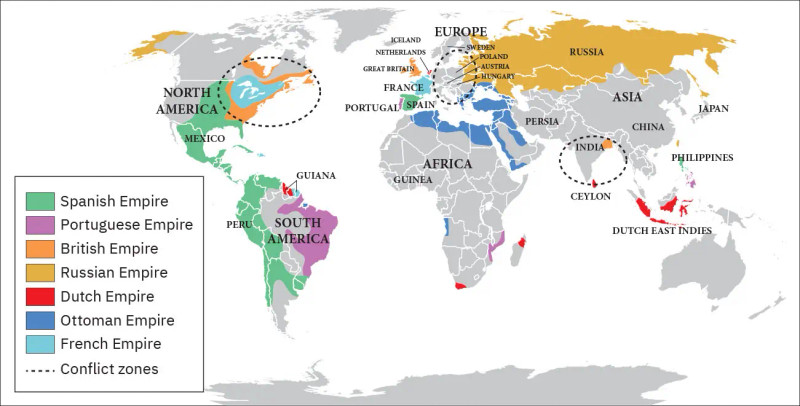
Global empires and conflict zones in the Seven Years’ War
By 1763, Britain had become the strongest European naval and colonial power.
Key Takeaways
Treaty of Tordesillas
1494 agreement dividing overseas claims between Spain west of a north-south line and Portugal east of it, placing Brazil in Portugal’s zone
Spanish Overseas Empire
Territorial empire across the Americas, Caribbean, and Philippines whose silver and trade helped make Spain Europe’s dominant 16th-century monarchy
Manila Galleon Trade
Spanish Pacific trade linking American silver through Manila in the Philippines to Asian markets
Portuguese Commercial Empire
Maritime network of fortified ports, trading posts, and naval routes in Africa, Brazil, and the Indian Ocean rather than a primarily territorial Asian empire
French Overseas Empire
Empire based on trade, forts, missions, and indigenous alliances in North America plus profitable plantation colonies in the Caribbean
English/British Overseas Empire
Settler and plantation colonies supported by private enterprise, privateering, merchant shipping, and growing naval power in North America and the Caribbean
Dutch Commercial Empire
Maritime empire built through merchant fleets and armed chartered companies that challenged Portuguese trade in Asia and competed in the Atlantic
Privateer / Privateering
A privately owned armed ship, or its activity, authorized by a government to seize enemy ships and cargo
Chartered Trading Companies
Privately financed companies granted monopolies and public powers by governments, including authority to negotiate, build forts, maintain armies, and wage war
Dutch East India Company (VOC)
Dutch chartered company founded in 1602 that traded, negotiated treaties, built forts, maintained armed forces, and waged war in Asia
Dutch West India Company
Dutch chartered company founded in 1621 to conduct trade and imperial operations in the Atlantic
English Navigation Acts
Laws reserving English colonial trade for English ships and merchants, intensifying commercial rivalry with the Dutch
Anglo-Dutch Wars
Three wars from 1652 to 1674 over shipping, markets, and maritime power that helped England surpass the Dutch as a naval and colonial power
Asiento
Spanish Crown contract authorizing a person, company, or foreign power to supply enslaved Africans to Spanish America and gain controlled access to its markets
War of the Spanish Succession
1701–1713 war over Philip of Anjou’s inheritance of Spain that prevented a French-Spanish union and shifted strategic and commercial advantages to Britain
Peace of Utrecht
1713 settlement that kept Philip V on Spain’s throne but barred union with France and awarded Britain Gibraltar, North American territories, and the asiento
Seven Years’ War
1756–1763 global war in which Britain defeated France overseas and emerged as the leading European naval and colonial power
Treaty of Paris of 1763
Settlement ending the Seven Years’ War’s colonial struggle that gave Britain Canada, Florida, and dominance in India, making it the leading naval and colonial power
French and Indian War
North American theater of the Seven Years’ War, begun in 1754 as Britain and France competed for the Ohio Valley with indigenous allies
Notes
Treaty of Tordesillas
1494 agreement dividing overseas claims between Spain west of a north-south line and Portugal east of it, placing Brazil in Portugal’s zone
Spanish Overseas Empire
Territorial empire across the Americas, Caribbean, and Philippines whose silver and trade helped make Spain Europe’s dominant 16th-century monarchy
Manila Galleon Trade
Spanish Pacific trade linking American silver through Manila in the Philippines to Asian markets
Portuguese Commercial Empire
Maritime network of fortified ports, trading posts, and naval routes in Africa, Brazil, and the Indian Ocean rather than a primarily territorial Asian empire
French Overseas Empire
Empire based on trade, forts, missions, and indigenous alliances in North America plus profitable plantation colonies in the Caribbean
English/British Overseas Empire
Settler and plantation colonies supported by private enterprise, privateering, merchant shipping, and growing naval power in North America and the Caribbean
Dutch Commercial Empire
Maritime empire built through merchant fleets and armed chartered companies that challenged Portuguese trade in Asia and competed in the Atlantic
Privateer / Privateering
A privately owned armed ship, or its activity, authorized by a government to seize enemy ships and cargo
Chartered Trading Companies
Privately financed companies granted monopolies and public powers by governments, including authority to negotiate, build forts, maintain armies, and wage war
Dutch East India Company (VOC)
Dutch chartered company founded in 1602 that traded, negotiated treaties, built forts, maintained armed forces, and waged war in Asia
Dutch West India Company
Dutch chartered company founded in 1621 to conduct trade and imperial operations in the Atlantic
English Navigation Acts
Laws reserving English colonial trade for English ships and merchants, intensifying commercial rivalry with the Dutch
Anglo-Dutch Wars
Three wars from 1652 to 1674 over shipping, markets, and maritime power that helped England surpass the Dutch as a naval and colonial power
Asiento
Spanish Crown contract authorizing a person, company, or foreign power to supply enslaved Africans to Spanish America and gain controlled access to its markets
War of the Spanish Succession
1701–1713 war over Philip of Anjou’s inheritance of Spain that prevented a French-Spanish union and shifted strategic and commercial advantages to Britain
Peace of Utrecht
1713 settlement that kept Philip V on Spain’s throne but barred union with France and awarded Britain Gibraltar, North American territories, and the asiento
Seven Years’ War
1756–1763 global war in which Britain defeated France overseas and emerged as the leading European naval and colonial power
Treaty of Paris of 1763
Settlement ending the Seven Years’ War’s colonial struggle that gave Britain Canada, Florida, and dominance in India, making it the leading naval and colonial power
French and Indian War
North American theater of the Seven Years’ War, begun in 1754 as Britain and France competed for the Ohio Valley with indigenous allies
