Topic 7.5 Notes – The Age of Progress and Modernity
Progress, Reason, and the New Doubt
Europe entered the 1800s with a strong belief that history was moving upward. The Enlightenment taught that reason could uncover truth, and the Industrial Revolution made that belief look convincing because railroads, factories, medicine, education, and state bureaucracy all seemed to prove that knowledge created improvement.
For many Europeans, progress meant more than change. It meant civilization itself was advancing through science, technology, public health, literacy, and better administration.
The key shift in this topic is that confidence in objective truth started to crack. New thinking did not destroy science. It grew out of science and serious inquiry. The surprise was that the more people studied nature and human behavior, the more they found uncertainty, hidden motives, and limits to old certainties.
By the early 1900s, this produced modernism, a mood shaped by:
- subjectivity because experience depends on perspective
- ambiguity because truth looked less fixed
- fragmentation because reality no longer felt neat and unified
- skepticism toward universal answers
Positivism, Realism, and Materialism
These all focused on observable reality, but they are not the same thing.
Positivism
Positivism said science alone gives real knowledge. It rejected theology, metaphysics, and unsupported speculation, and trusted observation, evidence, classification, and laws.
Auguste Comte is the name to know.
- He coined sociology.
- He argued society could be studied scientifically and improved through rational administration.
- His law of three stages described human thought moving through:
- Theological stage: events explained by divine forces
- Metaphysical stage: events explained by abstract ideas
- Positive stage: events explained by observable laws and evidence
This fit state-building too. Governments gathered statistics, demographic data, and studies of crime and poverty because they believed social problems could be measured and managed.
Realism
After the failed revolutions of 1848, many people lost faith in idealism. Realism turned toward the world as it actually was.
- In politics, this became Realpolitik, practical power politics.
- In culture, realism meant attention to ordinary life and concrete conditions. The art and literature side matters more in Topic 7.8.
Materialism
Materialism explained events through physical, economic, and biological forces instead of spiritual purpose. Darwin mattered here because natural processes seemed to explain life without design.
Together, positivism, realism, and materialism show mid-1800s confidence that reality was objectively understandable.
Thinkers Who Challenged Rational Certainty
Later thinkers pushed back against that confidence by stressing instinct, struggle, emotion, and intuition.
Friedrich Nietzsche
Nietzsche attacked universal moral truth and what he called herd morality.
- “God is dead” meant Christian moral certainty was collapsing.
- He emphasized self-creation and the will to power.
- Values, in his view, are historically created, not eternal.
Students often miss this part. Nietzsche was later misused by nationalists, but he himself opposed anti-Semitism and crude nationalism.
Georges Sorel
Sorel argued politics is moved by myth and emotion more than careful reason.
- His key example was the general strike as a revolutionary myth for syndicalists.
- He believed violence could be creative or regenerative.
- He shows the growing belief that struggle can produce progress.
Henri Bergson
Bergson said measured clock time is different from lived experience, which he called duration.
- Intuition can reveal reality better than analysis in some cases.
- In Creative Evolution, he described élan vital, a vital life force.
- Science is useful, but it does not capture all reality.
That broader challenge to reason also sets up Freud, who pushed the critique of rational self-control even further.
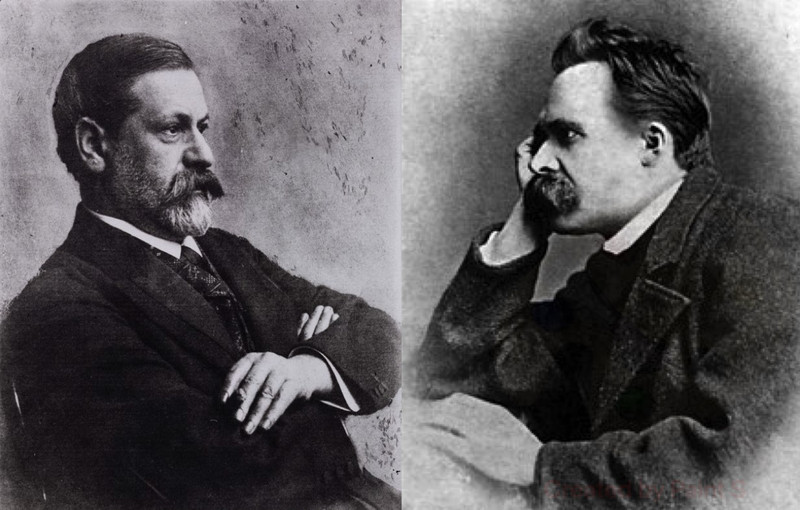
Nietzsche and Freud
Freud and the Unconscious Mind
Sigmund Freud challenged the idea that humans are mostly rational and self-aware. In The Interpretation of Dreams (1900), he argued that behavior is shaped by the unconscious.
Keep these ideas together:
- repression means disturbing thoughts get pushed out of awareness
- dreams express hidden wishes and conflicts
- free association tries to uncover buried thoughts
- slips of speech and symptoms can reveal hidden motives
The big point is that reason does not fully control behavior. People are not fully transparent to themselves. The id, ego, superego model is later and is not the core focus here.
New Physics and the Rise of Modernism
Newton’s physics had long represented an orderly, predictable universe. Around 1900, new science showed that Newton still worked in many situations, but he was not the final word.
Max Planck
In 1900, Planck explained blackbody radiation by proposing that energy comes in quanta, not a smooth continuous flow. That launched quantum theory and challenged classical assumptions at very small scales.
Albert Einstein
In 1905, Einstein’s special relativity showed that space and time are not absolute. Measurement depends on the observer’s frame of reference. He also gave , showing mass-energy equivalence.
By the 1920s, figures such as Planck and Einstein were part of a broader revolution in physics, alongside younger scientists developing quantum mechanics.
Do not confuse scientific relativity with “all opinions are equally true.” The historical point is that even physics no longer seemed to offer simple absolutes.
Key Takeaways
Nineteenth-Century Idea of Progress
Belief that accumulating scientific knowledge, industrial growth, and rational organization demonstrated civilization's advance and enabled social improvement
Positivism
Philosophy that genuine knowledge comes only from observable evidence and scientific methods, which can be applied to society as well as nature
Auguste Comte
French thinker most closely associated with positivism who coined sociology and sought scientific laws that could guide rational social organization
Law of Three Stages
Comte's theory that thought progresses from theological explanations through metaphysical abstractions to positive, empirically discovered scientific laws
Realism
Post-1848 emphasis on concrete conditions and the world as it existed rather than romantic ideals, emotional fantasy, or imagined harmony
Materialism
Explanation of reality and historical change primarily through physical, economic, or environmental causes rather than spiritual purposes
Irrationalism
Late nineteenth-century emphasis on instinct, intuition, will, emotion, myth, and subconscious desire rather than conscious rational calculation
Friedrich Nietzsche
Philosopher who rejected universal morality, treated values as historical creations, and emphasized self-creation, struggle, and the will to power
God Is Dead
Nietzsche's declaration expressing Christianity's declining authority and the resulting crisis of inherited moral certainty
Will to Power
Nietzsche's concept of the drive to overcome resistance, impose form, create values, and reject passive conformity to inherited morality
Georges Sorel
Thinker who argued that emotionally powerful myths and revolutionary violence could mobilize movements and generate creative moral energy
Sorelian Myth
An emotionally compelling image, such as a future general strike, valued for inspiring collective action rather than accurately predicting events
Henri Bergson
Philosopher who distinguished measured time from lived duration and argued that intuition could grasp realities inaccessible to mechanical analysis
Duration
Bergson's concept of time as the continuous, subjective flow experienced by consciousness rather than equal units measured by a clock
Intuition in Bergson's Philosophy
A way of apprehending lived movement, becoming, and continuous consciousness without dividing experience into fixed analytical categories
Creative Evolution
Bergson's 1907 work describing life as creative development driven by an élan vital rather than entirely predictable mechanical causation
Élan Vital (Vital Impetus)
Bergson's creative life force, which he argued could not be reduced to predictable mechanical causation
Sigmund Freud
Thinker whose psychoanalysis argued that unconscious desires, fears, memories, and conflicts strongly shape apparently rational human behavior
The Unconscious (Subconscious)
The portion of mental life outside conscious awareness whose hidden desires, memories, fears, and conflicts influence behavior
Psychoanalysis
Freud's method of uncovering unconscious conflicts by interpreting dreams, free associations, resistance, symptoms, and slips of speech
Free Association
Psychoanalytic method in which a patient speaks without deliberate censorship so an analyst can identify patterns and repressed conflicts
Repression
Freud's process by which disturbing desires or memories are excluded from awareness yet return indirectly through dreams, symptoms, anxiety, or mistakes
The Interpretation of Dreams
Freud's 1900 work arguing that dreams express unconscious wishes and conflicts rather than meaningless mental accidents
Newtonian Mechanics
Classical model of matter moving predictably through absolute space and time according to universal laws, accurate but not universally sufficient
Max Planck
Physicist who proposed in 1900 that energy is emitted or absorbed in discrete quanta, helping initiate quantum theory
Quantum Theory
Theory originating with Planck's proposal that energy is emitted or absorbed in discrete quanta rather than in an entirely continuous flow
Albert Einstein
Physicist whose 1905 special relativity made measurements of space and time dependent on relative motion and established mass-energy equivalence
Special Theory of Relativity
Einstein's 1905 theory that space and time measurements depend on relative motion while the vacuum speed of light remains constant
Mass-Energy Equivalence
Einstein's relationship E = mc², establishing the equivalence of mass and energy
Relativism
Weakening confidence in fixed, universally accessible standards as knowledge and values appeared shaped by perspective, culture, history, or level of analysis
Modernism
Intellectual and cultural response to weakened certainty that emphasized fragmentation, ambiguity, subjectivity, experimentation, and skepticism toward inherited forms
Notes
Nineteenth-Century Idea of Progress
Belief that accumulating scientific knowledge, industrial growth, and rational organization demonstrated civilization's advance and enabled social improvement
Positivism
Philosophy that genuine knowledge comes only from observable evidence and scientific methods, which can be applied to society as well as nature
Auguste Comte
French thinker most closely associated with positivism who coined sociology and sought scientific laws that could guide rational social organization
Law of Three Stages
Comte's theory that thought progresses from theological explanations through metaphysical abstractions to positive, empirically discovered scientific laws
Realism
Post-1848 emphasis on concrete conditions and the world as it existed rather than romantic ideals, emotional fantasy, or imagined harmony
Materialism
Explanation of reality and historical change primarily through physical, economic, or environmental causes rather than spiritual purposes
Irrationalism
Late nineteenth-century emphasis on instinct, intuition, will, emotion, myth, and subconscious desire rather than conscious rational calculation
Friedrich Nietzsche
Philosopher who rejected universal morality, treated values as historical creations, and emphasized self-creation, struggle, and the will to power
God Is Dead
Nietzsche's declaration expressing Christianity's declining authority and the resulting crisis of inherited moral certainty
Will to Power
Nietzsche's concept of the drive to overcome resistance, impose form, create values, and reject passive conformity to inherited morality
Georges Sorel
Thinker who argued that emotionally powerful myths and revolutionary violence could mobilize movements and generate creative moral energy
Sorelian Myth
An emotionally compelling image, such as a future general strike, valued for inspiring collective action rather than accurately predicting events
Henri Bergson
Philosopher who distinguished measured time from lived duration and argued that intuition could grasp realities inaccessible to mechanical analysis
Duration
Bergson's concept of time as the continuous, subjective flow experienced by consciousness rather than equal units measured by a clock
Intuition in Bergson's Philosophy
A way of apprehending lived movement, becoming, and continuous consciousness without dividing experience into fixed analytical categories
Creative Evolution
Bergson's 1907 work describing life as creative development driven by an élan vital rather than entirely predictable mechanical causation
Élan Vital (Vital Impetus)
Bergson's creative life force, which he argued could not be reduced to predictable mechanical causation
Sigmund Freud
Thinker whose psychoanalysis argued that unconscious desires, fears, memories, and conflicts strongly shape apparently rational human behavior
The Unconscious (Subconscious)
The portion of mental life outside conscious awareness whose hidden desires, memories, fears, and conflicts influence behavior
Psychoanalysis
Freud's method of uncovering unconscious conflicts by interpreting dreams, free associations, resistance, symptoms, and slips of speech
Free Association
Psychoanalytic method in which a patient speaks without deliberate censorship so an analyst can identify patterns and repressed conflicts
Repression
Freud's process by which disturbing desires or memories are excluded from awareness yet return indirectly through dreams, symptoms, anxiety, or mistakes
The Interpretation of Dreams
Freud's 1900 work arguing that dreams express unconscious wishes and conflicts rather than meaningless mental accidents
Newtonian Mechanics
Classical model of matter moving predictably through absolute space and time according to universal laws, accurate but not universally sufficient
Max Planck
Physicist who proposed in 1900 that energy is emitted or absorbed in discrete quanta, helping initiate quantum theory
Quantum Theory
Theory originating with Planck's proposal that energy is emitted or absorbed in discrete quanta rather than in an entirely continuous flow
Albert Einstein
Physicist whose 1905 special relativity made measurements of space and time dependent on relative motion and established mass-energy equivalence
Special Theory of Relativity
Einstein's 1905 theory that space and time measurements depend on relative motion while the vacuum speed of light remains constant
Mass-Energy Equivalence
Einstein's relationship E = mc², establishing the equivalence of mass and energy
Relativism
Weakening confidence in fixed, universally accessible standards as knowledge and values appeared shaped by perspective, culture, history, or level of analysis
Modernism
Intellectual and cultural response to weakened certainty that emphasized fragmentation, ambiguity, subjectivity, experimentation, and skepticism toward inherited forms
