Topic 1.4 Notes – Printing
How Printing Changed the Spread of Ideas
Europe before Gutenberg still had books, scholars, and vernacular writing. The problem was scale. Manuscripts had to be copied by hand, so books were slow to make, expensive, and uneven from copy to copy.
The major change in the 1450s came from Johannes Gutenberg in Mainz, who created a commercially practical system of movable-type printing.
- Printing press means the full mechanical system for reproducing texts.
- Movable type means reusable individual metal letters.
- Manuscript means a text copied by hand.
- Dissemination means the spread of ideas and information.
- Vernacular means the everyday local language, not Latin.
- Print culture means the whole network of printers, publishers, booksellers, and readers.
The chain you want in your head is simple:
- Movable type made copying texts faster.
- Faster production meant more copies.
- More copies lowered the cost per copy.
- Cheaper books and pamphlets reached more people.
- Ideas spread farther and faster.
- Cultural and intellectual change sped up.
That’s why printing is an enabling technology. It did not invent humanism or vernacular literature. Those already existed. It made them much harder to keep local.
Gutenberg’s System and Why It Worked
What made Gutenberg important was the way several parts worked together as one system:
- Metal movable type could be arranged, printed, then reused.
- A hand press applied pressure evenly.
- Oil-based ink stuck well to metal.
- Paper was cheaper than parchment.
Once a page was set, printers could make many copies efficiently. That made long print runs worth the labor and cost.
Gutenberg Bible
The standard example is the Gutenberg Bible, printed in Mainz around 1454-1455. It helps explain why early printed books did not always look radically new at first glance.
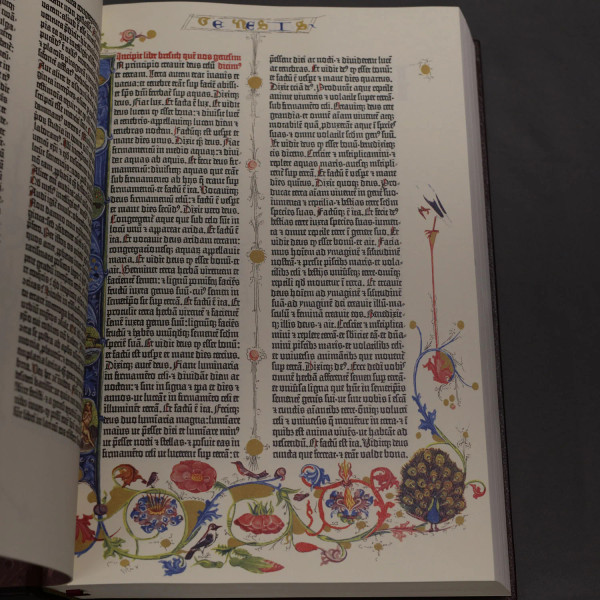
Gutenberg Bible page
Key facts:
- It was the Latin Vulgate Bible, not a vernacular translation.
- It is also called the Forty-Two-Line Bible.
- It looked like a luxury manuscript, with hand-added decoration.
This is a favorite AP point because it shows continuity and change. Early print still copied manuscript style, but production had been transformed.
Do not overclaim:
- Printing did not create mass literacy right away.
- Printing did not begin as an attack on the Catholic Church.
- Early printed works often supported traditional religion and scholarship.
How Printing Spread Renaissance Learning beyond Italy
Printing followed the places where money, trade, and learning already existed. It spread through urban, commercial, and university networks. You can see that pattern in the map, with clusters of printing centers in northern Italy, the Low Countries, France, and the German-speaking lands.
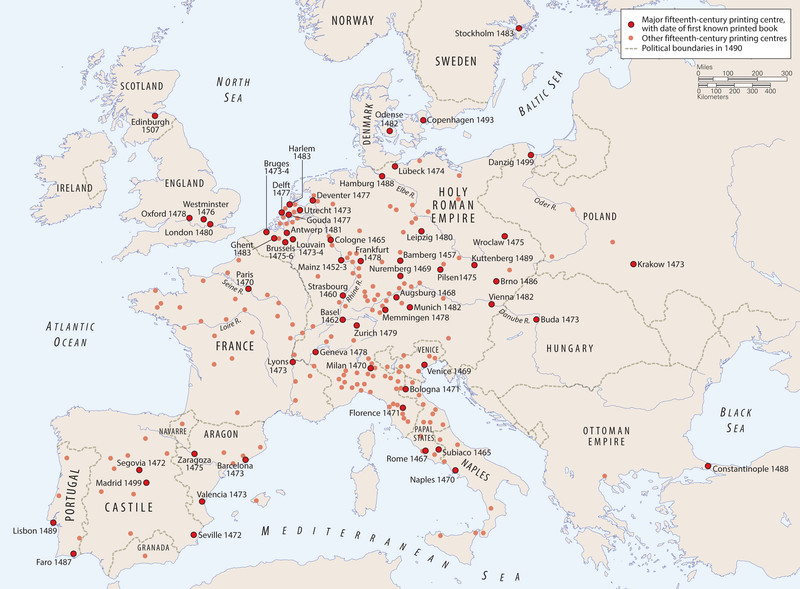
Fifteenth-century European printing centers
Major centers included Mainz, Venice, Paris, Lyon, Antwerp, and London. Venice stands out because it had wealth, trade links, access to paper, and strong Renaissance connections.
Printers sold what people would buy, so commerce and learning were tied together. Common printed works included:
- Bibles, sermons, devotional texts
- Greek and Roman classics
- Humanist scholarship
- Legal texts, grammars, schoolbooks, calendars, practical manuals
This helped the Renaissance move beyond Italy because classical texts and humanist commentary could now circulate widely. Scholars could compare editions and practice philology, meaning close language-based study of texts.
Erasmus
Erasmus is the named example to remember.
- In 1516, he published a Greek New Testament with a revised Latin translation.
- His Northern Renaissance humanism spread widely because print could carry it across Europe.
Vernacular Literature and the Growth of National Cultures
Printers had a strong reason to publish in the vernacular. More people knew local languages than Latin, so vernacular books meant more buyers.
William Caxton
In England, William Caxton set up a press at Westminster in 1476.
- He printed in English
- He published works including Chaucer’s Canterbury Tales
Caxton did not create English literature. He expanded its audience.
Repeated printing of certain spellings and dialect forms gradually pushed languages toward standardization. Over time, people in different regions could read the same stories, histories, and religious works in the same language. That helped build national cultures.
Be careful with the claim here. Printing helped lay the linguistic and cultural foundations for later national identity. It did not instantly create modern nationalism or nation-states.
Limits, Control, and Long-Term Significance
Access widened, but literacy stayed unequal by class, gender, and location. Many people still could not read. Print still reached them through read-aloud culture, images, broadsheets, pamphlets, and public discussion.
Authorities noticed the danger and the usefulness.
- States and churches used licensing, censorship, privileges, and punishment to control print.
- Print was not naturally Protestant or rebellious.
- Both rulers and critics used it.
Its long-term importance shows up all over AP Euro:
- Reformation: Luther’s Ninety-Five Theses and German New Testament spread rapidly.
- Catholic Reformation: catechisms and official teachings spread too.
- Scientific Revolution: printed diagrams and findings supported cumulative scholarship.
- Enlightenment: books, pamphlets, journals, and newspapers widened debate.
Key Takeaways
Johannes Gutenberg
Mainz printer who developed a commercially practical European movable-type printing system in the 1450s
Printing Press
Mechanical and organizational system that reproduced many substantially identical pages quickly and lowered the cost per copy for large print runs
Movable Type
Reusable individual metal characters arranged to form pages, then redistributed for later printing
Manuscript
A text written or copied by hand; its production was slow and labor-intensive, and individual copies could vary
Dissemination
The circulation or spread of information and ideas
Vernacular
An ordinary spoken regional language, such as English or French, as distinct from scholarly Latin
Print Culture
The network of printers, publishers, booksellers, readers, and practices surrounding printed material
Gutenberg Bible (Forty-Two-Line Bible)
Latin Vulgate Bible printed at Mainz around 1454–1455, showing that printing could produce numerous substantially identical copies while retaining manuscript conventions
William Caxton
Printer who established a Westminster press in 1476 and expanded English vernacular print, including Chaucer’s Canterbury Tales
Philology
Humanist use of linguistic and historical analysis to determine the meaning and authenticity of texts
Notes
Johannes Gutenberg
Mainz printer who developed a commercially practical European movable-type printing system in the 1450s
Printing Press
Mechanical and organizational system that reproduced many substantially identical pages quickly and lowered the cost per copy for large print runs
Movable Type
Reusable individual metal characters arranged to form pages, then redistributed for later printing
Manuscript
A text written or copied by hand; its production was slow and labor-intensive, and individual copies could vary
Dissemination
The circulation or spread of information and ideas
Vernacular
An ordinary spoken regional language, such as English or French, as distinct from scholarly Latin
Print Culture
The network of printers, publishers, booksellers, readers, and practices surrounding printed material
Gutenberg Bible (Forty-Two-Line Bible)
Latin Vulgate Bible printed at Mainz around 1454–1455, showing that printing could produce numerous substantially identical copies while retaining manuscript conventions
William Caxton
Printer who established a Westminster press in 1476 and expanded English vernacular print, including Chaucer’s Canterbury Tales
Philology
Humanist use of linguistic and historical analysis to determine the meaning and authenticity of texts
