Topic 6.4 Notes – Social Effects of Industrialization
How Industrialization Reshaped European Society
Industrialization pulled labor, capital, and machinery into factories, mills, and mines, especially in cities. That changed society because more people now depended on wages instead of land, guild status, or household production.
- In Great Britain, Belgium, northern France, the Netherlands, and parts of Germany, industrial society became strongest.
- In southern and eastern Europe, agriculture stayed dominant much longer, so old landed elites kept more power.
This industrial map helps you see that uneven pattern across Europe.
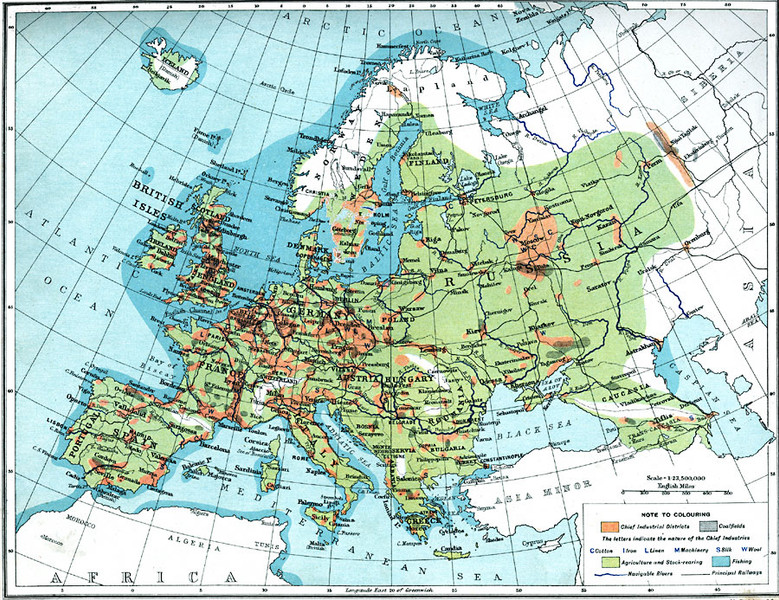
Industrial districts in Europe
The main chain to remember runs like this:
- Factories and wage labor expanded.
- People got sorted more sharply by their relationship to property and work.
- Class formation became more visible.
- Urban migration increased.
- Family and gender roles changed.
- Pressure built for labor laws, public health reform, and welfare measures.
- By the late 1800s, many workers saw higher living standards.
Industrialization did not invent inequality. Europe already had rich and poor. What changed was the scale and structure of inequality. Class lines became more tied to capital, wages, occupation, and urban life.
New Social Classes and Where They Were Strongest
Industrial society sharpened two major class labels, even though Europe still had peasants, nobles, and many in-between groups.
The bourgeoisie
The bourgeoisie was the property-owning and professional middle class.
- Wealthier members included industrialists, bankers, merchants, investors.
- Professional members included lawyers, doctors, engineers, managers.
- The petite bourgeoisie included shopkeepers, clerks, teachers, small proprietors.
Their identity rested on property, education, discipline, respectability, and domestic order. They reinforced it through:
- reform societies
- chambers of commerce
- clubs
- charitable organizations
- religious and professional associations
Some bourgeois families even merged socially with aristocrats through land purchases, titles, and marriage.
The proletariat
The proletariat was the industrial working class, people who depended on wages.
- Included factory workers, miners, dockworkers, transport workers, laborers, workshop employees
- Skilled workers usually had better wages and more bargaining power than unskilled workers
- Women and children usually earned less
Working conditions often meant long hours, dangerous machines, explosions or collapse in mines, poor air, and close supervision.
Class identity grew through:
- friendly societies
- mutual aid societies
- trade unions
- newspapers
- demonstrations
Continuing agricultural elites
In Russia, Hungary, Poland, southern Italy, and much of the Balkans, landed elites stayed powerful. Peasants and farm laborers still outnumbered industrial workers. This contrast shows up a lot on AP questions. Northwest Europe had stronger industrial class society; south/east Europe stayed more agrarian.
Urbanization and the Industrial City
Industrial jobs pulled people out of the countryside. Factory, mine, rail, and service work offered wages, and population pressure pushed many to leave villages.
Urbanization means the growing number and proportion of people living in cities.
Manchester
Manchester is the classic industrial city.
- famous for textile mills
- packed with warehouses, canals, railroads
- surrounded by dense working-class neighborhoods
Images of Manchester often focus on its mills and canals, which made it a symbol of the new industrial city.
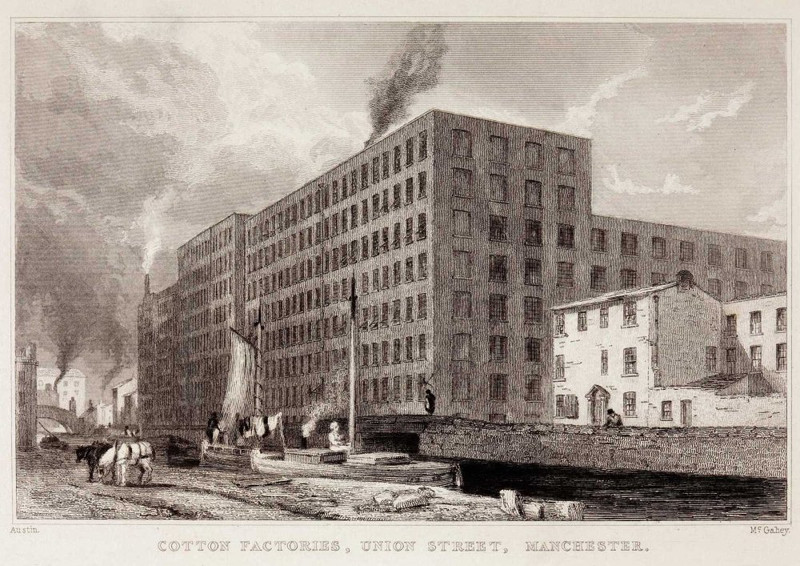
Cotton factories in Manchester
It stood for both industrial success and industrial misery.
Urban problems
- overcrowded tenements, subdivided houses, even cellars
- weak sewer, drainage, and clean water systems
- heavy coal smoke and pollution
- diseases like cholera and typhus
- visible class segregation as middle classes moved to suburbs or better neighborhoods
Rural communities changed too. They often lost young adults and labor, village ties weakened, and some families depended on remittances sent home.
Family Life, Gender Roles, and Quality of Life
Factory work moved production out of the home and into workplaces. That made the split between home and work much sharper.
Bourgeois family ideals
The middle class centered life on the nuclear family and the cult of domesticity.
- Men belonged to the public sphere of work, politics, business.
- Women belonged to the private sphere of home, children, morality, religion.
This ideal mostly fit families with enough money to live on one main income.
Working-class realities
Working-class families usually needed a family wage economy. Men, women, and children all worked.
- Women often carried a double burden of paid work plus housework
- Domestic service was a huge female occupation
- Child labor was common early on
Key British laws:
- Factory Act of 1833 restricted child labor in textile mills
- Mines Act of 1842 barred underground mine work for women and young boys
- Ten Hours Act of 1847 limited hours for women and young people
Marriage still had economic purposes, but companionate marriage grew, with more emphasis on affection and partnership. By the late century, birth control, lower fertility, higher real wages, shorter hours, welfare programs, better diet, public health, and cleaner water improved working-class life and reduced infant mortality.
Leisure, Everyday Life, and How Historians Interpret Industrial Society
As hours slowly fell and wages rose, people had more distinct leisure time, often centered on families or small groups.
Common leisure spaces included:
- parks
- sports clubs and arenas
- beaches and seaside resorts reached by rail
- department stores
- museums
- theaters and opera houses
- cafés, clubs, public houses
Leisure stayed class-based. Opera and exclusive clubs served elites. Music halls, football, and cheap excursions reached broader audiences.
A common source comparison is Andrew Ure vs Friedrich Engels.
| Thinker | Main view |
|---|---|
| Andrew Ure | Praised factories for order, productivity, prosperity |
| Friedrich Engels | Stressed exploitation, disease, and misery, especially in Manchester |
The test loves this point. Both sources reflect perspective and purpose. Industrialization brought real economic growth and severe human costs.
Key Takeaways
Division of Labor
The division of production into specialized tasks, which increased efficiency and created distinct occupations and class positions
Factory Discipline
Organization of labor around clocks, fixed shifts, supervision, and employer rules rather than household routines, seasons, or craft autonomy
Bourgeoisie
The property-owning and professional middle class, including industrialists, merchants, investors, managers, and professionals
Petite Bourgeoisie
The lower middle class of shopkeepers, small proprietors, clerks, teachers, and lesser officials
Proletariat
The industrial working class, whose members owned little productive property and lived primarily by selling their labor for wages
Class Consciousness
Awareness among members of a class that they share interests and experiences distinct from those of other social groups
Mutual Aid Societies (Friendly Societies)
Worker-funded associations that provided limited assistance during sickness, unemployment, injury, or death
Trade Unions
Worker organizations that used collective bargaining, strikes, and shared action to pursue better wages, hours, and working conditions
Agricultural Elites
Large landowners who retained economic, social, and political dominance in less industrialized southern and eastern Europe
Urbanization
An increase in both the number and the proportion of people living in towns and cities
Rural-to-Urban Migration
Movement from villages and farms to industrial towns for work, causing urban overcrowding and losses of labor and community cohesion in rural areas
Manchester
The leading example of an industrial city, where textile production drove rapid growth, overcrowding, pollution, class segregation, and worker organization
Nuclear Family
A family centered on parents and their dependent children rather than primarily on extended kin or household production
Cult of Domesticity (Ideology of Separate Spheres)
The bourgeois ideal assigning men to public work and politics and women to the private sphere of home, children, and morality
Working-Class Family Wage Economy
A household economy that pooled the earnings of husbands, wives, and children because one wage was usually insufficient
Male Breadwinner Model
A family model in which the husband earned the principal wage while the wife concentrated on unpaid domestic work
Factory Act of 1833
British law that barred children under nine from most textile mills, limited older children’s hours, required some schooling, and created factory inspectors
Mines and Collieries Act of 1842
British law that prohibited underground mine work by women and girls and by boys under ten
Ten Hours Act of 1847
British law limiting women and young people in textile mills to a ten-hour workday, indirectly shortening many men’s workdays as well
Economic Marriage vs. Companionate Marriage
Economic marriage emphasized property, wages, and family strategy; companionate marriage increasingly emphasized affection and emotional partnership as well
Demographic Transition
The shift from high birth and death rates to lower birth and death rates as mortality fell and families increasingly limited births
Andrew Ure, The Philosophy of Manufactures
An 1835 defense of mechanized factories as sources of productivity, order, discipline, and national prosperity
Friedrich Engels, The Condition of the Working Class in England
An 1845 critique describing disease, polluted housing, insecure employment, and exploitation in industrial cities, especially Manchester
Child Labor
Employment of children for low wages in factories and mines, where long hours, dangerous conditions, and limited schooling prompted gradual legal restrictions
Notes
Division of Labor
The division of production into specialized tasks, which increased efficiency and created distinct occupations and class positions
Factory Discipline
Organization of labor around clocks, fixed shifts, supervision, and employer rules rather than household routines, seasons, or craft autonomy
Bourgeoisie
The property-owning and professional middle class, including industrialists, merchants, investors, managers, and professionals
Petite Bourgeoisie
The lower middle class of shopkeepers, small proprietors, clerks, teachers, and lesser officials
Proletariat
The industrial working class, whose members owned little productive property and lived primarily by selling their labor for wages
Class Consciousness
Awareness among members of a class that they share interests and experiences distinct from those of other social groups
Mutual Aid Societies (Friendly Societies)
Worker-funded associations that provided limited assistance during sickness, unemployment, injury, or death
Trade Unions
Worker organizations that used collective bargaining, strikes, and shared action to pursue better wages, hours, and working conditions
Agricultural Elites
Large landowners who retained economic, social, and political dominance in less industrialized southern and eastern Europe
Urbanization
An increase in both the number and the proportion of people living in towns and cities
Rural-to-Urban Migration
Movement from villages and farms to industrial towns for work, causing urban overcrowding and losses of labor and community cohesion in rural areas
Manchester
The leading example of an industrial city, where textile production drove rapid growth, overcrowding, pollution, class segregation, and worker organization
Nuclear Family
A family centered on parents and their dependent children rather than primarily on extended kin or household production
Cult of Domesticity (Ideology of Separate Spheres)
The bourgeois ideal assigning men to public work and politics and women to the private sphere of home, children, and morality
Working-Class Family Wage Economy
A household economy that pooled the earnings of husbands, wives, and children because one wage was usually insufficient
Male Breadwinner Model
A family model in which the husband earned the principal wage while the wife concentrated on unpaid domestic work
Factory Act of 1833
British law that barred children under nine from most textile mills, limited older children’s hours, required some schooling, and created factory inspectors
Mines and Collieries Act of 1842
British law that prohibited underground mine work by women and girls and by boys under ten
Ten Hours Act of 1847
British law limiting women and young people in textile mills to a ten-hour workday, indirectly shortening many men’s workdays as well
Economic Marriage vs. Companionate Marriage
Economic marriage emphasized property, wages, and family strategy; companionate marriage increasingly emphasized affection and emotional partnership as well
Demographic Transition
The shift from high birth and death rates to lower birth and death rates as mortality fell and families increasingly limited births
Andrew Ure, The Philosophy of Manufactures
An 1835 defense of mechanized factories as sources of productivity, order, discipline, and national prosperity
Friedrich Engels, The Condition of the Working Class in England
An 1845 critique describing disease, polluted housing, insecure employment, and exploitation in industrial cities, especially Manchester
Child Labor
Employment of children for low wages in factories and mines, where long hours, dangerous conditions, and limited schooling prompted gradual legal restrictions
