Topic 6.10 Notes – Causation in the Age of Industrialization
How Industrialization Caused Change Across Europe
Industrialization was a cumulative process. Coal, capital, machines, factories, railroads, cities, and new politics all fed each other.
- The main chain looks like this
favorable conditions → innovation and investment → factory production → transport and communication growth → urbanization and new classes → ideological movements → government reform - Technology was both cause and effect. Britain already had capital, markets, resources, and institutions that encouraged invention. Then inventions reshaped society.
- On tests, don’t just list events in order. Explain the mechanism. Example: railroads did not just appear after factories. They lowered transport costs, linked markets, and created demand for coal, iron, steel, and banking.
- Industrialization was uneven. Britain, France, Germany, and Russia did not industrialize the same way because resources, labor systems, state policy, and investment differed.
Why Britain Industrialized First and How the First Industrial Revolution Worked
Britain had the strongest mix of conditions.
- Coal and iron ore gave Britain the fuel and materials for engines, machines, and rails.
- Rivers, ports, canals, and compact geography made moving goods cheaper and faster.
- Agricultural commercialization increased food output and freed workers from the countryside.
- Population growth created both a labor force and a market of consumers.
- Colonial and commercial networks supplied cotton and overseas markets.
- Banks, investors, patent protections, inventors, and entrepreneurs helped turn ideas into businesses.
- Parliamentary government protected property and commerce. The repeal of the Corn Laws in 1846 showed industrial and commercial interests beating old landed interests.
First-wave breakthroughs
- Mechanized textile production made cloth faster and cheaper.
- Steam power removed dependence on water sites and expanded factory location.
- Iron production supported machines, tools, and transport.
- The factory system centralized workers, imposed regular hours, supervision, and repetitive labor. Artisans lost ground, though domestic production still survived.
Manchester
Manchester is the classic industrial city. Textile mills brought migrants, wealth, pollution, overcrowding, and sharp class divisions all in one place. This kind of smoke-filled mill district is the image AP Euro often wants you to connect to early industrial Britain.
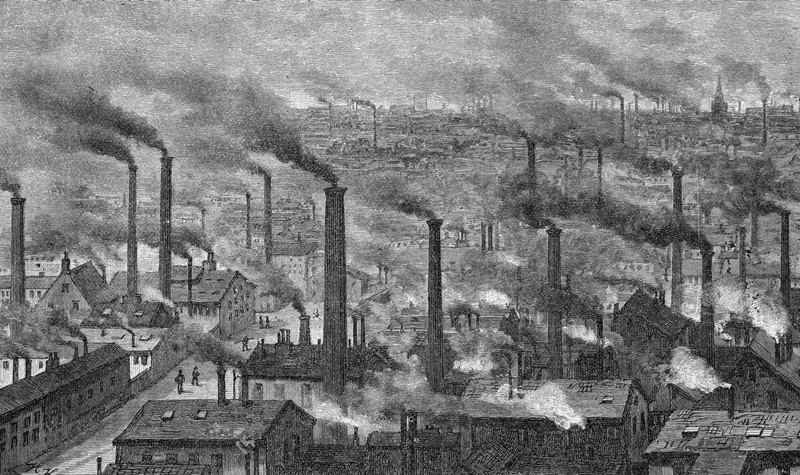
Industrial Manchester
Crystal Palace
The Great Exhibition of 1851 in the Crystal Palace showed Britain presenting industrial power as national pride.
How Industrialization Spread and Deepened
Continental Europe followed Britain, but usually with more help from the state.
| Region | Pattern |
|---|---|
| France | Industrialized gradually, kept more small workshops and rural production, and used government support for canals, railroads, and banking. |
| Prussia and Germany | The Zollverein (1834) cut internal tariffs and created a larger market. Friedrich List backed protective tariffs and national development. Railroads, technical education, and heavy industry grew fast. Krupp at Essen became the model steel and armaments giant. |
| Russia and eastern/southern Europe | Industrialized more slowly because of weak infrastructure, less capital, powerful landed elites, and serfdom. Alexander II freed the serfs in 1861. Sergei Witte pushed railways and state-led growth later. |
The second industrial revolution
After about 1870, industry became larger and more scientific.
- Steel expanded through the Bessemer process
- Chemicals produced dyes, fertilizers, explosives
- Electricity, telegraph, telephone sped communication and daily life
- Internal combustion engine led to cars and early aviation
- Big firms, cartels, monopolies, and bank finance grew
- Governments used tariffs and more intervention, which weakened pure laissez-faire
How Industrialization Reshaped Everyday Life
Industrial growth changed where people lived and how they experienced daily life.
- Urbanization pulled migrants from countryside to city. Many lived in tenements with pollution, disease, and poor sanitation.
- The Irish potato famine and the Hungry Forties remind you Europe was still vulnerable to agrarian crisis.
- Railroads, steamships, and telegraphs integrated markets and stimulated coal, iron, steel, engineering, and banking. They also spread standardized time, suburbs, and global food distribution.
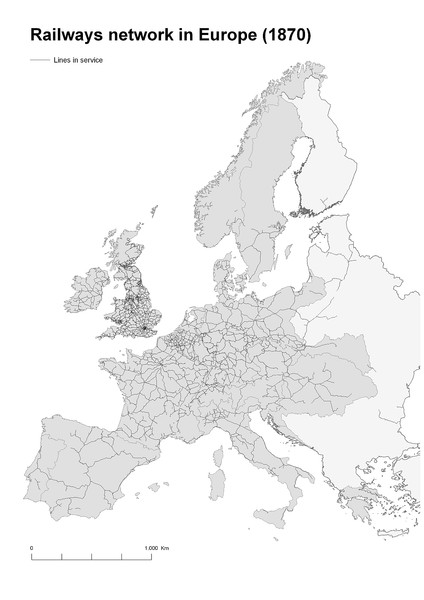
European railway network, 1870
By 1870, the rail network was especially dense in Britain and western Europe, which helps explain why industrial growth and market integration moved fastest there.
New classes
- Bourgeoisie included industrialists, merchants, professionals, and managers.
- Proletariat meant wage laborers who survived by selling their labor.
- Class identity deepened through neighborhoods, unions, clubs, and parties.
Family and gender
- The bourgeois ideal stressed separate spheres and the cult of domesticity.
- Working-class families often needed women’s and children’s wages.
- Key laws in Britain
- Factory Act of 1833 limited child labor
- Mines Act of 1842 restricted women and children underground
- Ten Hours Act of 1847 limited hours for women and young people
- Later, smaller families, compulsory schooling, and declining child labor changed family life.
By the late 1800s, rising consumption brought department stores, advertising, bicycles, processed foods, tourism, sports, parks, and music halls.
How Europeans Responded to Industrial Society
Industrial society created problems, and Europeans answered them with ideologies, collective action, and reform.
Ideological responses
- Conservatism defended order, tradition, and hierarchy. Think Burke, de Maistre, Metternich.
- Liberalism supported rights, constitutions, free markets, and reform. Think Bentham and J. S. Mill.
- Socialism criticized competition and inequality. Think Saint-Simon, Fourier, Robert Owen.
- Marx and Engels argued history was driven by class struggle between bourgeoisie and proletariat.
- Anarchism, linked to Bakunin, attacked the state itself.
- Feminism pushed legal and political rights. Think Flora Tristan, Barbara Leigh Smith Bodichon, and the Pankhursts.
Collective action and reform
- Workers formed trade unions, mutual-aid societies, and used strikes.
- Chartists demanded universal male suffrage.
- The German Social Democratic Party and British Labour Party turned worker interests into mass politics.
- The revolutions of 1848 came from food shortages, liberal demands, nationalism, and worker grievances together.
Government intervention
Governments moved away from strict laissez-faire.
- They passed labor laws, expanded suffrage, recognized unions, and built social insurance.
- Edwin Chadwick pushed public health reform.
- Haussmann rebuilt Paris with boulevards, sewers, and better movement, but also more state control.
- Compulsory education created literate workers and more disciplined citizens.
- Bismarck’s welfare programs aimed to weaken socialism by giving workers state benefits.
