Topic 2.5 Notes – The Catholic Reformation
How the Catholic Church Reformed Itself and Defended Its Authority
People had complained about Church abuses before Luther. Problems like ignorant priests, absentee bishops, and the selling of indulgences were already hurting the Church’s reputation. Protestant success turned those complaints into an emergency.
The Catholic Reformation or Counter-Reformation had three parts working together:
- revival through deeper spirituality and new religious energy
- discipline through better training and tighter control
- defense of doctrine against Protestant ideas
The Church had two major goals:
- fix internal abuses in the clergy and church administration
- answer Protestant teachings and stop more Catholics from leaving
Some things stayed the same from 1450 to 1648:
- The pope still led the Church.
- The hierarchy of bishops and priests stayed in place.
- The seven sacraments, the Mass, saints, relics, and Church authority all remained central.
What changed was the Church’s style. It became more disciplined, more centralized, and much more active in policing belief. Europe also stopped being one shared Christian world. It became permanently divided into Catholic and Protestant regions.
The Council of Trent
The Church’s clearest answer came from the Council of Trent, called by Pope Paul III in 1545 and meeting off and on until 1563.
This council became the centerpiece of the Catholic Reformation.
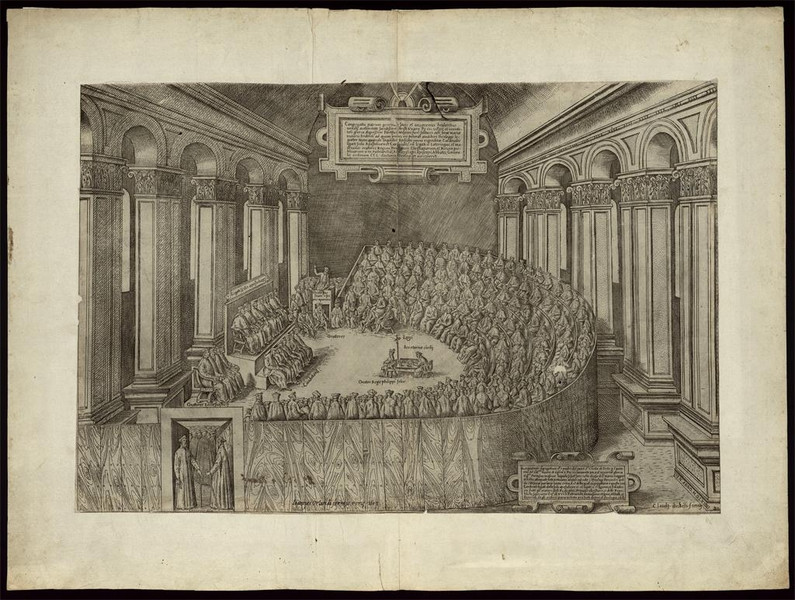
The Council of Trent
Trent did two things at the same time.
Doctrinal reaffirmation
Trent refused compromise with Protestants and restated Catholic teaching:
- Scripture and tradition were both authoritative, which rejected sola scriptura.
- Salvation came by grace through faith, but not faith alone.
- All seven sacraments were reaffirmed.
- Transubstantiation stayed official teaching.
- The Church upheld confession, clerical celibacy, purgatory, prayers for the dead, saints, relics, and religious images.
- Indulgences stayed, but selling them for money was condemned.
Institutional and disciplinary reform
Trent also cleaned up Church administration:
- It attacked absenteeism and pluralism.
- Bishops had to live in their dioceses and supervise clergy.
- Priests were expected to preach better and behave more seriously.
- Seminaries were created to train priests properly.
- The Roman Catechism of 1566 standardized teaching.
- The Roman Missal of 1570 standardized worship in the Tridentine Mass.
Why Trent mattered
Trent revived Catholicism without changing its core beliefs. That is the whole point. It made the Church stronger and clearer, but it also made reunion with Protestants far less likely.
New Catholic Energy Through Religious Orders and Spiritual Renewal
Trent gave rules. Religious orders gave energy.
Jesuits
The Jesuits, founded by Ignatius of Loyola and approved in 1540, became the most famous Catholic reform order. Loyola’s Spiritual Exercises taught self-discipline, obedience, and devotion. Jesuits were known for special loyalty to the pope.
Their main jobs:
- education through Jesuit colleges
- defending Catholicism in places like the Holy Roman Empire, Poland, and Bohemia
- advising rulers and shaping elites
- missions overseas
Named examples matter here:
- Francis Xavier worked in India, Southeast Asia, and Japan
- Matteo Ricci worked in China
Teresa of Ávila
Teresa of Ávila was a Spanish mystic who reformed the Carmelite order. She pushed stricter prayer, poverty, and discipline and founded the Discalced Carmelites with help from John of the Cross. She shows that intense personal spirituality could be fully Catholic and approved by Church authority.
Ursulines
The Ursulines, founded by Angela Merici in 1535, focused on girls’ education. They show how women took on larger religious roles, even though the male clerical hierarchy stayed in place.
Other reforming orders, including the Capuchins and Theatines, added preaching, charity, and stricter clerical standards.
How the Church Enforced Orthodoxy
Catholic renewal used persuasion and force together.
- The Roman Inquisition, created in 1542 by Paul III, investigated heresy, especially in Italy. It used tribunals, interrogation, confession, penance, and imprisonment.
- This is not the same as the Spanish Inquisition, which was earlier and controlled by the Spanish monarchy.
- The Index of Prohibited Books began in 1559, with a revised Tridentine Index in 1564. It banned Protestant and other dangerous works in response to print culture.
That campaign against forbidden reading shows up clearly in surviving copies of the Index itself.
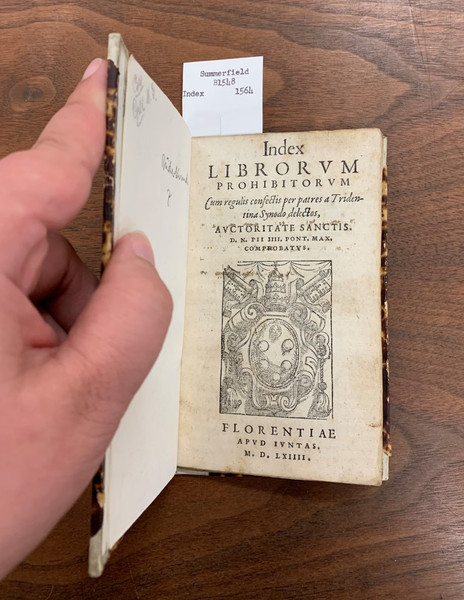
1564 Index of Prohibited Books
The Church also taught the faith through catechisms, preaching, confession, missions, festivals, and approved religious images. This leads into Baroque art later, but here the point is simple. Culture helped enforce belief.
Revival Without Reunion
By 1648, Catholicism stayed strong in Italy, Spain, and Portugal and regained strength in Poland, Austria, Bohemia, southern Germany, and Habsburg lands. The Church became more effective in education, missions, charity, and moral discipline.
This fits confessionalization, when both Catholic and Protestant states tried to shape belief and behavior.
Continuity means Catholic doctrine, sacraments, hierarchy, and social role survived.
Change means the Church became more disciplined, more global, and more sharply defined in a permanently divided Europe.
Key Takeaways
Catholic Reformation (Counter-Reformation)
Sixteenth- and early seventeenth-century Catholic revival and reform; “Catholic Reformation” stresses internal renewal, while “Counter-Reformation” stresses resistance to Protestantism
Council of Trent
Intermittent Catholic council from 1545 to 1563 that reaffirmed Catholic doctrine, rejected Protestant claims, reformed clerical discipline, and required diocesan seminaries
Seven Sacraments
Baptism, confirmation, Eucharist, penance, anointing of the sick, holy orders, and matrimony, all reaffirmed by the Council of Trent
Transubstantiation
Catholic teaching that the substance of Eucharistic bread and wine becomes Christ’s body and blood while its outward appearance remains unchanged
Seminaries
Diocesan institutions required by Trent to provide priests with systematic theological, doctrinal, and pastoral education
Society of Jesus (Jesuits)
Centrally organized Catholic order approved in 1540 that strengthened Catholicism through education, preaching, political counsel, and global missions
Ignatius of Loyola
Spanish former soldier who founded the Jesuits and promoted disciplined spirituality, education, obedience, and active service to the pope
Spiritual Exercises
Ignatius of Loyola’s structured program of meditation, prayer, self-examination, and decision-making intended to discipline the will for service to God
Teresa of Ávila
Spanish mystic who reformed the Carmelites into stricter Discalced communities emphasizing poverty, discipline, enclosure, and contemplative prayer
Ursulines (Company of Saint Ursula)
Women’s religious community founded by Angela Merici in 1535 and especially devoted to educating girls and strengthening Catholic family life
Roman Inquisition
Papal system of tribunals established in 1542 to investigate heresy and enforce Catholic orthodoxy, especially in the Italian states
Index of Prohibited Books
Catholic lists, first issued papally in 1559 and revised in 1564, restricting works judged heretical, immoral, or dangerous to the faith
Confessionalization
Process by which early modern churches and governments promoted distinct doctrines, moral discipline, clerical supervision, and religious conformity
Notes
Catholic Reformation (Counter-Reformation)
Sixteenth- and early seventeenth-century Catholic revival and reform; “Catholic Reformation” stresses internal renewal, while “Counter-Reformation” stresses resistance to Protestantism
Council of Trent
Intermittent Catholic council from 1545 to 1563 that reaffirmed Catholic doctrine, rejected Protestant claims, reformed clerical discipline, and required diocesan seminaries
Seven Sacraments
Baptism, confirmation, Eucharist, penance, anointing of the sick, holy orders, and matrimony, all reaffirmed by the Council of Trent
Transubstantiation
Catholic teaching that the substance of Eucharistic bread and wine becomes Christ’s body and blood while its outward appearance remains unchanged
Seminaries
Diocesan institutions required by Trent to provide priests with systematic theological, doctrinal, and pastoral education
Society of Jesus (Jesuits)
Centrally organized Catholic order approved in 1540 that strengthened Catholicism through education, preaching, political counsel, and global missions
Ignatius of Loyola
Spanish former soldier who founded the Jesuits and promoted disciplined spirituality, education, obedience, and active service to the pope
Spiritual Exercises
Ignatius of Loyola’s structured program of meditation, prayer, self-examination, and decision-making intended to discipline the will for service to God
Teresa of Ávila
Spanish mystic who reformed the Carmelites into stricter Discalced communities emphasizing poverty, discipline, enclosure, and contemplative prayer
Ursulines (Company of Saint Ursula)
Women’s religious community founded by Angela Merici in 1535 and especially devoted to educating girls and strengthening Catholic family life
Roman Inquisition
Papal system of tribunals established in 1542 to investigate heresy and enforce Catholic orthodoxy, especially in the Italian states
Index of Prohibited Books
Catholic lists, first issued papally in 1559 and revised in 1564, restricting works judged heretical, immoral, or dangerous to the faith
Confessionalization
Process by which early modern churches and governments promoted distinct doctrines, moral discipline, clerical supervision, and religious conformity
