Topic 8.7 Notes – Europe During the Interwar Period
Why the Interwar Peace Broke Down
The peace settlement after World War I left Europe unsettled instead of secure. Germany hated the Treaty of Versailles because it imposed reparations, disarmament, war guilt, and territorial losses. Italy was a victor, but a frustrated one, since many Italians felt cheated out of the rewards they expected.
A map of postwar Europe helps show why the settlement was so unstable.
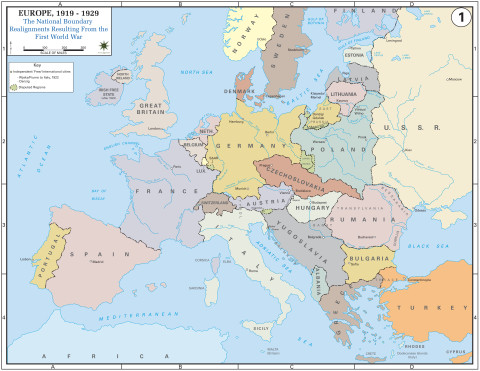
Europe after World War I, 1919-1921
New states in eastern and central Europe, like Czechoslovakia and Yugoslavia, looked neat on maps but were often ethnically mixed and politically weak. That made them vulnerable when bigger powers started pushing borders around.
The League of Nations
The League of Nations was supposed to defend peace through collective security. The problem was simple. It had no army of its own and depended on member states to act together.
- The U.S. never joined, which badly weakened the League from the start.
- Germany and the USSR were initially excluded, so major powers were missing from the system.
- The Locarno Treaties and Kellogg-Briand Pact sounded peaceful, but they had no real enforcement.
The Great Depression made all this worse. Democracies faced unemployment, extremism, and political division. Governments also became less willing to spend on rearmament or risk war to stop aggression. So before Hitler made his biggest moves, the system was already fragile.
The Forces That Made Aggression Possible
This crisis had two sides. Fascist states wanted expansion, and the powers that might have stopped them were hesitant and divided.
Fascist ideology praised war, discipline, violence, and conquest. Mussolini wanted empire and prestige. Hitler wanted to destroy Versailles, unite all Germans, and dominate Europe.
Nazi goals
Nazi expansion went beyond ordinary power politics because of racial ideology.
- Volksgemeinschaft meant an exclusive racial national community, not citizenship for everyone in the state.
- Lebensraum meant conquest in eastern Europe for German “living space.”
- Anti-Slavic racism and anti-Bolshevism made eastern conquest central to Nazi goals.
Why appeasement happened
Britain and France feared another trench-war disaster. Appeasement meant giving concessions to preserve peace, not supporting Nazism.
Reasons it appealed to leaders:
- Depression weakness made war spending hard.
- British imperial overstretch meant Britain had commitments around the world.
- French instability and defensive thinking led to reliance on the Maginot Line.
- Some leaders thought German grievances were partly legitimate.
- Many feared communism as much as fascism.
- They felt militarily unready, especially against air attack.
Isolationism and distrust
The United States stayed out through Senate rejection of Versailles and the Neutrality Acts, which weakened collective security.
Britain, France, and the USSR never built a solid anti-German coalition because they distrusted each other. Western leaders feared communism. Stalin suspected the West wanted Hitler to move east.
The Chain of Fascist Expansion
Each successful challenge taught Hitler and Mussolini that they probably would not be stopped. This sequence of moves is easier to track on the map, especially from the Rhineland to Austria, Czechoslovakia, and finally Poland.
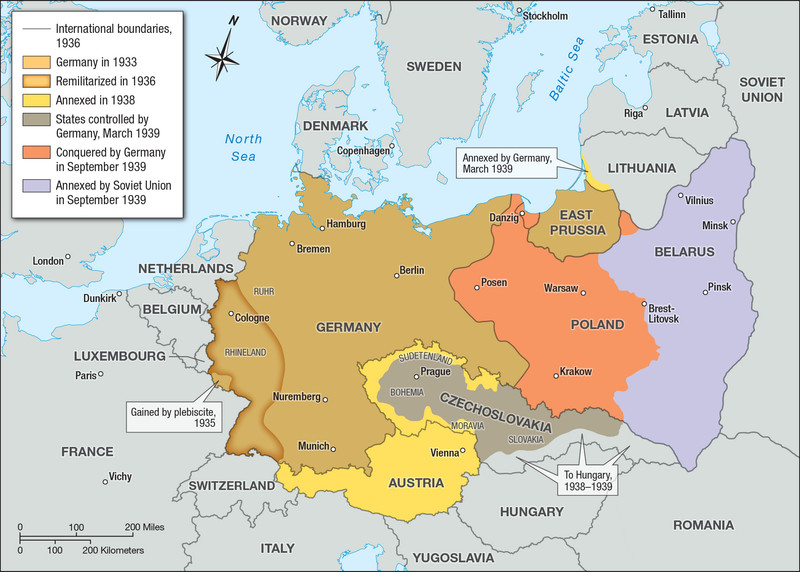
German expansion in Europe, 1933-1939
- German rearmament, 1933-1935
Germany left the League and Disarmament Conference, restored conscription, and built an air force. The Anglo-German Naval Agreement signaled weak enforcement. - Italian invasion of Ethiopia, 1935-1936
League sanctions were limited. Britain kept the Suez Canal open and there was no full oil embargo. Collective security looked helpless, and Mussolini moved closer to Hitler. - Remilitarization of the Rhineland, 1936
This violated Versailles and Locarno. Hitler could have been stopped here. German troops had orders to withdraw if challenged. Britain and France did nothing. - Spanish Civil War, 1936-1939
Germany and Italy backed Franco. The USSR backed the Republic. Britain and France stayed noninterventionist. The war helped align dictatorships and test modern warfare. - Anschluss with Austria, March 1938
Germany absorbed Austria, claiming self-determination for German speakers. Germany gained people, territory, and resources. - Munich Agreement and Sudetenland, September 1938
Chamberlain, Daladier, Hitler, and Mussolini agreed to give Germany the Sudetenland. Czechoslovakia and the USSR were excluded. This is the classic appeasement example. - Violation of Munich, March 1939
Hitler occupied Prague and Bohemia-Moravia. That proved he wanted empire, not just unification of Germans. Britain and France then guaranteed Poland. - Italy occupied Albania, 1939 and Germany and Italy signed the Pact of Steel.
The Nazi-Soviet Pact and Why Appeasement Failed
The Molotov-Ribbentrop Pact of August 1939 publicly promised nonaggression between Germany and the USSR. Its secret protocol divided eastern Europe, especially Poland.
Hitler avoided a two-front war. Stalin bought time and territory after failed talks with Britain and France. This was the high point of Western-Soviet distrust.
Appeasement failed because Hitler’s aims were not limited. Concessions also made Germany stronger:
- Rhineland protected Germany’s west
- Austria added manpower and resources
- Sudetenland took Czechoslovakia’s defenses
- Czech industry then fell under German control
Germany invaded Poland on September 1, 1939. Britain and France declared war on September 3.
Key Takeaways
Interwar Period
The period from the end of World War I in 1918 to the outbreak of World War II in Europe in September 1939
Revisionism
Efforts to revise or overturn the territorial and political settlement established after World War I.
Collective Security
The principle that states should jointly oppose aggression through diplomatic pressure, sanctions, or military force
League of Nations
International organization intended to preserve collective security but weakened by absent powers, no independent army, and members unwilling to enforce its decisions
Locarno Treaties
1925 agreements confirming Germany’s western borders but creating no dependable mechanism for enforcement
Kellogg–Briand Pact
1928 agreement formally renouncing war as an instrument of national policy but lacking effective enforcement
Extreme Nationalism
The belief that the nation was entitled to unity, power, territory, and expansion despite existing borders and treaties
Volksgemeinschaft
The Nazi racial “national community,” including those classified as German or Aryan while excluding Jews and other allegedly alien groups
Lebensraum
The Nazi doctrine of conquering “living space” in eastern Europe for the German racial nation
Appeasement
Meeting some demands of an aggressive state through negotiation and concessions in hopes of preserving peace
American Isolationism
The policy of avoiding sustained political and military commitments abroad, leaving the United States outside European collective security
Neutrality Acts
U.S. laws beginning in 1935 that restricted arms sales, loans, and assistance to belligerents to keep the country out of foreign wars
German Rearmament
Hitler’s restoration of German military power in violation of Versailles, including an air force and conscription announced in 1935
Anglo-German Naval Agreement
1935 agreement allowing a German navy limited in relation to Britain’s, thereby accepting part of German rearmament and weakening cooperation with France
Italian Invasion of Ethiopia
Italy’s 1935–1936 conquest of Ethiopia, which ineffective League sanctions failed to stop and which discredited collective security
Stresa Front
Brief 1935 cooperation among Britain, France, and Italy against German treaty violations, undermined by the Ethiopian crisis
Rome–Berlin Axis
The political alignment between Mussolini’s Italy and Hitler’s Germany identified by that name in 1936
Remilitarization of the Rhineland
Germany’s March 1936 deployment of troops into the demilitarized Rhineland, strengthening Hitler after Britain and France failed to resist
Anschluss
Germany’s coerced political union with and annexation of Austria in March 1938
Munich Agreement (Munich Conference)
September 1938 settlement allowing Germany to take the Sudetenland from Czechoslovakia without Czechoslovak or Soviet participation
German Occupation of Czechoslovakia
Hitler’s March 1939 destruction of the remaining Czechoslovak state, which violated Munich and revealed ambitions beyond ethnic self-determination
Pact of Steel
The May 1939 agreement formalizing the military alliance between Germany and Italy
Nazi–Soviet Non-Aggression Pact (Molotov–Ribbentrop Pact)
August 1939 agreement pledging German-Soviet nonaggression, with a secret protocol dividing parts of eastern Europe and planning Poland’s partition
German Invasion of Poland
Germany’s attack on Poland on September 1, 1939, followed by British and French declarations of war on September 3
Spanish Civil War
1936 conflict in which Germany and Italy aided Franco’s Nationalists, the Soviet Union supported the Republic, and Western nonintervention strengthened fascist cooperation and exposed weak resistance to aggression
Notes
Interwar Period
The period from the end of World War I in 1918 to the outbreak of World War II in Europe in September 1939
Revisionism
Efforts to revise or overturn the territorial and political settlement established after World War I.
Collective Security
The principle that states should jointly oppose aggression through diplomatic pressure, sanctions, or military force
League of Nations
International organization intended to preserve collective security but weakened by absent powers, no independent army, and members unwilling to enforce its decisions
Locarno Treaties
1925 agreements confirming Germany’s western borders but creating no dependable mechanism for enforcement
Kellogg–Briand Pact
1928 agreement formally renouncing war as an instrument of national policy but lacking effective enforcement
Extreme Nationalism
The belief that the nation was entitled to unity, power, territory, and expansion despite existing borders and treaties
Volksgemeinschaft
The Nazi racial “national community,” including those classified as German or Aryan while excluding Jews and other allegedly alien groups
Lebensraum
The Nazi doctrine of conquering “living space” in eastern Europe for the German racial nation
Appeasement
Meeting some demands of an aggressive state through negotiation and concessions in hopes of preserving peace
American Isolationism
The policy of avoiding sustained political and military commitments abroad, leaving the United States outside European collective security
Neutrality Acts
U.S. laws beginning in 1935 that restricted arms sales, loans, and assistance to belligerents to keep the country out of foreign wars
German Rearmament
Hitler’s restoration of German military power in violation of Versailles, including an air force and conscription announced in 1935
Anglo-German Naval Agreement
1935 agreement allowing a German navy limited in relation to Britain’s, thereby accepting part of German rearmament and weakening cooperation with France
Italian Invasion of Ethiopia
Italy’s 1935–1936 conquest of Ethiopia, which ineffective League sanctions failed to stop and which discredited collective security
Stresa Front
Brief 1935 cooperation among Britain, France, and Italy against German treaty violations, undermined by the Ethiopian crisis
Rome–Berlin Axis
The political alignment between Mussolini’s Italy and Hitler’s Germany identified by that name in 1936
Remilitarization of the Rhineland
Germany’s March 1936 deployment of troops into the demilitarized Rhineland, strengthening Hitler after Britain and France failed to resist
Anschluss
Germany’s coerced political union with and annexation of Austria in March 1938
Munich Agreement (Munich Conference)
September 1938 settlement allowing Germany to take the Sudetenland from Czechoslovakia without Czechoslovak or Soviet participation
German Occupation of Czechoslovakia
Hitler’s March 1939 destruction of the remaining Czechoslovak state, which violated Munich and revealed ambitions beyond ethnic self-determination
Pact of Steel
The May 1939 agreement formalizing the military alliance between Germany and Italy
Nazi–Soviet Non-Aggression Pact (Molotov–Ribbentrop Pact)
August 1939 agreement pledging German-Soviet nonaggression, with a secret protocol dividing parts of eastern Europe and planning Poland’s partition
German Invasion of Poland
Germany’s attack on Poland on September 1, 1939, followed by British and French declarations of war on September 3
Spanish Civil War
1936 conflict in which Germany and Italy aided Franco’s Nationalists, the Soviet Union supported the Republic, and Western nonintervention strengthened fascist cooperation and exposed weak resistance to aggression
