Topic 7.9 Notes – Causation in 19th-Century Perspectives and Political Developments
How Nationalism and Imperialism Reshaped Stability After 1815
The Vienna settlement tried to restore dynastic legitimacy and a balance of power after Napoleon. The map below shows the Europe that emerged from the Congress of Vienna. It worked for a while, but it sat on top of nationalist demands that did not go away.
- Nationalism meant loyalty to a people with a shared language, culture, history, or ethnicity, often leading to demands for self-rule.
- Imperialism meant extending state power over foreign peoples and territories for profit, security, prestige, or ideology.
The test likes to treat stability in three connected ways:
| Level | What it means |
|---|---|
| International | keeping the balance of power and avoiding major war |
| Internal | controlling liberal and nationalist unrest inside states |
| Global | holding empires together and managing rivalry overseas |
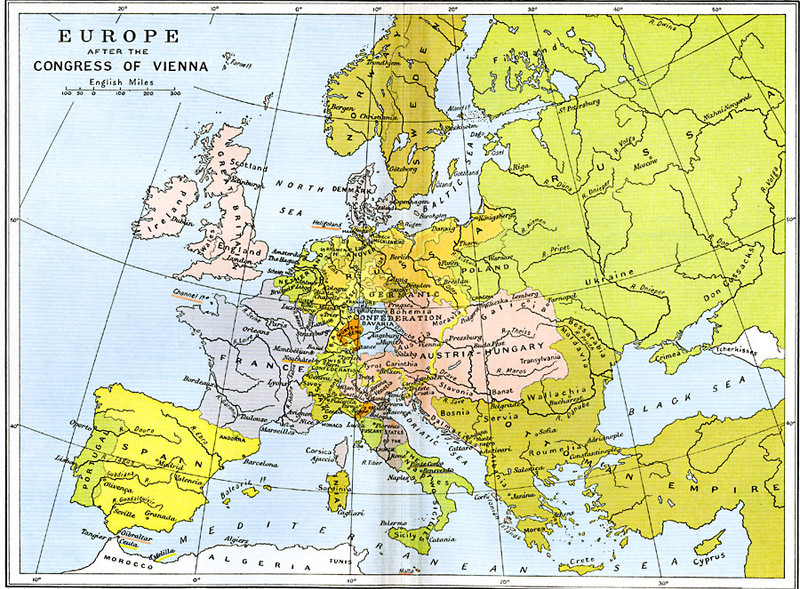
Europe after the Congress of Vienna
Here’s the chain to remember:
- The Concert of Europe weakens.
- The Crimean War damages cooperation, especially between Austria and Russia.
- Italy and Germany unify through war and diplomacy.
- The balance of power shifts sharply after 1871.
- New alliances are built.
- Imperial and Balkan crises harden rival blocs.
- Europe becomes much more fragile by 1914.
How the Breakdown of the Concert Opened the Door to Unification
The revolutions of 1820, 1830, and 1848 showed that the Vienna order could suppress nationalism and liberalism, but not erase them. After 1848, many leaders stopped trusting mass revolution and turned to state power instead.
Romantic nationalism
Before political unity came cultural unity.
- J. G. Fichte promoted a shared German identity.
- The Grimm Brothers collected folk tales that helped define German culture.
- Giuseppe Mazzini pushed republican Italian nationalism.
- Pan-Slavism encouraged solidarity among Slavic peoples.
Crimean War
In 1853 to 1856, Britain and France backed the Ottomans against Russia. Austria angered Russia by opposing it. That mattered because conservative great-power cooperation broke down.
Italian unification
- Cavour used diplomacy and got Piedmont-Sardinia involved in the Crimean War.
- French help against Austria in 1859 brought Lombardy.
- Garibaldi and the Red Shirts took Sicily and Naples in 1860.
- Victor Emmanuel II became king of unified Italy in 1861.
- Venetia joined in 1866, and Rome in 1870.
German unification
- Prussia had military strength, the Zollverein, and Bismarck’s Realpolitik.
- Danish War in 1864
- Austro-Prussian War in 1866 removed Austria from German affairs.
- Franco-Prussian War in 1870 to 1871 united southern German states.
- The German Empire was proclaimed at Versailles. France lost Alsace-Lorraine.
German unification mattered more than Italian unification because it created the strongest industrial power in central Europe.
How States Tried to Restore Order and Why It Became Fragile
Nationalism did not just build states. It also threatened multinational empires.
- Austria-Hungary was created by the Ausgleich of 1867. It satisfied the Magyars, but many Slavs, Czechs, and Romanians still felt excluded.
- The weakening Ottoman Empire fed Balkan nationalism and the Eastern Question.
Bismarck then tried to preserve peace after 1871 by making Germany a “satisfied power.”
- Three Emperors’ League 1873
- Dual Alliance 1879
- Triple Alliance 1882
- Reinsurance Treaty 1887
- Congress of Berlin 1878 temporarily cooled Balkan tensions
After Bismarck’s dismissal in 1890, the system unraveled.
- The Reinsurance Treaty lapsed.
- The Franco-Russian Alliance formed.
- Britain ended splendid isolation.
- The Triple Entente emerged by 1907.
By the early 1900s, Europe had hardened into two major alliance blocs.
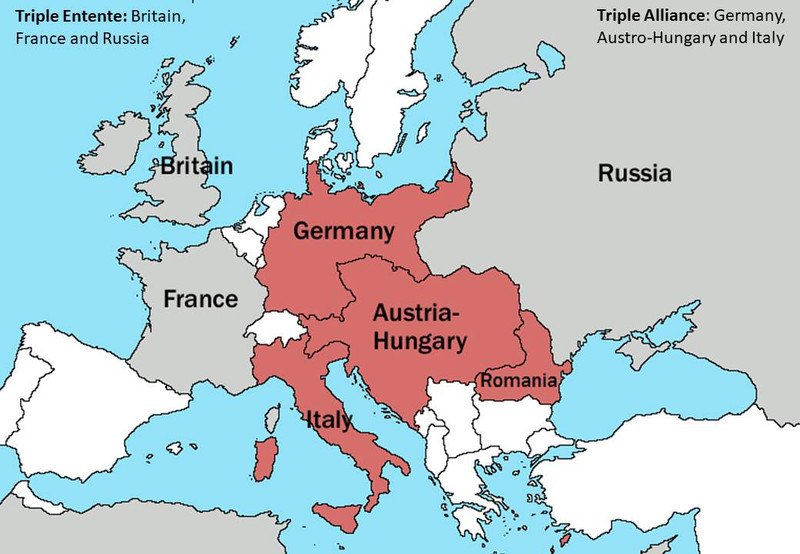
Europe’s alliance system before World War I
Balkan crises then spread local nationalism into international danger.
- Bosnia-Herzegovina annexation 1908
- First Balkan War 1912 to 1913
- Second Balkan War 1913
How New Imperialism Increased Global Control and Great Power Tension
Imperialism came from several motives at once:
- Economic: raw materials, markets, investment
- Strategic: naval bases, routes to India, blocking rivals
- Political: prestige and national greatness
- Cultural/religious: missionaries and the “civilizing mission”
- Ideological: racialism and Social Darwinism
The Second Industrial Revolution made empire easier to build and control.
- Steamships, railroads, telegraph
- Breech-loading rifles, artillery, machine guns
- Quinine, germ theory, antiseptics
The Berlin Conference of 1884 to 1885 set rules for the partition of Africa through “effective occupation.” It reduced conflict among Europeans for the moment, but ignored Africans completely.
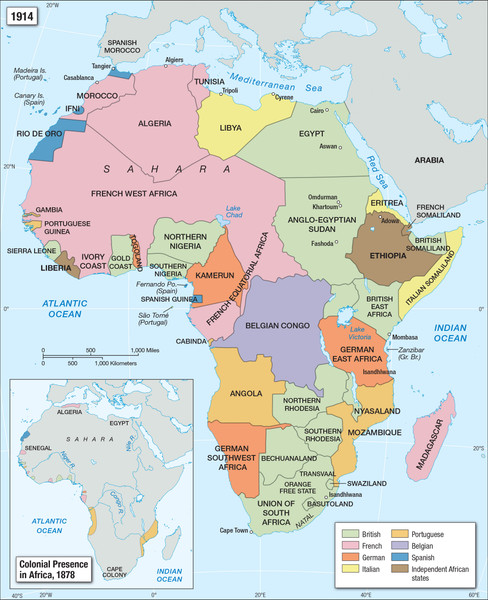
Africa under European imperial control, 1914
By 1914, the “Scramble for Africa” had left most of the continent under European rule, with only a few independent states still visible on the map.
Important examples:
- Fashoda crisis 1898 between Britain and France
- Moroccan crises 1905 and 1911, which pushed Britain and France closer together and isolated Germany
- Resistance included the Sepoy Rebellion, Zulu resistance, and the Boxer Rebellion
- The Indian National Congress founded in 1885 shows empire helped create anti-imperial nationalism
- The Meiji Restoration in 1868 shows modernization could resist European domination
How 19th-Century Ideas Supported Nationalism, Realpolitik, and Imperialism
After 1848, politics and culture moved toward realism and materialism.
- Realpolitik meant practical power politics. Cavour and Bismarck are the big names.
- Realism and naturalism focused on ordinary life and social problems. Think Courbet, Daumier, Dickens, George Eliot, Zola, Tolstoy.
A common AP trap is mixing up Darwin and Social Darwinism.
- Darwin explained biological evolution by natural selection.
- Social Darwinism twisted that idea to justify empire, racial hierarchy, and struggle between peoples.
Nationalism could also turn exclusionary.
- Anti-Semitism grew even after Jewish emancipation.
- The Dreyfus Affair showed how nationalism could become hateful and divisive.
- Karl Lueger used anti-Semitism in Vienna politics.
- Theodor Herzl responded with Zionism.
Romanticism helped imagine nations, realism shaped politics after 1848, and pseudo-scientific racism helped justify imperial rule.
