Topic 9.10 Notes – The European Union
How European Integration Worked After World War II
Europe in 1945 was wrecked. Cities, factories, and transport networks were destroyed, the Marshall Plan pushed recovery, the Cold War made Western unity more urgent, and extreme nationalism looked dangerous after fascism and war.
The key idea was pooled sovereignty. Countries gave up some control in limited areas because they thought shared control would make them stronger and safer together than acting alone.
Two ideas explain how this worked:
- Supranationalism meant states accepted institutions above the national level in certain fields.
- Functionalism meant starting with practical economic cooperation, then letting success spill into wider integration.
Robert Schuman and Jean Monnet were the major architects. In the Schuman Declaration of 1950, Schuman proposed joint control of coal and steel, the basic industries needed for war. If France and West Germany shared those resources, war became harder to prepare and easier to detect.
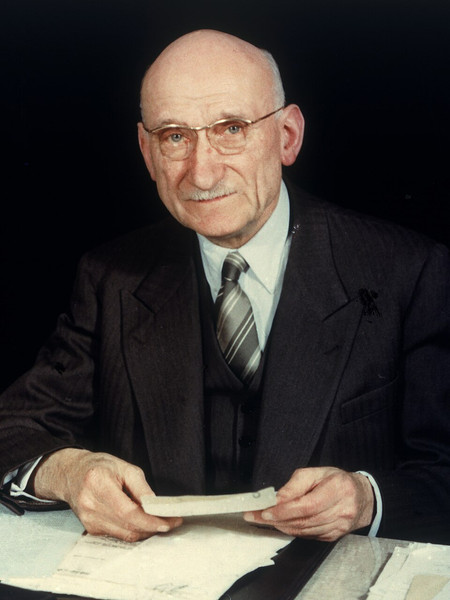
Robert Schuman
From Coal and Steel to the European Union
You need the sequence cold. ECSC → EEC → EU.
European Coal and Steel Community
The Treaty of Paris in 1951 created the European Coal and Steel Community, active in 1952.
Its six founders were:
- France
- West Germany
- Italy
- Belgium
- Netherlands
- Luxembourg
It created a common market in coal and steel. That helped industrial recovery, tied West Germany firmly to the West, and reduced the chance that any one state could quietly rearm.
European Economic Community
The Treaties of Rome in 1957 created the EEC, active in 1958. This was the Common Market.
The EEC lowered tariffs and built a customs union. It also developed the four freedoms:
- movement of goods
- movement of services
- movement of capital
- movement of workers
That meant a larger market, more competition, more labor mobility, and economies of scale. The Common Agricultural Policy showed how integration worked in practice. It supported farmers through shared policy and spending, but it also caused budget fights. Regional development funds tried to reduce inequality between richer and poorer areas.
European Union
The Single European Act of 1986/1987 pushed completion of the internal market. The Maastricht Treaty of 1992/1993 officially created the EU and added political cooperation, EU citizenship, and a path toward monetary union. The Lisbon Treaty of 2007/2009 reformed institutions after expansion and strengthened Parliament. The failed European Constitution in 2005 showed that deeper integration had real public opposition.
How the EU Changed Europe’s Economy
The single market was the EU’s biggest economic achievement. It removed tariffs, customs delays, and many regulatory barriers. Common standards for products, labor, consumers, and the environment made cross-border trade much easier.
It also increased movement of capital and labor, which boosted investment and job mobility. Acting together gave Europe more bargaining power in global trade.
The euro
The euro showed the deepest kind of integration. It launched electronically in 1999 and appeared as notes and coins in 2002.
Benefits:
- easier trade
- easier price comparison
- less exchange-rate uncertainty
Cost:
- countries lost independent monetary policy
The European Central Bank set monetary policy for eurozone members.
The debt crisis after 2009, especially in Greece, exposed the problem. Europe had gone further in monetary union than in fiscal union. Countries shared a currency, but not one shared budget system. That is why austerity became such a huge conflict between EU rules and national democracy.
Expansion, Institutions, and Shared European Identity
The EU kept widening, and each round changed what “Europe” meant.
- 1973 Britain, Denmark, Ireland
- 1981 Greece
- 1986 Spain, Portugal
- 1995 Austria, Finland, Sweden
- 2004 major eastward expansion, mostly former communist states
- 2007 Bulgaria, Romania
- 2013 Croatia
This map helps you see the pattern. The darkest shading marks the original core, then the labels trace later waves of entry across southern, northern, and eastern Europe.
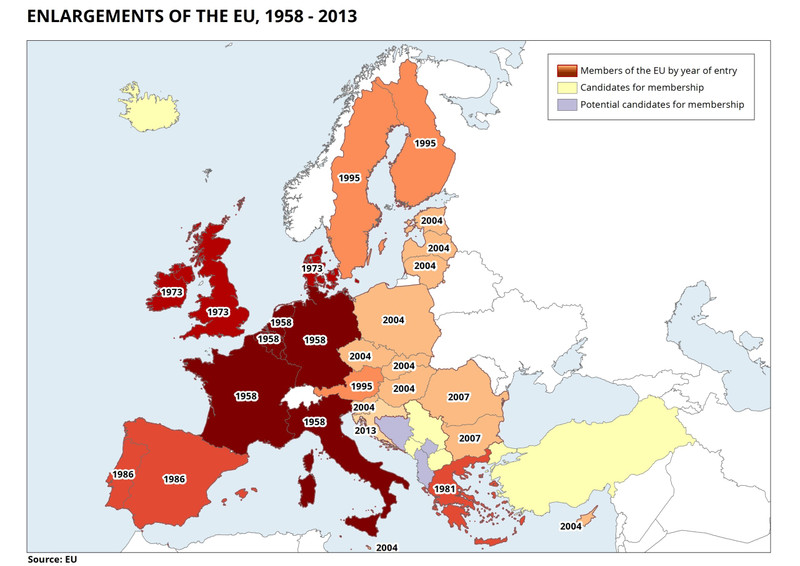
EU enlargements, 1958-2013
Enlargement spread market economics and democratic norms, especially after the Cold War. It also created tensions over migration, wages, and budget contributions.
Main institutions
| Institution | What it does |
|---|---|
| European Commission | proposes legislation and administers EU policy |
| European Parliament | directly elected body representing citizens |
| Council of the European Union | represents member-state governments |
| European Council | sets broad political direction |
| Court of Justice of the EU | interprets EU law |
| European Central Bank | runs monetary policy for the eurozone |
A shared European identity grew through EU citizenship from Maastricht, direct elections to Parliament since 1979, exchange programs, common passport format, the euro, free movement, the EU flag, and “Ode to Joy.” National identity stayed strong, though. Students often miss that the EU added identity layers. It did not erase older ones.
Sovereignty, Free Movement, and Brexit
The central argument around the EU is always shared power vs national control. Member states kept taxation, welfare systems, armies, and constitutions, but in agreed areas EU law could take priority.
Subsidiarity meant decisions should stay close to citizens unless EU-level action worked better.
Free movement let EU citizens live, work, and study across borders. That is different from Schengen. Free movement is a legal right of EU citizens. Schengen is mainly about border checks, and the membership lists are not identical.
Brexit is the clearest sovereignty example. Britain joined the EEC in 1973, stayed outside the euro, and remained outside much of Schengen. In the 2016 referendum, Leave won about 52%. Britain formally exited in 2020.
- Leave stressed laws, borders, and trade independence.
- Remain stressed single market access, investment, and influence.
Key Takeaways
Functionalism
Strategy of beginning integration in useful, limited fields so successful cooperation creates pressure for wider economic and political integration
Schuman Declaration
Robert Schuman’s 1950 proposal to place French and West German coal and steel under a common European authority to promote recovery and prevent war
Treaty of Paris
The 1951 treaty that created the European Coal and Steel Community
European Coal and Steel Community (ECSC)
Six-state community operating from 1952 that created a common coal-and-steel market to aid recovery, bind West Germany to Western Europe, and make war less likely
Treaties of Rome
The 1957 treaties that created the European Economic Community and Euratom, effective in 1958
European Economic Community (EEC) / Common Market
Organization created by the Treaties of Rome to remove trade barriers, form a customs union, and integrate the economies of its members
Free-Trade Area vs. Customs Union
A free-trade area removes internal tariffs; a customs union also imposes a common external tariff on imports from nonmembers
Four Freedoms
The free movement of goods, services, capital, and workers within the European single market
Common Agricultural Policy (CAP)
European policy using shared financing, price supports, and protections to support farmers and food security, while provoking disputes over costs and subsidies
EU Enlargement
Expansion from a six-state western core into northern, southern, and postcommunist eastern Europe, extending the single market and encouraging democratic and legal reforms
Single European Act
Treaty signed in 1986 and effective in 1987 that sought to complete the internal market and expanded common European decision-making
Maastricht Treaty
Treaty signed in 1992 and effective in 1993 that created the EU, introduced EU citizenship, and set a path toward economic and monetary union
European Union (EU)
Economic and political union established in 1993 through which sovereign European states share institutions, laws, markets, and selected powers
Treaty of Lisbon
Treaty signed in 2007 and effective in 2009 that reformed EU institutions after enlargement and strengthened the European Parliament
European Commission
EU executive and administrative body that proposes legislation, administers programs, and monitors compliance with EU law
European Parliament
Directly elected EU institution that represents citizens and shares legislative, budgetary, and supervisory powers
Council of the European Union / Council of Ministers
Institution representing member-state governments whose relevant national ministers adopt legislation jointly with the European Parliament
European Council
Body of member states’ heads of state or government that sets the EU’s broad political direction and priorities but normally does not legislate
Court of Justice of the European Union (CJEU)
Court that interprets EU law, ensures its uniform application, and upholds its precedence in fields granted to the union
European Central Bank (ECB)
Independent institution that manages the euro and sets monetary policy for the euro area
European Single Market
Integrated economic area combining free movement and common rules to reduce tariffs, customs delays, regulatory barriers, and restrictions on labor and capital
Euro
Common currency launched electronically in 1999 and as notes and coins in 2002, reducing exchange costs while ending participating states’ independent monetary policies
Eurozone / Euro Area
The group of EU countries using the euro; it does not include every EU member
Eurozone Sovereign-Debt Crisis
Post-2009 crisis in which indebted euro states, especially Greece, received assistance tied to austerity, exposing the gap between shared currency and national budgets
EU Free Movement
Right of EU citizens, under common rules, to live, work, and study in other member states
Schengen Agreement / Schengen Area
System initiated by the 1985 agreement that removed internal passport and border checks among participating countries; its membership is not identical to the EU’s
Citizenship of the European Union
Citizenship added to national citizenship by Maastricht, including rights to move and reside in the EU and vote in European and certain local elections
European Identity
A shared, layered identity encouraged by EU rights, institutions, symbols, travel, and exchange programs that coexists with national identities
Supranational Authority
Authority exercised by institutions above the national level whose decisions can bind participating member states
Pooled Sovereignty
Member states’ joint exercise of selected powers through EU institutions to gain greater collective influence while accepting limits on independent action
Subsidiarity
Principle that decisions should be made as close to citizens as practical and handled by the EU only when member states cannot achieve the objective sufficiently alone
Brexit
Britain’s withdrawal from the EU after the 2016 referendum, completed in 2020, which restored some autonomy but created new barriers and reduced influence over EU decisions
Notes
Functionalism
Strategy of beginning integration in useful, limited fields so successful cooperation creates pressure for wider economic and political integration
Schuman Declaration
Robert Schuman’s 1950 proposal to place French and West German coal and steel under a common European authority to promote recovery and prevent war
Treaty of Paris
The 1951 treaty that created the European Coal and Steel Community
European Coal and Steel Community (ECSC)
Six-state community operating from 1952 that created a common coal-and-steel market to aid recovery, bind West Germany to Western Europe, and make war less likely
Treaties of Rome
The 1957 treaties that created the European Economic Community and Euratom, effective in 1958
European Economic Community (EEC) / Common Market
Organization created by the Treaties of Rome to remove trade barriers, form a customs union, and integrate the economies of its members
Free-Trade Area vs. Customs Union
A free-trade area removes internal tariffs; a customs union also imposes a common external tariff on imports from nonmembers
Four Freedoms
The free movement of goods, services, capital, and workers within the European single market
Common Agricultural Policy (CAP)
European policy using shared financing, price supports, and protections to support farmers and food security, while provoking disputes over costs and subsidies
EU Enlargement
Expansion from a six-state western core into northern, southern, and postcommunist eastern Europe, extending the single market and encouraging democratic and legal reforms
Single European Act
Treaty signed in 1986 and effective in 1987 that sought to complete the internal market and expanded common European decision-making
Maastricht Treaty
Treaty signed in 1992 and effective in 1993 that created the EU, introduced EU citizenship, and set a path toward economic and monetary union
European Union (EU)
Economic and political union established in 1993 through which sovereign European states share institutions, laws, markets, and selected powers
Treaty of Lisbon
Treaty signed in 2007 and effective in 2009 that reformed EU institutions after enlargement and strengthened the European Parliament
European Commission
EU executive and administrative body that proposes legislation, administers programs, and monitors compliance with EU law
European Parliament
Directly elected EU institution that represents citizens and shares legislative, budgetary, and supervisory powers
Council of the European Union / Council of Ministers
Institution representing member-state governments whose relevant national ministers adopt legislation jointly with the European Parliament
European Council
Body of member states’ heads of state or government that sets the EU’s broad political direction and priorities but normally does not legislate
Court of Justice of the European Union (CJEU)
Court that interprets EU law, ensures its uniform application, and upholds its precedence in fields granted to the union
European Central Bank (ECB)
Independent institution that manages the euro and sets monetary policy for the euro area
European Single Market
Integrated economic area combining free movement and common rules to reduce tariffs, customs delays, regulatory barriers, and restrictions on labor and capital
Euro
Common currency launched electronically in 1999 and as notes and coins in 2002, reducing exchange costs while ending participating states’ independent monetary policies
Eurozone / Euro Area
The group of EU countries using the euro; it does not include every EU member
Eurozone Sovereign-Debt Crisis
Post-2009 crisis in which indebted euro states, especially Greece, received assistance tied to austerity, exposing the gap between shared currency and national budgets
EU Free Movement
Right of EU citizens, under common rules, to live, work, and study in other member states
Schengen Agreement / Schengen Area
System initiated by the 1985 agreement that removed internal passport and border checks among participating countries; its membership is not identical to the EU’s
Citizenship of the European Union
Citizenship added to national citizenship by Maastricht, including rights to move and reside in the EU and vote in European and certain local elections
European Identity
A shared, layered identity encouraged by EU rights, institutions, symbols, travel, and exchange programs that coexists with national identities
Supranational Authority
Authority exercised by institutions above the national level whose decisions can bind participating member states
Pooled Sovereignty
Member states’ joint exercise of selected powers through EU institutions to gain greater collective influence while accepting limits on independent action
Subsidiarity
Principle that decisions should be made as close to citizens as practical and handled by the EU only when member states cannot achieve the objective sufficiently alone
Brexit
Britain’s withdrawal from the EU after the 2016 referendum, completed in 2020, which restored some autonomy but created new barriers and reduced influence over EU decisions
