Topic 5.7 Notes – The Congress of Vienna
What the Congress of Vienna Tried to Do
After Napoleon’s defeat, Europe’s rulers had a huge problem. The French Revolution and Napoleon had removed dynasties, redrawn borders, and spread liberalism and nationalism across the continent. Vienna was their answer.
The core goal was simple. Europe needed order, and no single power could be allowed to dominate again the way Napoleonic France had.
The four principles fit together:
- Balance of power meant preventing hegemony. The powers did not want to destroy France completely. They wanted to contain it by strengthening nearby states.
- Legitimacy meant putting hereditary rulers back on thrones where practical. The clearest example is the Bourbon restoration in France under Louis XVIII.
- Compensation meant rewarding the victors with territory. These choices were strategic, not based on what local people wanted.
- Conservatism meant defending monarchy, hierarchy, and stability against revolution, liberalism, and nationalism.
A common trap is thinking Vienna simply restored pre-1789 Europe. It didn’t. The Holy Roman Empire was not revived, independent Poland was not restored, and some Napoleonic changes stayed because they made states easier to govern.
The map of Europe in 1815 helps make that point. You can see restored dynasties and strategic border changes, but you can also see that the settlement created a new political layout rather than turning the clock all the way back.
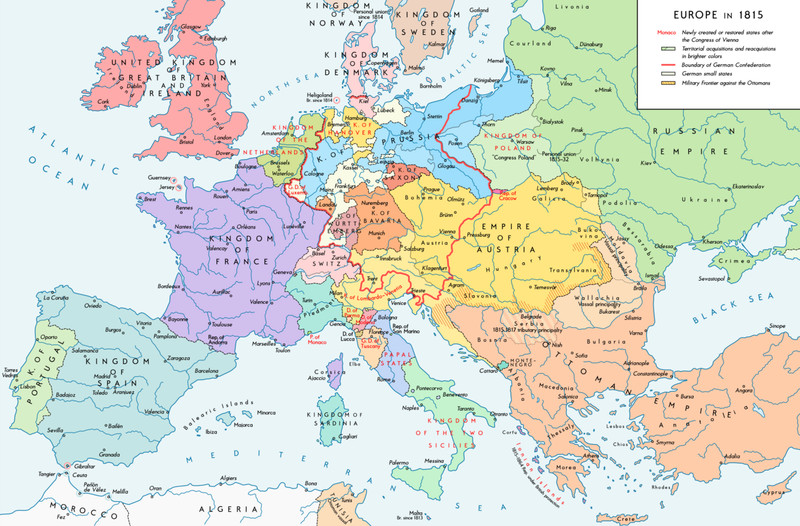
Europe after the Congress of Vienna, 1815
The Great Powers and Their Goals
The Congress makes the most sense when you see the five powers as each protecting its own interests.
- Austria under Metternich led the conservative side. He feared nationalism because Austria was a multinational empire that could fall apart.
- Britain under Castlereagh wanted a stable continent, safe trade, and British naval dominance.
- Russia under Tsar Alexander I wanted most of Poland and promoted the Holy Alliance.
- Prussia under Hardenberg and Frederick William III wanted territory, especially Saxony and land in the west.
- France under Talleyrand managed to return to diplomacy despite defeat by playing the victors against each other.
The Polish-Saxon crisis
This is the best example of competing interests at Vienna.
- Russia wanted most of the Duchy of Warsaw.
- Prussia wanted most of Saxony.
- Austria and Britain feared Russia and Prussia were becoming too strong.
- Talleyrand sided with Austria and Britain.
- The compromise gave Russia most of Poland and Prussia only part of Saxony.
That pattern matters on tests. The allies were united against Napoleon, but balance-of-power fears often mattered more than alliance loyalty.
How Vienna Redrew the Map of Europe
Vienna’s map was built to surround France with stronger neighbors and reward the winners.
- France was reduced to near pre-revolutionary borders. It was contained, not partitioned.
- Buffer states around France
- Kingdom of the Netherlands created to the north
- Piedmont-Sardinia restored and enlarged with Genoa
- Switzerland recognized as permanently neutral
- Prussia strengthened on the Rhine
- German lands
- Holy Roman Empire not restored
- German Confederation of 39 states created
- Austria held the presidency
- Prussia gained the Rhineland, Westphalia, and part of Saxony
- Poland and eastern Europe
- Russia got most of the Duchy of Warsaw as Congress Poland
- Prussia got Posen
- Austria kept Galicia
- Italy
- Austria directly controlled Lombardy-Venetia
- Papal States restored
- Bourbons restored in the Two Sicilies
- Italian unification was blocked
- Britain and the north
- Britain kept Malta, Cape Colony, and Ceylon
- Norway was transferred from Denmark to Sweden
What Vienna Could Not Solve
Vienna restored dynasties, but ideas were harder to put back in the box.
- Liberalism wanted constitutions, civil liberties, representative government, and limits on monarchs.
- Nationalism said people with a shared language, culture, and history should govern themselves.
Vienna ignored nationalism in major places:
- Poles stayed divided and under foreign control.
- Italians stayed divided and heavily influenced by Austria.
- Germans stayed divided among 39 states.
- Dutch and Belgians were forced into one kingdom.
- Austria and Russia still ruled many ethnic groups.
Vienna suppressed these movements for a while. It did not erase them.
Results and Legacy
The settlement lasted because the powers kept cooperating after 1815.
- Quadruple Alliance = Britain, Austria, Russia, Prussia
- Holy Alliance = Russia, Austria, Prussia
- Congress of Vienna means the 1814 to 1815 settlement itself.
- Concert of Europe means the later system of great-power consultation used to preserve that settlement.
Vienna’s biggest success was peace among the major powers. France was contained without being destroyed, and Europe avoided another continent-wide war on the Napoleonic scale until 1914.
Its limits showed up fast. Revolutions came back in the 1820s, 1830s, and especially 1848. Later Italian and German unification broke apart the Vienna map.
Key Takeaways
Congress of Vienna
1814–1815 diplomatic settlement that restored legitimate dynasties where practical, contained France, reestablished a balance of power, and sought to restrain liberalism and nationalism after Napoleon’s defeat
Klemens von Metternich
Austrian foreign minister and leading architect of the Vienna settlement who defended monarchy and opposed liberalism and nationalism as threats to Austria and European stability
Charles-Maurice de Talleyrand
French foreign minister who invoked legitimacy and exploited divisions among the victors to restore defeated France to major-power diplomacy
Polish-Saxon Crisis
Congress dispute over Russian control of Poland and Prussian annexation of Saxony, resolved by giving Russia most of the Duchy of Warsaw and Prussia only part of Saxony
Balance of Power
Distribution of power intended to prevent any one state from dominating Europe; at Vienna it meant containing but not destroying France and strengthening neighboring states
Legitimacy
Vienna principle of restoring lawful hereditary dynasties displaced by revolution or Napoleon, applied selectively when compatible with strategic interests
Compensation
Vienna principle of rewarding victorious powers, usually with territory, for wartime sacrifices or lands surrendered elsewhere
Conservatism
Defense of hereditary monarchy, established authority, social hierarchy, religion, and gradual development against revolutionary political change
Kingdom of the Netherlands
Buffer state created by uniting the Dutch Republic with the former Austrian Netherlands; its southern provinces broke away as Belgium in 1830
German Confederation
Loose association of 39 German states created at Vienna under Austrian presidency, without a strong central government or German national unity
Congress Poland
Kingdom formed from most of the former Duchy of Warsaw, nominally autonomous but controlled by the Russian tsar as its king
Liberalism
Ideology favoring legal equality, constitutional government, civil liberties, representative institutions, and limits on arbitrary monarchical power
Nationalism
Belief that a people sharing a language, culture, history, or identity constitute a nation entitled to political unity or self-government
Quadruple Alliance
1815 alliance of Britain, Austria, Russia, and Prussia to guard against renewed French aggression, uphold the Vienna settlement, and continue consultation
Holy Alliance
Alliance proposed by Tsar Alexander I and joined by Russia, Austria, and Prussia, symbolically linking Christian monarchical solidarity with opposition to revolution
Concert of Europe
Post-Vienna system of great-power conferences and collective diplomacy intended to manage disputes and preserve the European settlement
Piedmont-Sardinia
Restored under the House of Savoy and enlarged with Genoa to create a stronger buffer against France on its southeastern frontier
Notes
Congress of Vienna
1814–1815 diplomatic settlement that restored legitimate dynasties where practical, contained France, reestablished a balance of power, and sought to restrain liberalism and nationalism after Napoleon’s defeat
Klemens von Metternich
Austrian foreign minister and leading architect of the Vienna settlement who defended monarchy and opposed liberalism and nationalism as threats to Austria and European stability
Charles-Maurice de Talleyrand
French foreign minister who invoked legitimacy and exploited divisions among the victors to restore defeated France to major-power diplomacy
Polish-Saxon Crisis
Congress dispute over Russian control of Poland and Prussian annexation of Saxony, resolved by giving Russia most of the Duchy of Warsaw and Prussia only part of Saxony
Balance of Power
Distribution of power intended to prevent any one state from dominating Europe; at Vienna it meant containing but not destroying France and strengthening neighboring states
Legitimacy
Vienna principle of restoring lawful hereditary dynasties displaced by revolution or Napoleon, applied selectively when compatible with strategic interests
Compensation
Vienna principle of rewarding victorious powers, usually with territory, for wartime sacrifices or lands surrendered elsewhere
Conservatism
Defense of hereditary monarchy, established authority, social hierarchy, religion, and gradual development against revolutionary political change
Kingdom of the Netherlands
Buffer state created by uniting the Dutch Republic with the former Austrian Netherlands; its southern provinces broke away as Belgium in 1830
German Confederation
Loose association of 39 German states created at Vienna under Austrian presidency, without a strong central government or German national unity
Congress Poland
Kingdom formed from most of the former Duchy of Warsaw, nominally autonomous but controlled by the Russian tsar as its king
Liberalism
Ideology favoring legal equality, constitutional government, civil liberties, representative institutions, and limits on arbitrary monarchical power
Nationalism
Belief that a people sharing a language, culture, history, or identity constitute a nation entitled to political unity or self-government
Quadruple Alliance
1815 alliance of Britain, Austria, Russia, and Prussia to guard against renewed French aggression, uphold the Vienna settlement, and continue consultation
Holy Alliance
Alliance proposed by Tsar Alexander I and joined by Russia, Austria, and Prussia, symbolically linking Christian monarchical solidarity with opposition to revolution
Concert of Europe
Post-Vienna system of great-power conferences and collective diplomacy intended to manage disputes and preserve the European settlement
Piedmont-Sardinia
Restored under the House of Savoy and enlarged with Genoa to create a stronger buffer against France on its southeastern frontier
