Topic 8.3 Notes – The Russian Revolution and Its Effects
How the Russian Revolution Happened
Russia entered World War I with a weak political system already under strain. Tsar Nicholas II still ruled as an autocrat, and the limited reforms after 1905 never solved the deeper problems.
- The 1905 Revolution mattered because it showed the regime could be shaken. Bloody Sunday, mass strikes, mutinies, and the first soviets forced concessions, but the tsar kept real power.
- Rural land hunger remained intense after serf emancipation in 1861. Peasants were legally free, but many still lacked enough land.
- Social inequality stayed sharp. Nobles, workers, peasants, and the middle classes lived very different lives and wanted different things from the state.
- Uneven industrialization made cities explosive. Russia had modern factories, but not a stable modern economy. Workers faced low pay, harsh conditions, and food shortages.
World War I was the immediate catalyst, not the only cause. It turned long-term weakness into collapse.
- Military defeats and massive casualties destroyed faith in the government.
- Food and fuel shortages, inflation, and transport breakdown made daily life miserable.
- In 1915 Nicholas II took personal command of the army, so military failure became his failure.
- Alexandra and Rasputin made the court look corrupt and incompetent.
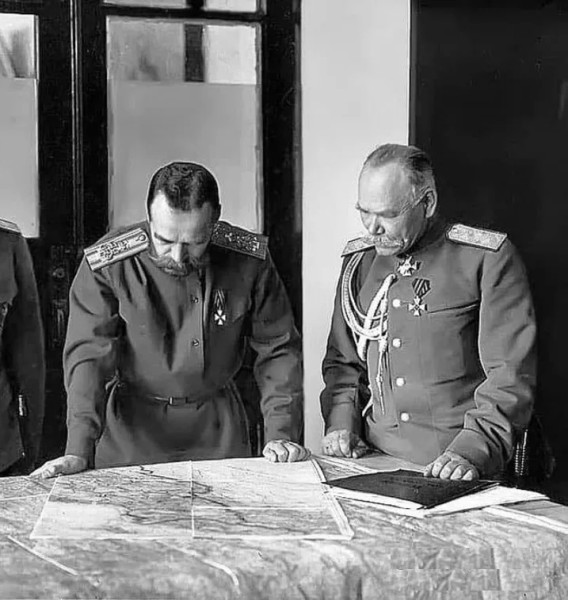
Nicholas II during World War I
The pattern to remember is simple. Long-term instability + wartime collapse of state authority = revolution.
The Two Revolutions of 1917
Russia had two separate revolutions in one year, and AP questions often expect you to keep them distinct.
February March Revolution
The first revolution began in Petrograd with bread riots and strikes on International Women’s Day.
- Women textile workers were key starters of the protests.
- Demonstrations grew from demands for bread into demands to end the war and remove the tsar.
- The turning point came when soldiers refused to fire or mutinied.
- Nicholas II abdicated, ending Romanov rule.
- Leaders from the Duma formed the Provisional Government, led first by Prince Lvov, then Alexander Kerensky.
Dual power and the Petrograd Soviet
The fall of the tsar did not create one clear government. It created dual power.
- The Provisional Government had formal authority.
- The Petrograd Soviet represented workers and soldiers and had real influence on the streets and in the army.
- Order No. 1 weakened normal military discipline and increased soviet power.
- The Provisional Government’s biggest mistake was continuing the war and delaying land reform.
This split helps explain why the Provisional Government looked legitimate on paper but struggled to control events.
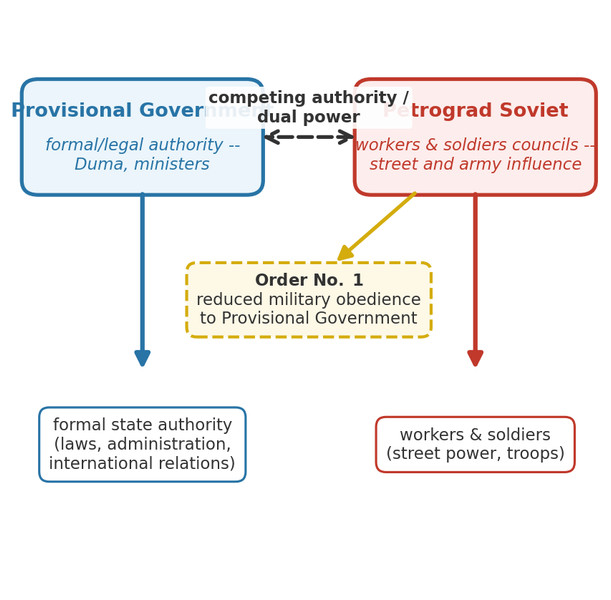
Dual power in 1917 Russia
October November Revolution
By fall 1917, the Provisional Government had lost support, and the Bolsheviks gained it.
- Lenin returned in April and issued the April Theses.
- Bolshevik slogans were “Peace, Land, Bread” and “All Power to the Soviets.”
- The July Days showed unrest.
- The Kornilov Affair weakened conservatives and made Bolsheviks look like defenders of the revolution.
- Trotsky organized the Military Revolutionary Committee.
- Bolsheviks seized bridges, rail stations, and the Winter Palace in Petrograd.
February was more spontaneous. October was a planned Bolshevik takeover.
How the Bolsheviks Built a Marxist Leninist State
Marx expected revolution in advanced industrial countries. Russia was mostly peasant, so Lenin adapted Marxism.
Marxism-Leninism
- Vanguard party means a small, disciplined party leads the revolution.
- Workers-peasants alliance fit Russian reality better than pure worker revolution.
- Dictatorship of the proletariat in practice meant rule through the party.
- Democratic centralism meant debate inside the party, then total unity after decisions.
Lenin created the Council of People’s Commissars and moved fast to answer popular demands.
- Decree on Peace called for ending the war.
- Decree on Land recognized peasant seizure of land.
- Treaty of Brest-Litovsk took Russia out of WWI, but at huge territorial cost.
- When the Constituent Assembly did not give the Bolsheviks a majority, Lenin shut it down in 1918.
- The Cheka enforced one-party rule through censorship, arrests, and terror.
- By 1918 the Bolsheviks renamed themselves the Communist Party.
This was the first durable communist state.
Civil War and Economic Survival
The Bolshevik seizure of power led straight into civil war.
Red and White forces
- The Reds, led by Trotsky’s Red Army, had central location, rail access, discipline, and clearer leadership.
- The Whites included monarchists, liberals, conservatives, rival socialists, and nationalists. They were deeply divided.
- Foreign powers like Britain, France, the United States, and Japan aided anti-Bolshevik forces.
- Bolsheviks used that intervention as propaganda against foreign capitalist enemies.
Red victory came from unity, geography, railroads, and White disunity. This map captures the basic problem for the Bolsheviks in 1918 to 1919. They faced attacks from several directions, including foreign-backed anti-Bolshevik forces, but still held the central core.
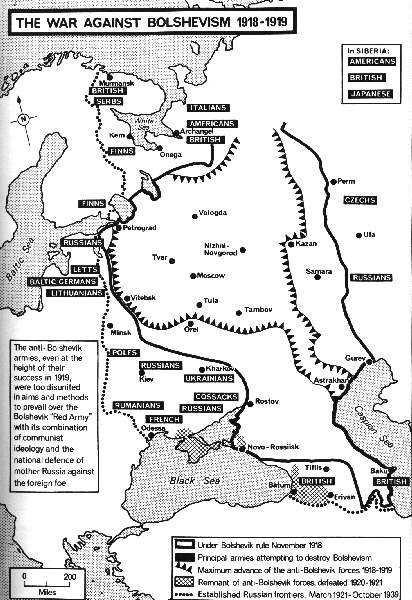
Russian Civil War, 1918-1919
War Communism
During the civil war, the regime used emergency controls:
- Grain requisitioning
- Nationalization
- State control of industry
- Bans on private trade
- Rationing
It helped win the war but caused famine, black markets, economic collapse, and more repression. The Red Terror expanded, and resistance appeared in the Tambov rebellion and Kronstadt uprising.
New Economic Policy
In 1921 Lenin pulled back with the NEP.
- Requisitioning was replaced by a tax in kind.
- Small private trade and small businesses returned.
- The state kept heavy industry, banking, transport, and foreign trade.
The NEP showed Lenin would compromise ideology to keep Bolshevik power alive.
Effects of the Revolution
The revolution destroyed the Romanov monarchy and old landed elite, but it did not create liberal democracy. It created a centralized one-party communist state.
- In 1922, the USSR was formed.
- The state promised equality and liberation, but also imposed repression and crushed political freedom.
- The Comintern spread communist ideas abroad.
- The revolution frightened conservatives, liberals, and moderates across Europe and increased polarization.
This is a classic AP change-and-continuity topic.
- Change included communist ideology, new landholding patterns, withdrawal from WWI, and a party-state.
- Continuity included centralized authority and coercion, now under a new ideology.
Key Takeaways
Tsar Nicholas II
Russia’s last tsar, whose resistance to constitutional rule and association with World War I failures led to his abdication in March 1917 and the collapse of the Romanov monarchy
Revolution of 1905
Uprising of workers, peasants, and soldiers that forced Nicholas II to promise civil liberties and a Duma but failed to end tsarist autocracy
Bloody Sunday
The 1905 firing by tsarist troops on peaceful demonstrators in St. Petersburg, which helped provoke strikes, peasant unrest, and military mutinies
October Manifesto
Nicholas II’s 1905 promise of civil liberties and an elected Duma, concessions later undermined by his continued autocratic authority
Duma
Russia’s elected legislature after 1905, limited by the tsar’s power to control ministers, alter elections, and dissolve it
Fundamental Laws of 1906
Laws affirming Nicholas II’s autocratic authority despite the constitutional promises of the October Manifesto
Soviets
Councils claiming to represent workers, soldiers, or peasants directly, first formed in 1905 and revived as centers of revolutionary power in 1917
Socialist Revolutionaries
Russian socialist movement supported largely by peasants that emphasized land redistribution and later won the largest share of the Constituent Assembly vote
Bolsheviks
Lenin’s disciplined revolutionary Marxist faction, which used support in key soviets to seize power in October 1917 and establish a communist state
Mensheviks
Marxist faction favoring a broader party and a prolonged liberal-capitalist stage before socialist revolution, unlike Lenin’s Bolsheviks
Vladimir Lenin
Bolshevik leader who adapted Marxism to Russian conditions, directed the October Revolution, founded the communist state, and introduced the NEP.
Marxism–Leninism
Lenin’s adaptation of Marxism emphasizing a disciplined vanguard party, worker-peasant alliance, party-led proletarian rule, and accelerated revolution
February/March Revolution
The March 1917 worker and soldier uprising in Petrograd that began over bread shortages, caused Nicholas II’s abdication, and created the Provisional Government
Provisional Government
Temporary government formed by Duma leaders after the tsar’s abdication; continuing World War I and postponing land reform eroded its support and aided the Bolsheviks
Alexander Kerensky
Socialist politician who became prime minister of the Provisional Government but was weakened by the war, the Kornilov Affair, and Bolshevik opposition
Petrograd Soviet
Influential council of workers and soldiers that shared authority with the Provisional Government and eventually gained a Bolshevik majority
Dual Power
The unstable sharing of authority in 1917 between the formally legal Provisional Government and the Petrograd Soviet’s practical influence over workers and soldiers
Order No. 1
Petrograd Soviet directive encouraging soldiers’ committees and asserting Soviet influence over the capital’s garrison, weakening government military authority
April Theses
Lenin’s 1917 program rejecting the Provisional Government and demanding peace, land for peasants, soviet power, and movement toward socialist revolution
July Days
Unrest in Petrograd in July 1917 that the Provisional Government suppressed, temporarily weakening the Bolsheviks and forcing Lenin into hiding
Kornilov Affair
General Kornilov’s apparent military threat to Petrograd in August 1917, which weakened Kerensky and empowered armed Bolsheviks as defenders of the revolution
October/November Revolution
The Bolsheviks’ planned November 1917 seizure of strategic points in Petrograd and overthrow of the Provisional Government
Leon Trotsky
Bolshevik leader who organized the October seizure through the Military Revolutionary Committee and later organized the Red Army during the civil war
Decree on Peace
Early Bolshevik measure calling for an end to World War I and fulfilling the revolutionaries’ promise of peace
Decree on Land
Early Bolshevik measure recognizing peasants’ seizure and control of landed estates
Constituent Assembly
Elected body dispersed by the Bolsheviks in January 1918 after it refused to accept their supremacy, ending the prospect of multiparty parliamentary rule
Cheka
Bolshevik political police created in 1917 to combat counterrevolution and sabotage through arrests and coercion
Treaty of Brest-Litovsk
March 1918 treaty withdrawing Russia from World War I at the cost of extensive western territories, population, farmland, and industry
Russian Civil War
The mainly 1918–1921 conflict between the Bolshevik government and its opponents, ending in Red victory, communist consolidation, and enormous destruction
Red Army and White Armies
The disciplined Bolshevik Red Army held Russia’s central regions and defeated the divided White opponents operating from poorly coordinated peripheral fronts
Foreign Intervention in the Russian Civil War
British, French, Japanese, American, and other aid to anti-Bolshevik forces, which remained uncoordinated but supported Bolshevik claims of resisting foreign invasion
Red Terror
Bolshevik campaign of Cheka-led executions, arrests, and repression against actual or suspected opponents during the civil war
War Communism
Civil War emergency system of nationalization, grain requisitioning, restricted trade, rationing, and militarized labor that supplied the Red Army but intensified economic collapse and unrest
Kronstadt Uprising
1921 rebellion by formerly revolutionary sailors demanding freer soviets and economic reform; its suppression showed political opposition would not be tolerated
New Economic Policy (NEP)
Lenin’s 1921 mixed economy restoring limited private trade and small enterprise while retaining state control of major industries, helping revive production after War Communism
Union of Soviet Socialist Republics (USSR)
Union formed in 1922 by Soviet Russia and other Soviet republics under the Communist Party’s centralized one-party rule
Communist International (Comintern)
Organization founded in 1919 that encouraged foreign communist parties to follow Bolshevik leadership and work toward international socialist revolution
Notes
Tsar Nicholas II
Russia’s last tsar, whose resistance to constitutional rule and association with World War I failures led to his abdication in March 1917 and the collapse of the Romanov monarchy
Revolution of 1905
Uprising of workers, peasants, and soldiers that forced Nicholas II to promise civil liberties and a Duma but failed to end tsarist autocracy
Bloody Sunday
The 1905 firing by tsarist troops on peaceful demonstrators in St. Petersburg, which helped provoke strikes, peasant unrest, and military mutinies
October Manifesto
Nicholas II’s 1905 promise of civil liberties and an elected Duma, concessions later undermined by his continued autocratic authority
Duma
Russia’s elected legislature after 1905, limited by the tsar’s power to control ministers, alter elections, and dissolve it
Fundamental Laws of 1906
Laws affirming Nicholas II’s autocratic authority despite the constitutional promises of the October Manifesto
Soviets
Councils claiming to represent workers, soldiers, or peasants directly, first formed in 1905 and revived as centers of revolutionary power in 1917
Socialist Revolutionaries
Russian socialist movement supported largely by peasants that emphasized land redistribution and later won the largest share of the Constituent Assembly vote
Bolsheviks
Lenin’s disciplined revolutionary Marxist faction, which used support in key soviets to seize power in October 1917 and establish a communist state
Mensheviks
Marxist faction favoring a broader party and a prolonged liberal-capitalist stage before socialist revolution, unlike Lenin’s Bolsheviks
Vladimir Lenin
Bolshevik leader who adapted Marxism to Russian conditions, directed the October Revolution, founded the communist state, and introduced the NEP.
Marxism–Leninism
Lenin’s adaptation of Marxism emphasizing a disciplined vanguard party, worker-peasant alliance, party-led proletarian rule, and accelerated revolution
February/March Revolution
The March 1917 worker and soldier uprising in Petrograd that began over bread shortages, caused Nicholas II’s abdication, and created the Provisional Government
Provisional Government
Temporary government formed by Duma leaders after the tsar’s abdication; continuing World War I and postponing land reform eroded its support and aided the Bolsheviks
Alexander Kerensky
Socialist politician who became prime minister of the Provisional Government but was weakened by the war, the Kornilov Affair, and Bolshevik opposition
Petrograd Soviet
Influential council of workers and soldiers that shared authority with the Provisional Government and eventually gained a Bolshevik majority
Dual Power
The unstable sharing of authority in 1917 between the formally legal Provisional Government and the Petrograd Soviet’s practical influence over workers and soldiers
Order No. 1
Petrograd Soviet directive encouraging soldiers’ committees and asserting Soviet influence over the capital’s garrison, weakening government military authority
April Theses
Lenin’s 1917 program rejecting the Provisional Government and demanding peace, land for peasants, soviet power, and movement toward socialist revolution
July Days
Unrest in Petrograd in July 1917 that the Provisional Government suppressed, temporarily weakening the Bolsheviks and forcing Lenin into hiding
Kornilov Affair
General Kornilov’s apparent military threat to Petrograd in August 1917, which weakened Kerensky and empowered armed Bolsheviks as defenders of the revolution
October/November Revolution
The Bolsheviks’ planned November 1917 seizure of strategic points in Petrograd and overthrow of the Provisional Government
Leon Trotsky
Bolshevik leader who organized the October seizure through the Military Revolutionary Committee and later organized the Red Army during the civil war
Decree on Peace
Early Bolshevik measure calling for an end to World War I and fulfilling the revolutionaries’ promise of peace
Decree on Land
Early Bolshevik measure recognizing peasants’ seizure and control of landed estates
Constituent Assembly
Elected body dispersed by the Bolsheviks in January 1918 after it refused to accept their supremacy, ending the prospect of multiparty parliamentary rule
Cheka
Bolshevik political police created in 1917 to combat counterrevolution and sabotage through arrests and coercion
Treaty of Brest-Litovsk
March 1918 treaty withdrawing Russia from World War I at the cost of extensive western territories, population, farmland, and industry
Russian Civil War
The mainly 1918–1921 conflict between the Bolshevik government and its opponents, ending in Red victory, communist consolidation, and enormous destruction
Red Army and White Armies
The disciplined Bolshevik Red Army held Russia’s central regions and defeated the divided White opponents operating from poorly coordinated peripheral fronts
Foreign Intervention in the Russian Civil War
British, French, Japanese, American, and other aid to anti-Bolshevik forces, which remained uncoordinated but supported Bolshevik claims of resisting foreign invasion
Red Terror
Bolshevik campaign of Cheka-led executions, arrests, and repression against actual or suspected opponents during the civil war
War Communism
Civil War emergency system of nationalization, grain requisitioning, restricted trade, rationing, and militarized labor that supplied the Red Army but intensified economic collapse and unrest
Kronstadt Uprising
1921 rebellion by formerly revolutionary sailors demanding freer soviets and economic reform; its suppression showed political opposition would not be tolerated
New Economic Policy (NEP)
Lenin’s 1921 mixed economy restoring limited private trade and small enterprise while retaining state control of major industries, helping revive production after War Communism
Union of Soviet Socialist Republics (USSR)
Union formed in 1922 by Soviet Russia and other Soviet republics under the Communist Party’s centralized one-party rule
Communist International (Comintern)
Organization founded in 1919 that encouraged foreign communist parties to follow Bolshevik leadership and work toward international socialist revolution
