Topic 9.4 Notes – Two Super Powers Emerge
How Europe Was Divided Between Two Superpowers
World War II wrecked the old balance of power. Britain and France survived but were weakened. Germany was defeated and divided. That left the United States and the USSR as the only states strong enough to dominate Europe.
The map below captures that division. Western Europe largely aligned with NATO, and Eastern Europe largely fell under Soviet control through the Warsaw Pact.
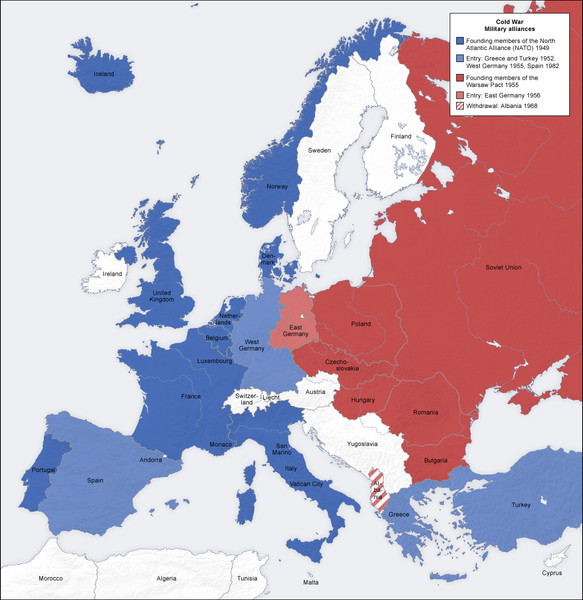
Cold War military alliances in Europe
The Iron Curtain was the line dividing Europe into two spheres.
- West = liberal democracy, capitalist economies, formally sovereign states, heavy American influence
- East = communist one-party states, central planning, Soviet domination, limited sovereignty
A common test point is that these blocs were not symmetrical. Both had alliances and economic systems, but Western countries kept their own governments and could disagree with the U.S. Eastern European states were far less independent.
Also keep containment straight. It meant stopping the spread of communism, not automatically trying to overthrow communist governments where they already existed.
American Influence in Western Europe
The U.S. wanted a stable, prosperous Western Europe that would resist communism. It shaped the West through aid, military alliances, and the capitalist world economy, but it did not directly rule Western European states.
Marshall Plan
The Marshall Plan poured American aid into Western Europe after the war.
- It helped rebuild factories, transportation, and trade.
- It tied recovery to capitalist cooperation.
- Stalin blocked Eastern European participation, which deepened the split between East and West.
NATO
Founded in 1949, NATO linked the U.S. permanently to European defense.
- Article 5 said an attack on one member counted as an attack on all.
- This gave Western Europe an American security guarantee.
- West Germany joined in 1955, which alarmed the USSR and helped trigger the Warsaw Pact.
The Western monetary and trade system
These institutions supported capitalist recovery:
| Institution | What it did |
|---|---|
| IMF | Promoted exchange-rate stability and gave short-term loans |
| World Bank | Funded reconstruction, then development loans |
| GATT | Reduced tariffs and encouraged freer trade |
| WTO | Created in 1995 to formalize trade rules and settle disputes |
The result was a rebuilt Western Europe inside a growing consumer-oriented capitalist economy under strong U.S. leadership.
Soviet Control of Eastern Europe
The USSR wanted a buffer zone for security and also wanted communism to spread. Backed by the Red Army, communist parties took over coalition governments and eliminated rivals by the late 1940s.
Satellite states included:
- East Germany
- Poland
- Czechoslovakia
- Hungary
- Romania
- Bulgaria
Two exceptions matter because they show Soviet control was powerful but not automatic:
- Yugoslavia under Tito broke with Stalin in 1948
- Albania later distanced itself from Moscow
Political life in the East meant one-party rule, censorship, secret police, restricted religion and speech, and limits on emigration. The clearest symbol was the Berlin Wall, built in 1961 to stop East Germans from escaping through Berlin.
The Warsaw Pact
Founded in 1955, the Warsaw Pact was the Soviet bloc’s military alliance. It mattered for defense, but also for discipline. Unlike NATO, it could be used to keep member states obedient.
How the Soviet Bloc Economy Worked
Eastern Europe used central planning instead of market capitalism. The state owned major industry, banks, transportation, and trade. Governments set targets, prices, wages, and investment through multiyear plans.
Strengths
- Rapid reconstruction after the war
- Heavy industry, energy, machinery, and arms production grew fast
- Low unemployment and broad welfare benefits like health care, education, pensions, subsidized housing, and transport
Weaknesses
- Consumer goods got low priority
- Shortages, waiting lists, and poor quality goods were common
- Bureaucracy, weak incentives, old technology, and slow innovation caused stagnation
COMECON
Founded in 1949, COMECON coordinated the Eastern bloc economy.
- It pushed specialized production among member states.
- It tied Eastern Europe to Soviet raw materials, energy, and protected markets.
The long-term result was clear. The East industrialized and expanded welfare, but over time it fell behind the more flexible and dynamic West.
Reform, Revolt, and the Limits of Soviet Power
After Stalin died in 1953, Khrushchev tried de-Stalinization. His 1956 Secret Speech attacked Stalin’s cult of personality and purges. That raised hopes for change, but it did not bring real political freedom or solve economic problems.
Hungarian Revolt of 1956
- Hungarians protested repression and Soviet control.
- Imre Nagy pushed liberalization, neutrality, and withdrawal from the Warsaw Pact.
- The USSR invaded, crushed the revolt, executed Nagy, and about 200,000 people fled.
Prague Spring of 1968
- Alexander Dubček promoted “socialism with a human face.”
- Reforms included less censorship and some decentralization.
- Warsaw Pact forces invaded and ended the reform movement.
- The Brezhnev Doctrine said the USSR could intervene if socialism or Soviet bloc interests were threatened.
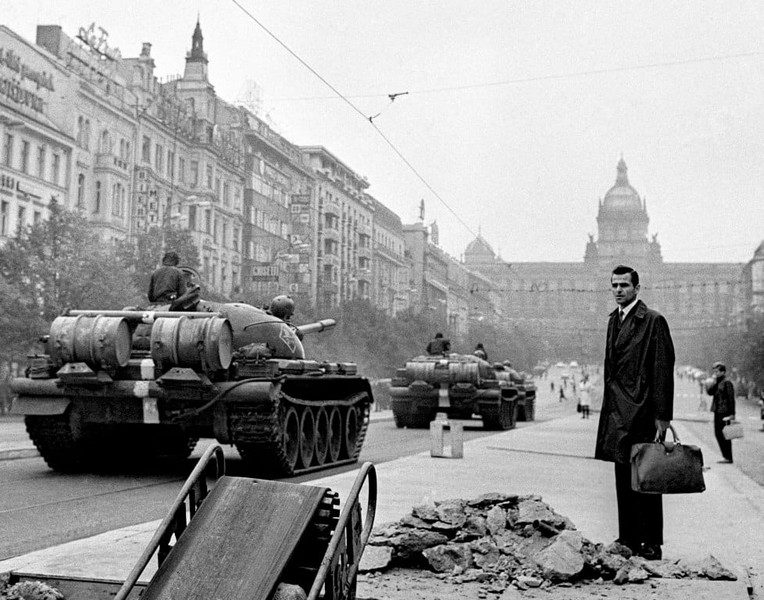
Soviet-led invasion of Prague, 1968
Images like this capture the basic pattern in the Eastern bloc. Reform movements could go only as far as Moscow allowed. Over time, Soviet rule swung between limited reform and repression. Nationalism stayed strong, and by 1989 it helped fuel mostly peaceful revolutions across Eastern Europe, though Romania turned violent. Soviet control lasted only as long as Moscow could combine economic coordination, military force, and repression.
Key Takeaways
Superpower
A state with exceptional military power, continental-scale resources, ideological influence, and the ability to organize international alliances; after World War II, the United States and Soviet Union
Postwar Bipolar Order
The division of postwar Europe into an American-influenced capitalist West and a Soviet-dominated communist East
North Atlantic Treaty Organization (NATO)
Collective-defense alliance founded in 1949 that gave Western Europe a permanent American security guarantee and treated an attack on one member as an attack on all
International Monetary Fund (IMF)
Institution created through the 1944 Bretton Woods agreements to promote monetary cooperation, exchange-rate stability, and short-term balance-of-payments lending
World Bank (International Bank for Reconstruction and Development)
International institution that initially made long-term loans for postwar reconstruction and later increasingly financed economic development
General Agreement on Tariffs and Trade (GATT)
The 1947 framework for reducing tariffs and trade barriers through multilateral negotiation and expanding commerce among capitalist economies
World Trade Organization (WTO)
Organization established in 1995 to succeed GATT, oversee international trade rules, and resolve trade disputes
Satellite State
A formally independent country that followed Soviet direction in foreign policy, military affairs, and major domestic decisions
Josip Broz Tito
Communist leader of Yugoslavia who broke with Stalin in 1948 and pursued an independent communist course outside the Soviet bloc
Soviet-Bloc Economic Model (Centrally Planned Economy)
A system of state ownership and compulsory planning that set production, prices, labor, and investment while emphasizing heavy industry, welfare guarantees, and restricted consumer choice
Council for Mutual Economic Assistance (COMECON)
Soviet-led organization founded in 1949 to coordinate communist-bloc economies through specialized production, protected trade, and dependence on Soviet resources and markets
Berlin Wall
Barrier erected by East Germany in 1961 to stop East Germans from emigrating through West Berlin into West Germany
Warsaw Pact
Soviet-dominated military alliance founded in 1955 that integrated Eastern European forces and enforced Soviet control over member states
Nikita Khrushchev
Soviet leader who initiated de-Stalinization and limited economic reforms but used force to preserve communist rule and Soviet control of Eastern Europe
De-Stalinization
Khrushchev’s effort to repudiate Stalin’s cult, terror, and abuses while preserving communist one-party rule and Soviet control of Eastern Europe
Secret Speech
Khrushchev’s 1956 speech to the Twentieth Party Congress denouncing Stalin’s cult of personality, purges, and abuses of power
Hungarian Revolt of 1956
Hungarian uprising for political freedom, Soviet withdrawal, and neutrality that was crushed after Imre Nagy announced withdrawal from the Warsaw Pact
Prague Spring
Czechoslovakia’s 1968 attempt under Alexander Dubček to liberalize communism, ended by a Warsaw Pact invasion and renewed repression
Socialism with a Human Face
Dubček’s Prague Spring program combining socialist ownership and communist leadership with less censorship, greater participation, and limited economic decentralization
Normalization
The post–Prague Spring restoration of censorship, Communist Party discipline, and political conformity under Gustáv Husák
Brezhnev Doctrine
The claim that socialist states had limited sovereignty and that the Soviet Union could intervene when reforms threatened socialism or the communist bloc
Iron Curtain
The political and ideological boundary dividing the American-influenced capitalist West from the Soviet-dominated communist East in postwar Europe
Notes
Superpower
A state with exceptional military power, continental-scale resources, ideological influence, and the ability to organize international alliances; after World War II, the United States and Soviet Union
Postwar Bipolar Order
The division of postwar Europe into an American-influenced capitalist West and a Soviet-dominated communist East
North Atlantic Treaty Organization (NATO)
Collective-defense alliance founded in 1949 that gave Western Europe a permanent American security guarantee and treated an attack on one member as an attack on all
International Monetary Fund (IMF)
Institution created through the 1944 Bretton Woods agreements to promote monetary cooperation, exchange-rate stability, and short-term balance-of-payments lending
World Bank (International Bank for Reconstruction and Development)
International institution that initially made long-term loans for postwar reconstruction and later increasingly financed economic development
General Agreement on Tariffs and Trade (GATT)
The 1947 framework for reducing tariffs and trade barriers through multilateral negotiation and expanding commerce among capitalist economies
World Trade Organization (WTO)
Organization established in 1995 to succeed GATT, oversee international trade rules, and resolve trade disputes
Satellite State
A formally independent country that followed Soviet direction in foreign policy, military affairs, and major domestic decisions
Josip Broz Tito
Communist leader of Yugoslavia who broke with Stalin in 1948 and pursued an independent communist course outside the Soviet bloc
Soviet-Bloc Economic Model (Centrally Planned Economy)
A system of state ownership and compulsory planning that set production, prices, labor, and investment while emphasizing heavy industry, welfare guarantees, and restricted consumer choice
Council for Mutual Economic Assistance (COMECON)
Soviet-led organization founded in 1949 to coordinate communist-bloc economies through specialized production, protected trade, and dependence on Soviet resources and markets
Berlin Wall
Barrier erected by East Germany in 1961 to stop East Germans from emigrating through West Berlin into West Germany
Warsaw Pact
Soviet-dominated military alliance founded in 1955 that integrated Eastern European forces and enforced Soviet control over member states
Nikita Khrushchev
Soviet leader who initiated de-Stalinization and limited economic reforms but used force to preserve communist rule and Soviet control of Eastern Europe
De-Stalinization
Khrushchev’s effort to repudiate Stalin’s cult, terror, and abuses while preserving communist one-party rule and Soviet control of Eastern Europe
Secret Speech
Khrushchev’s 1956 speech to the Twentieth Party Congress denouncing Stalin’s cult of personality, purges, and abuses of power
Hungarian Revolt of 1956
Hungarian uprising for political freedom, Soviet withdrawal, and neutrality that was crushed after Imre Nagy announced withdrawal from the Warsaw Pact
Prague Spring
Czechoslovakia’s 1968 attempt under Alexander Dubček to liberalize communism, ended by a Warsaw Pact invasion and renewed repression
Socialism with a Human Face
Dubček’s Prague Spring program combining socialist ownership and communist leadership with less censorship, greater participation, and limited economic decentralization
Normalization
The post–Prague Spring restoration of censorship, Communist Party discipline, and political conformity under Gustáv Husák
Brezhnev Doctrine
The claim that socialist states had limited sovereignty and that the Soviet Union could intervene when reforms threatened socialism or the communist bloc
Iron Curtain
The political and ideological boundary dividing the American-influenced capitalist West from the Soviet-dominated communist East in postwar Europe
