Topic 1.1 Notes – Introducing Calculus: Can Change Occur at an Instant?
1. Average Rate of Change and the Secant Line
For a function , the average rate of change on an interval is
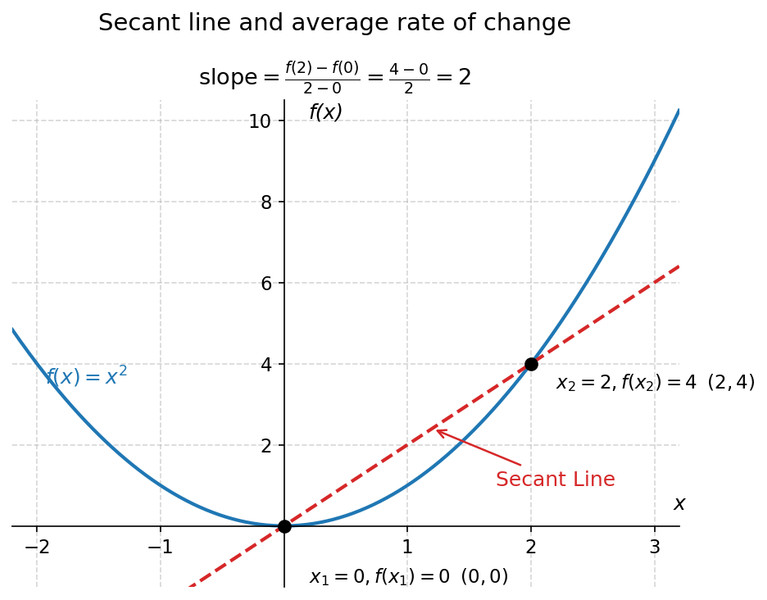
This is just the slope formula. Geometrically, it’s the slope of the secant line connecting the two points and .
In the example below, the function is . The secant line connects and , so the slope is .
What this means
- It measures how fast changes on average as moves from to .
- Units matter. If is distance (meters) and is time (seconds), the units are meters per second.
- If , then . Division by zero is undefined. So average rate of change cannot measure change at a single point.
With linear functions, the slope is constant, so average rate over any interval is the same. For nonlinear functions, the rate changes depending on where you look. That’s the problem calculus solves.
2. Instantaneous Rate of Change and the Tangent Line
Now imagine shrinking the interval. Let one point stay at , and let the other move closer and closer.
The instantaneous rate of change at is the slope of the tangent line at that point.
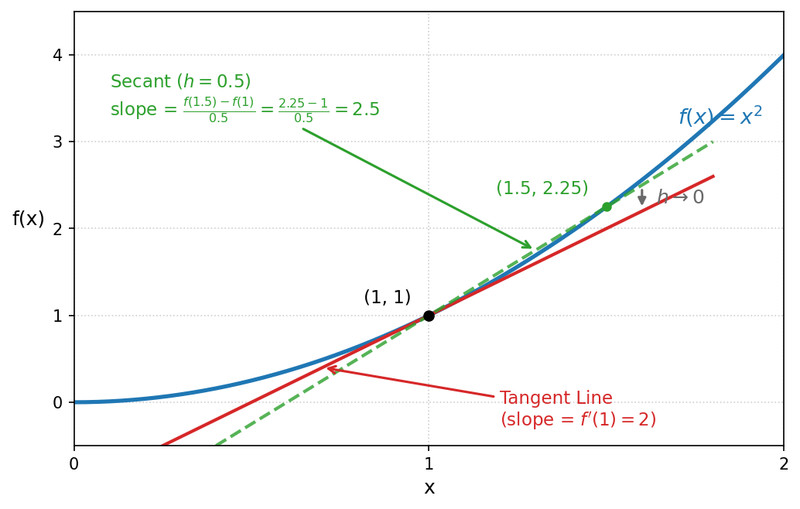
Secant line approaching the tangent line for at
In the graph above, the dashed secant line is drawn through two points on . As that second point moves closer to , the secant line rotates and begins to line up with the red tangent line.
As the second point approaches :
- Secant slopes begin to stabilize.
- They approach one specific value.
- That limiting value is the instantaneous rate of change.
In motion language:
- Average rate of change → average velocity
- Instantaneous rate of change → velocity at that exact moment
This slope of the tangent line is what we will soon call the derivative.
3. The Limit Idea That Makes This Possible
The bridge between average and instantaneous change is the limit.
Two common limit forms you’ll see:
and for rate of change,
Here’s what’s happening:
- represents a small change in .
- We never actually plug in .
- We examine what the fraction approaches as gets closer and closer to 0.
Why this matters:
- Average rate divides by .
- At a single point, , which is undefined.
- The limit of average rates of change as the interval shrinks defines instantaneous rate of change.
That idea powers all of calculus.
4. Recognizing These on a Test
When you see “average rate of change”
- You’re given two x-values.
- Plug into .
- Interpret with units in context.
When you see “rate of change at ” or “at an instant”
- Think tangent line.
- Think limit of secant slopes.
- If it’s written as , that’s the derivative definition.
On graphs
The picture below shows the secant line idea in two common forms you’ll see on tests.

Secant slope forms that lead to the derivative definition
- Positive slope → increasing.
- Negative slope → decreasing.
- Zero slope → horizontal tangent.
AP questions love asking you to interpret the meaning of a slope in context, not just compute it.
5. Common Mistakes and Traps
| Average Rate of Change | Instantaneous Rate of Change |
|---|---|
| Uses two points | Uses one point |
| Secant line | Tangent line |
| Direct slope formula | Limit of slope formula |
| Defined only if | Defined using a limit as interval shrinks |
Other traps:
- Plugging in immediately in a limit expression.
- Forgetting units when interpreting.
- Thinking a secant slope must equal the tangent slope. It only approaches it as the interval shrinks.
