Topic 1.6 Notes – Determining Limits Using Algebraic Manipulation
What Algebraic Manipulation Does to a Limit
Start every limit the same way. Plug the value in.
- If you get a real number, that number is the limit.
- If you get , that’s an indeterminate form. The limit might exist, but you need to rewrite the expression.
- If you get something like nonzero over 0, that usually signals a vertical asymptote (infinite limit or DNE).
The key idea behind everything in this section:
If two expressions are equal everywhere near (even if one is undefined at ), they have the same limit as .
So we manipulate the algebra to create an equivalent expression that’s easier to evaluate.
Factoring and Canceling Common Factors
This is the most common situation. Usually you’ll see a rational function where substitution gives .
Example structure:
Plug in 4 → . So factor:
Now:
Cancel the common factor (for ):
Now evaluate the limit:
So the limit is 8.
What’s happening graphically?
When you cancel the factor, the function behaves like the line everywhere except at .
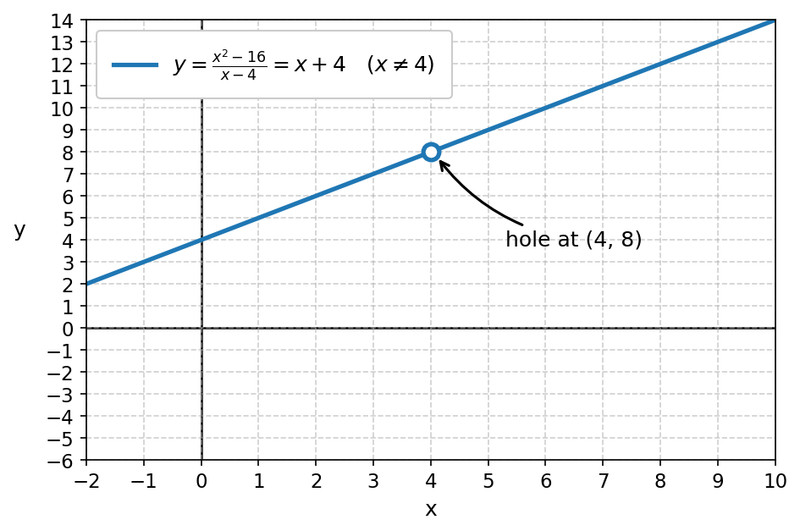
That open circle at is a hole. The function isn’t defined at 4, but it approaches 8 from both sides. That’s why the limit exists.
Common factoring patterns
- Difference of squares:
- Quadratics
- Factoring out a GCF
- Polynomial division if degree of numerator ≥ denominator
Students often try canceling terms instead of factors. You can cancel , but not just the 4’s inside separate terms.
Rationalizing with Conjugates
If radicals cause the , factoring won’t help. That’s when you use a conjugate.
The conjugate of is .
Example:
Plug in 9 → .
Multiply by the conjugate:
Use difference of squares:
So the expression becomes:
Cancel :
Now substitute:
Done.
This method shows up constantly on no-calculator sections. The biggest mistake is forgetting to multiply the entire fraction by the conjugate.
Trig Limits and Equivalent Forms
Certain trig limits are foundational:
Also, sine and cosine are continuous:
Using the sine limit with constants
Example:
Rewrite:
Now apply the rule → result is 5.
If you forget to adjust for that constant, you’ll lose points fast on MCQs.
Ratios like
Rewrite each to match the sine-over-angle pattern:
Each sine-over-angle → 1, so limit is .
The Squeeze Theorem
This is used when algebra alone doesn’t simplify things, often with oscillating functions.
If:
and both outer functions approach the same limit , then also approaches .
Classic example:
Since
Multiply everything by :
As , both outer expressions go to 0, so the middle must also go to 0.

Graph of bounded by and
The graph shows the function oscillating between the lines and , with the oscillations shrinking toward 0 as .
On FRQs, you often need to state the inequality explicitly to earn full credit.
