Topic 1.15 Notes – Connecting Limits at Infinity and Horizontal Asymptotes
Limits at Infinity and End Behavior
A limit at infinity asks:
This describes the function’s end behavior - what the graph does far right or far left.
Three possibilities:
- The limit is a finite number → the function levels off toward .
- The limit is → the function grows without bound.
- The function never settles (keeps oscillating) → the limit does not exist (DNE).
Important: this is not about behavior near a vertical asymptote or a specific x-value. It’s about long-term trends.
Horizontal Asymptotes
If
then the line
is a horizontal asymptote (HA) on the right side.
Same idea for .
Here’s what that looks like visually. In this example, the function approaches as , so is the horizontal asymptote.
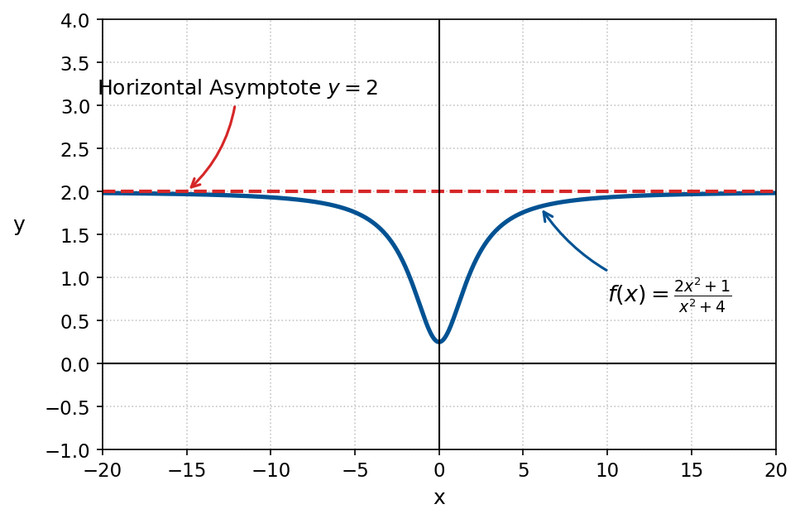
Horizontal asymptote
Key ideas students mix up:
- A function can cross a horizontal asymptote.
- You can have two different horizontal asymptotes (different left and right limits).
- Some functions have no horizontal asymptote.
On FRQs, if you’re asked to interpret , you should state that the function approaches 3 as x increases without bound. That language matters.
Rational Functions and Degree Rules
For
where and are polynomials, end behavior depends on degrees.
Case 1: Degree of < Degree of
The denominator grows faster, so the fraction shrinks toward 0.
Horizontal asymptote: .
Case 2: Degrees Are Equal
Only the highest-power terms matter far out.
Example:
Behaves like
So HA is .
Case 3: Degree of > Degree of
The function grows without bound.
No horizontal asymptote. (There could be a slant asymptote later in the course.)
On multiple choice, they often hide this inside an form. Compare degrees immediately. Don’t plug in giant numbers.
Comparing Growth Rates
When functions aren’t just polynomials, think about relative growth.
From slowest to fastest:
Logs < roots < polynomials < exponentials.
The graph below shows all four on the same axes so you can see how they separate as increases.
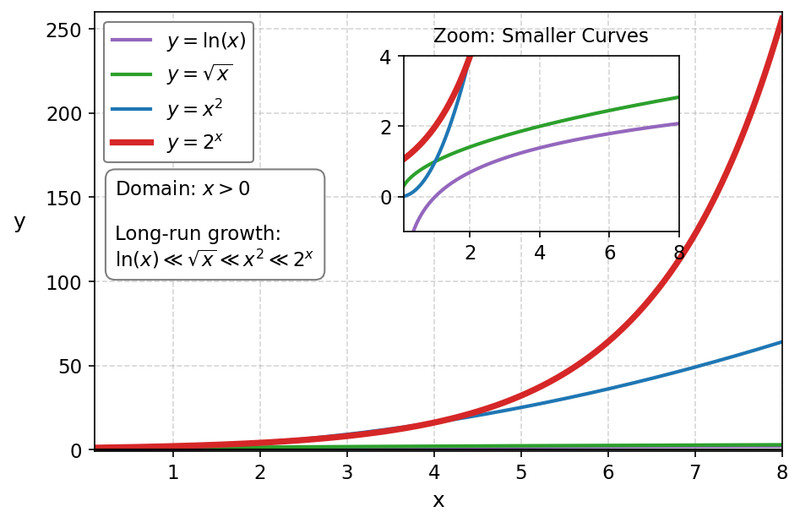
Relative growth of , , , and
Notice how eventually shoots upward, the polynomial rises steadily, the square root increases slowly, and the logarithm barely climbs. As , those gaps only get bigger.
How this helps:
- (exponential in denominator wins)
- (exponential in numerator wins)
The faster-growing function dominates the limit.
This shows up a lot in calculator-active MCQs where you’re comparing expressions quickly.
Oscillation and the Squeeze Idea
Not every function settles.
does not exist because it keeps bouncing between -1 and 1.
But if an oscillating function is divided by something growing:
The numerator stays between -1 and 1, while the denominator grows. The whole fraction gets squeezed to 0.
That “bounded over unbounded” pattern is common.
