Topic 6.13 Notes – Evaluating Improper Integrals
What an Improper Integral Is
A definite integral is improper if you cannot evaluate it directly with the Fundamental Theorem of Calculus because:
- One or both bounds are infinite
- The integrand is unbounded on the interval
(There’s a vertical asymptote at an endpoint or inside.)
Example:
The function blows up at , so this is improper.
Here’s the visual idea. The graph of has a vertical asymptote at . The curve shoots upward near that value, but we can still ask whether the shaded area from 0 to 2 settles to a finite number.
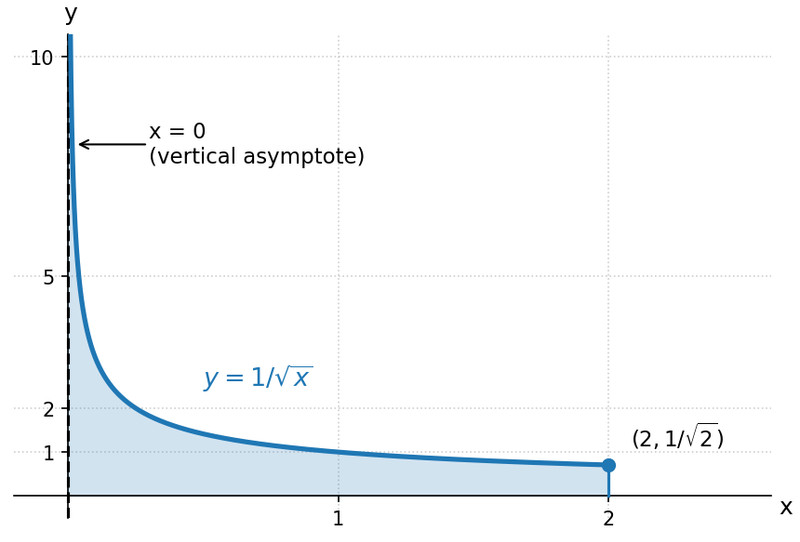
Improper integral with a vertical asymptote at
The big question every time is: Does the area settle to a finite number?
Rewriting as a Limit
Limits are what make this possible. You replace the “infinite” or undefined part with a variable and take a limit.
Infinite Upper Bound
Infinite Lower Bound
Both Bounds Infinite
Split it at any convenient number :
Each part must converge. If either diverges, the whole thing diverges.
Vertical Asymptote at an Endpoint
If the issue is at :
Vertical Asymptote Inside the Interval
If there’s an asymptote at in :
Each piece gets its own limit.
Students often forget to split at interior asymptotes. On an FRQ, that costs points immediately.
Evaluating Step by Step
Once it’s written as a limit, everything else is normal calculus.
- Rewrite as a limit.
- Find the antiderivative.
- Apply the Fundamental Theorem of Calculus.
- Take the limit.
- State clearly: converges to ___ or diverges.
Quick example:
Antiderivative:
Evaluate:
As , , so the result is .
This integral converges.
p-Integrals You Must Know
These show up constantly and are the comparison model for many problems.
Case 1
- Converges if
- Diverges if
Case 2
- Converges if
- Diverges if
Notice how the rule flips depending on where the issue is. That detail is tested.
Behavior at Infinity
A fast-decaying function tends to converge.
- shrinks very quickly → often converges.
- shrinks slowly → diverges.
- Higher powers like shrink faster → converge.
You’re judging how fast the function approaches zero as .
How It Appears on Tests
- “Evaluate or show that the integral diverges.”
- Partial fractions first, then apply limits.
- Substitution before evaluating the limit.
- Splitting at asymptotes.
On free-response, you must actually show the limit notation. Writing an antiderivative and plugging in infinity without the limit loses credit.
