Topic 2.8 Notes – The Product Rule
The Product Rule
If and are differentiable, then
Memory phrase you’ll hear in class:
“First d second + second d first.”
That phrase is worth memorizing exactly. It keeps you from dropping a term.
Very important:
If you multiply the derivatives, you are missing half the answer.
Why You Need It
You already know:
- Power rule
- Derivatives of
- Derivatives of
Those rules work when a function stands alone.
But when you see something like
both pieces change as changes. Expanding isn’t possible. That’s when the Product Rule is required.
Think of it this way: when two changing quantities multiply, both changes affect the result.
When to Use the Product Rule
Use it when:
- Two non-constant expressions are multiplied
Do NOT use it when:
- One factor is just a constant
- → constant multiple rule
- The expression is already a single polynomial
- → just use power rule
If it’s polynomial × polynomial, you can either:
- Expand first
- Or use Product Rule
Both are valid. On a no-calculator MCQ, expanding is sometimes faster.
How It Actually Works
Let’s walk through one clean example.
Find the derivative of
Step 1: Identify the factors
Step 2: Differentiate each
Step 3: Apply the formula
That is already a complete, correct answer.
You could factor:
But unless the problem says “simplify,” the unsimplified form earns full credit on FRQs.
What the Structure Looks Like
Every correct product rule derivative has two terms, and each term contains one original factor.
Here’s the standard structure you should recognize instantly:
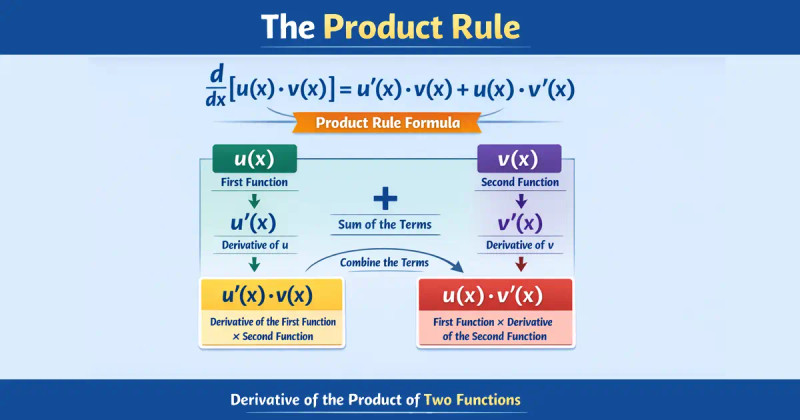
Product Rule structure: differentiate one factor at a time
Notice in the formula above:
- The first term keeps and differentiates
- The second term keeps and differentiates
If one original function completely disappears, something went wrong.
Common Product Types on Tests
Polynomial × Trig
Example structure:
- Differentiate trig carefully:
Sign mistakes here are very common on quizzes.
Polynomial × Exponential
Example:
Remember:
Students sometimes forget that stays the same.
Exponential × Trig
Example:
You’ll often factor afterward:
These show up in differential equation contexts later in BC.
Mistakes That Cost Easy Points
- Writing only one term
- Multiplying derivatives together
- Forgetting parentheses when differentiating a binomial
- Dropping a negative from
On FRQs, missing the second term usually loses most of the derivative points immediately.
How It Gets Tested
You’ll see it:
- On no-calculator multiple choice mixed with trig and exponentials
- Embedded inside larger FRQs (motion, accumulation, implicit differentiation)
- Combined with the chain rule, like
When rules combine, apply Product Rule first, then Chain Rule inside the pieces that need it.
