Topic 8.10 Notes – Volume with Disc Method: Revolving Around Other Axes
Disc method around any horizontal or vertical line
When you rotate a region around a line, you create a solid made of stacked circular discs.
Each slice has:
- Thickness: or
- Area of cross-section:
- Volume of one slice:
So total volume is:
Everything comes down to correctly writing the radius.
The radius is always the distance from the curve to the axis of rotation.
Rotating around a horizontal line
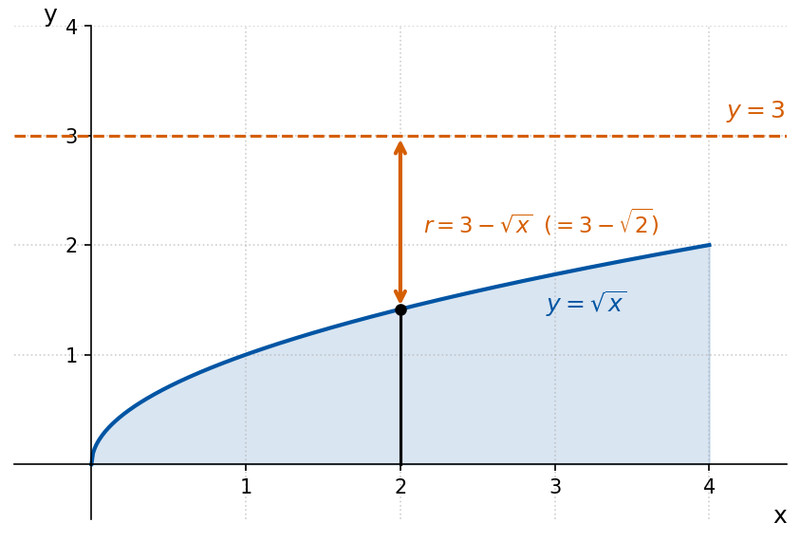
Picture a region under a curve being rotated around a horizontal line above it.
Region under rotated about
In the graph above, the radius is the vertical distance from the curve up to the line , so .
Because the axis is horizontal:
- Slices are vertical
- Integrate with respect to x
- Radius is a vertical distance
If the curve is and you rotate around ,
So the volume formula becomes:
Examples of horizontal axes:
- (the x-axis)
If rotating around , the radius becomes
Students lose points here by forgetting to subtract the axis value.
Rotating around a vertical line
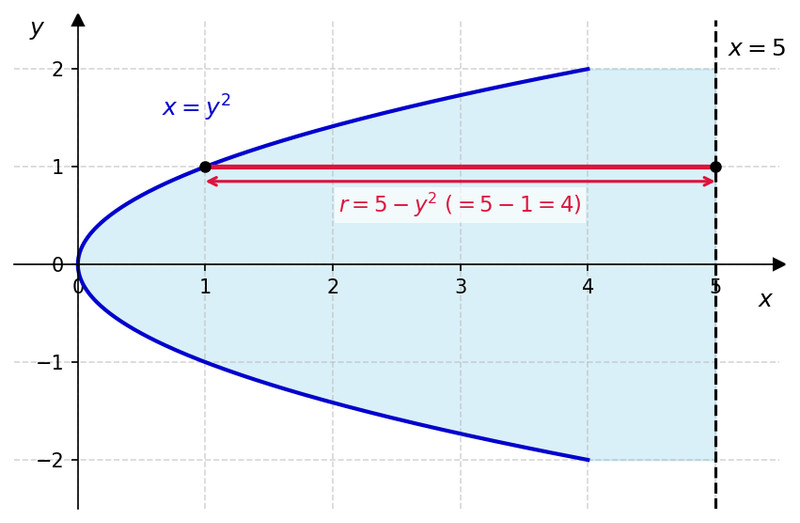
Now imagine rotating a region around a vertical line to the right.
Rotation about the vertical line
In the picture, the region defined by is rotated about . Notice the horizontal slice at . Its radius is the horizontal distance from the curve to the axis, which is .
Because the axis is vertical:
- Slices are horizontal
- Integrate with respect to y
- Radius is a horizontal distance
If the curve is written and rotated around ,
Volume becomes:
Examples:
- (the y-axis)
Quick check that saves people on tests:
Horizontal axis → integrate in x.
Vertical axis → integrate in y.
If that doesn’t match your setup, something’s off.
Finding the limits of integration
Limits come from:
- The given interval
- Intersection points
- Where the region hits another boundary
If two curves bound the region, set them equal to find intersection values.
On FRQs, you won’t earn full credit if your limits don’t match the actual region being rotated.
Mini Example
Find the volume when the region under from to is rotated about .
Axis is horizontal → integrate in .
Radius:
Volume:
Notice the entire difference is squared.
Not . That mistake shows up constantly.
When disc method is appropriate
Use discs when:
- The region touches the axis of rotation
- There is no gap between region and axis
- Cross-sections are solid circles
If there’s empty space between the region and axis, that’s the washer method (next topic).
Common errors that cost points
- Squaring only part of the radius instead of the whole difference
- Integrating in when rotating around a vertical line
- Forgetting to shift the radius when the axis isn’t zero
- Using the function value itself as the radius when the axis is elsewhere
On multiple choice, wrong radius setups are the most common trap.
