Topic 2.7 Notes – Derivatives of cos x, sin x, e^x, and ln x
The Four Core Derivatives You Must Know Cold
Here they are. No re-deriving. Just know them.
Two quick reminders:
- All trig derivatives assume radians.
- These apply directly unless something is nested inside (then you use chain rule).
A simple way to keep them straight:
- Sine turns into cosine.
- Cosine turns into negative sine.
- stays the same.
- becomes .
Only cosine creates a negative. That’s where most sign mistakes happen.
Using Them Inside Larger Expressions
You almost never see these alone. They’re buried inside sums, products, or compositions.
Linear combinations
If
Differentiate term by term:
- Constant
So
Nothing fancy here. Just don’t drop constants or signs.
Chain rule versions (very common)
When there’s something inside, multiply by the derivative of the inside.
General patterns:
Example:
- Outside derivative gives
- Inside derivative of is
So
Students often:
- Forget the inner derivative
- Write instead of for logs
- Miss the negative on cosine
Those are easy points to lose on a no-calculator section.
Seeing the Derivative Inside a Limit
This connects to the definition:
AP loves disguising derivatives as limits.
If you see something like:
That matches the definition with and .
So the answer is
You are not expected to use trig identities to prove this. Just recognize the structure.
Geometrically, this limit is the slope of the tangent line at . The diagram below shows secant lines approaching the tangent line as the second point moves toward .
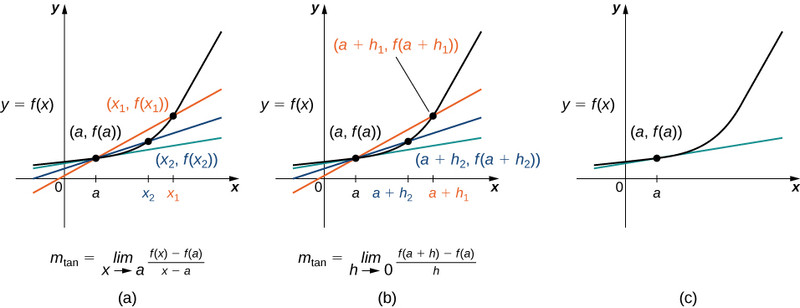
Secant lines approaching the tangent line at
In the middle panel, focus on the expression . As goes to 0, that secant slope becomes the tangent slope, which is .
Once you recognize the “ over ” pattern, replace the entire limit with the known derivative evaluated at that number.
This shows up often as a multiple choice question where the fastest students just spot the pattern instantly.
Domain and Behavior Details
A couple things that matter more than students expect:
- is only defined for .
So here also assumes . - is undefined at .
- is always positive, and so is its derivative.
- Sine and cosine derivatives cycle forever.
That cycling is easier to see if you think about sine and cosine on the unit circle.
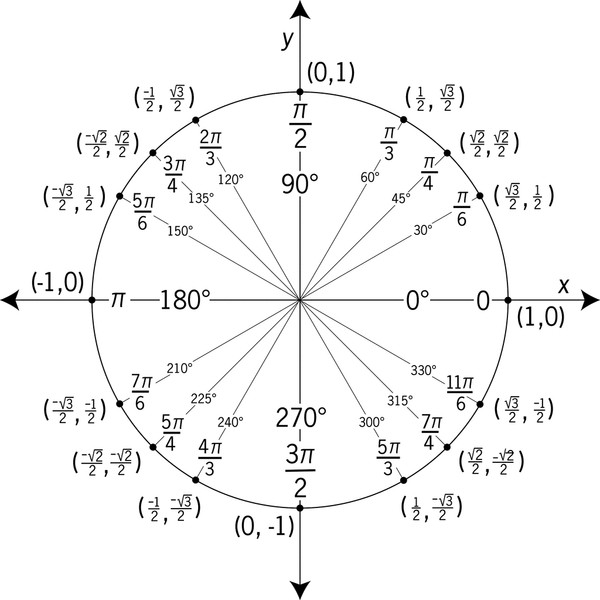
Unit circle with common angles in degrees and radians
As the angle increases around the circle, the y-coordinate (sine) and x-coordinate (cosine) repeat in a predictable pattern. That is why , , and the pattern keeps cycling.
