Topic 6.4 Notes – The Fundamental Theorem of Calculus and Accumulation Functions
The Fundamental Theorem of Calculus and Accumulation Functions
Take a continuous function . Now define a new function:
This is an accumulation function. For each value of , it gives the net signed area under from a fixed starting point to that .
A definite integral usually gives a number.
If one bound is a variable, it gives a function.
Here’s the key result:
That’s the Fundamental Theorem of Calculus (Part 1).
It says:
- Integration accumulates change.
- Differentiation measures instantaneous change.
- If is continuous, these undo each other.
So every accumulation function is automatically an antiderivative of .
What this looks like in action
Suppose
You could evaluate the integral and get .
Or you could use the theorem immediately:
The derivative of the accumulation function is just the integrand with replaced by .
Notice something important: the inside the integral is a dummy variable. It disappears after differentiation.
What an Accumulation Function Represents
Think of as a rate.
- If is velocity → is position change.
- If is a growth rate → is total growth.
- If is flow rate → is total volume accumulated.
Here’s the visual idea. The graph shows and the shaded region from a fixed starting point to a moving right endpoint .
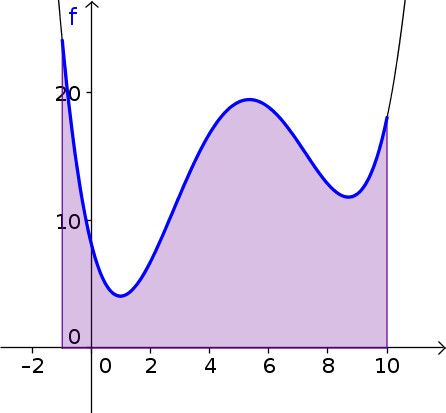
Accumulated area under from a fixed left endpoint to
As moves right, the shaded area grows. The rate at which it grows at that instant is . That’s exactly what the theorem says: .
Connecting behavior of and
Because :
- If , then is increasing.
- If , then is decreasing.
- Critical points of happen where .
- Since , concavity of depends on whether is increasing or decreasing.
This shows up a lot on FRQs. You’re often given a graph of and asked about where increases, has extrema, or changes concavity.
Representing Accumulation Functions with Integrals
You should be comfortable writing a function defined by accumulation.
Example:
Let be the rate (in liters per minute) at which water flows into a tank.
Then the total water added from time 2 to time is
That’s exactly what FUN-5 is about. A definite integral can define a new function.
And as long as is continuous,
On a multiple-choice question, they may give you a messy integrand. Don’t integrate it unless they ask you to. If the question is asking for the derivative, just apply the theorem.
What Has to Be True
The theorem requires:
- is continuous on an interval containing .
On the AP exam, they usually state continuity. If they don’t, assume it unless the problem clearly suggests otherwise.
Common Errors I See Every Year
- Writing the derivative as instead of replacing with .
- Trying to actually compute the integral before differentiating.
- Forgetting that the result is about rate of accumulation, not total area.
- Mixing up definite integrals that give numbers with accumulation functions that give functions.
