Topic 3.6 Notes – Calculating Higher-Order Derivatives
What Higher-Order Derivatives Are
If , then:
- First derivative is the rate of change of .
- Second derivative is the derivative of .
- Third derivative is the derivative of .
- And so on.
As long as each derivative exists, you can keep going.
Notation You Must Recognize
All of these mean the same thing for the second derivative:
For higher order:
On quizzes and the AP exam, they’ll switch notation without warning. You need to read them as identical.
What Higher-Order Derivatives Tell You
You’ve already used these ideas. This just organizes them.
First Derivative
- Slope of the tangent line
- Where the function is increasing or decreasing
- Critical points when or undefined
Second Derivative
- Concavity
- → concave up
- → concave down
- Helps identify points of inflection (where concavity changes)
Here’s the visual relationship between a function and its concavity. Notice how the curve switches from concave down to concave up at the marked inflection point.
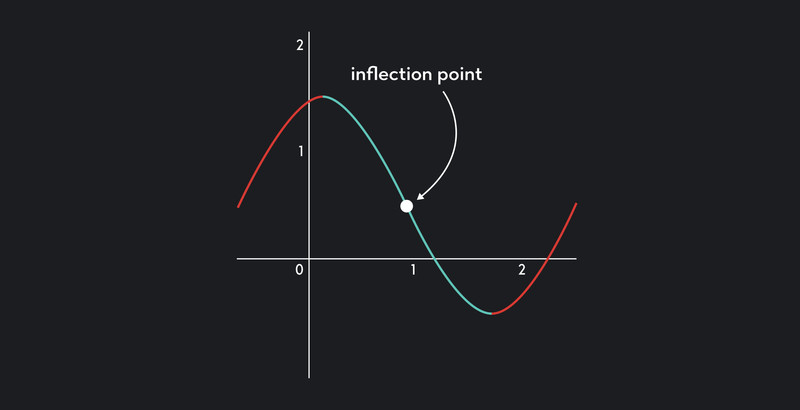
Concavity change at an inflection point
Motion Context (Very Common)
If is position:
- → velocity
- → acceleration
- → rate of change of acceleration
Units keep stacking. If position is meters:
- velocity is m/s
- acceleration is m/s
- third derivative is m/s
AP free-response questions love asking for interpretation like “What does mean?” That means acceleration is −2 units at , so velocity is decreasing at that instant.
How You Actually Calculate Them
There are no new derivative rules here.
You simply differentiate again.
Example 1 Polynomial
Let
First derivative:
Second derivative:
Third derivative:
Fourth derivative:
Notice what happened:
- Each derivative lowers the degree by 1.
- A degree polynomial becomes 0 after the th derivative.
That pattern is tested surprisingly often.
Using the Rules Repeatedly
Where students lose points is not the idea. It’s messy rule use.
Chain Rule Example
Let
First derivative:
Second derivative:
You must apply the chain rule again. The inside derivative does not disappear.
Product Rule Example
Let
First derivative:
Second derivative requires product rule again:
Combine like terms:
Expressions grow quickly. Stay organized.
Trig Functions Cycle
Derivatives of sine and cosine repeat every 4 steps:
Many students picture this as a loop. After four derivatives, you are back where you started.
Recognizing this cycle makes third and fourth derivatives much faster.
Common Mistakes I See Every Year
- Forgetting to apply the chain rule again on the second derivative.
- Dropping negative signs with trig.
- Only differentiating part of an expression.
- Making algebra errors because you didn’t simplify first.
On no-calculator multiple choice, most wrong answers are sign mistakes or missing factors from the chain rule.
