Topic 7.4 Notes – Reasoning Using Slope Fields
What a Slope Field Shows
A slope field (direction field) is a visual representation of a differential equation
At many points , you draw a tiny line segment whose:
- Slope equals
- Location is the point
- Direction shows how a solution curve would move through that point
For example, here is the slope field for . Each small segment represents the value of at that point.
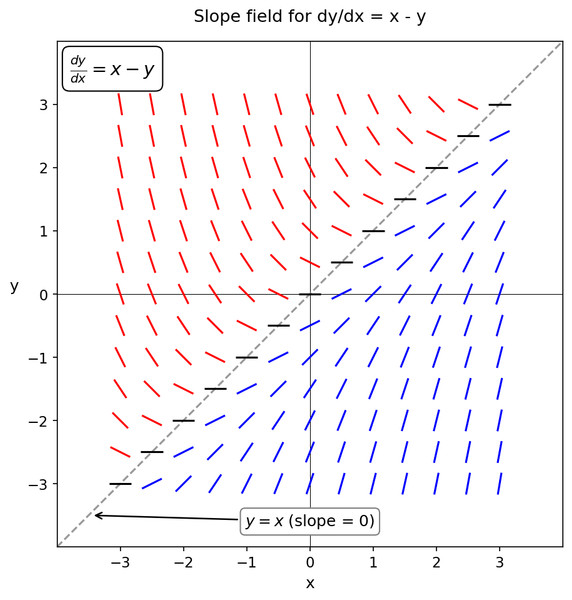
Slope field for
Notice that along the line , the segments are horizontal because the slope is 0 there. Above that line the segments tilt downward, and below it they tilt upward.
Important reminders when you read one:
- Horizontal segment → slope
- Slanting up → slope (solution increasing)
- Slanting down → slope (solution decreasing)
- Steeper segment → larger magnitude of slope
You are looking at the derivative, not the function itself. The slope field tells you how solutions behave without solving the equation.
Sketching and Estimating a Solution
A solution curve is a graph that is tangent to every little segment it touches.
If you’re given an initial condition like , here’s how you trace the solution:
- Plot the point .
- Look at the segment there and match its direction.
- Move a tiny bit in that direction.
- Keep adjusting so your curve stays tangent to nearby segments.
- Draw smoothly. No corners.
Think of it like flowing along the arrows.
Estimating a Value
Suppose you start at and want .
- If slopes near your path are mostly positive, your function rises.
- If slopes are getting steeper, the function rises faster.
- If slopes flatten out, growth slows down.
On quizzes or FRQs, they don’t expect perfection. They want a reasonable estimate that matches the field’s behavior.
A common mistake is drawing a curve that cuts across segments instead of following their direction. Your curve should always be tangent.
Critical Points and Equilibrium Solutions
Because the slope field represents , it tells you where slopes are zero.
Horizontal Segments
If you see horizontal segments along a line like , that means the slope is zero at those points.
For autonomous equations (where depends only on , not ), horizontal segments spanning an entire horizontal line indicate an equilibrium solution - a constant function that stays there forever once it starts there.
For non-autonomous equations (where the slope depends on both and ), scattered horizontal segments do not form equilibrium solutions. The AP frequently asks you to identify equilibrium solutions from a slope field - check whether horizontal segments span all -values at that -level.
Undefined Slopes
If segments were vertical, that would indicate an undefined slope. That suggests a vertical tangent. This is rare in AP-style slope fields, but it’s part of the definition of critical behavior.
Families of Solutions
When you actually solve a differential equation, you integrate and get:
That is not optional. It represents a family of functions.
Why?
Because the derivative of a constant is 0. When you integrate, you lose the original constant. So there are infinitely many solutions.
For example, if a differential equation leads to the general solution , changing shifts the graph up or down.
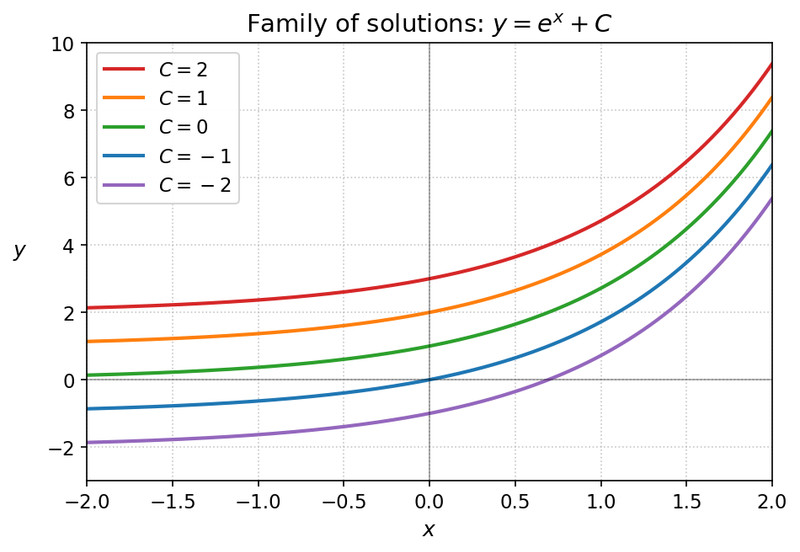
Family of solutions for
Each curve:
- Has the same overall shape
- Differs by a vertical shift
- Never intersects another solution curve (for well-behaved equations)
If you’re given an initial condition, you plug it in to solve for . That gives a particular solution.
Without an initial condition, you only have the general solution, meaning the entire family.
On AP free-response, they often ask you to explain why solutions form a family. The correct reasoning is that integrating introduces an arbitrary constant.
