Topic 7.5 Notes – Approximating Solutions Using Euler’s Method
Euler’s Method
Suppose you’re given
That initial condition gives you a starting point on the solution curve. The differential equation tells you the slope at any point .
Euler’s idea is simple:
- Start at .
- Use the slope there to move a small step forward in .
- Estimate the new -value using the tangent line.
- Repeat.
You’re replacing a curved solution with lots of tiny straight line segments.
The update formula
Everything comes from this one rule:
Where:
- is the step size
- is your current point
- is the slope at that point
You’re adding “slope × run” to the current .
Running the Algorithm
When you see an Euler question on a quiz or FRQ, it usually becomes a table.
Given:
- A differential equation
- An initial condition
- A step size
- A target -value
You repeatedly:
- Compute the slope .
- Multiply by .
- Add to the current .
- Increase by .
Quick example
Suppose
Step 1: Start
- ,
- Slope:
Step 2
- Slope:
So .
Notice how every step uses the new point. That’s a very common place to lose points.
Why It Works
At each step, you’re pretending the function behaves like its tangent line over a small interval.
Here’s the geometric picture:
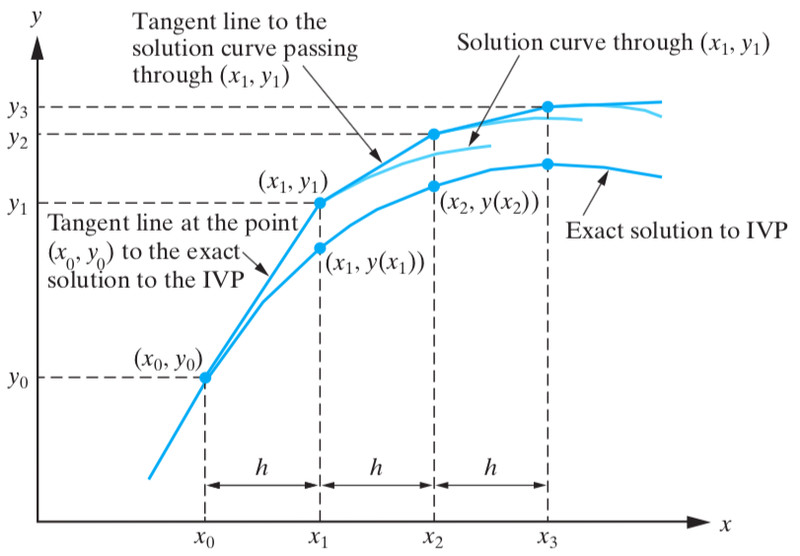
Euler’s method as repeated tangent-line approximations
Each short line segment shows you following the tangent line from one point to the next by a horizontal distance . At the new point, you recompute the slope and repeat.
This connects directly to:
- Derivatives as slopes (Unit 2)
- Linearization
Euler’s method is repeated linearization.
Step Size and Accuracy
The step size controls everything.
- Smaller → more steps → better approximation
- Larger → fewer steps → more accumulated error
Error builds at every step because you’re never on the true curve, only on a tangent line.
Overestimate or underestimate?
If the solution curve is:
- Increasing and concave up → Euler typically underestimates
- Increasing and concave down → Euler typically overestimates
That’s because the tangent line sits below or above the curve depending on concavity.
On tests, you may be asked to justify this using concavity or a second derivative argument. Be explicit about why the tangent line lies above or below.
Things That Trip People Up
- Plugging the wrong values into . Always use the current .
- Rounding too early. Keep several decimals until the final answer.
- Taking the wrong number of steps. Number of steps .
- Forgetting to stop exactly at the requested .
On FRQs, organization matters. A clean table with labeled columns makes scoring easy for the reader.
