5m left·0%
Reading Time: 5 min
Last Updated: March 23, 2026
Main Ideas: 5
Reading Time: 5 min
Last Updated: March 23, 2026
Main Ideas: 5

Topic 9.7 Notes – Defining Polar Coordinates and Differentiating in Polar Form

Verified for 2027 AP® Calculus BC Exam
Read aloud
Polar coordinates describe points using a distance from the origin and an angle, instead of xx and yy. In this topic, you connect polar equations r=f(θ)r = f(\theta) to parametric equations so you can differentiate them. Once you do that, all your parametric derivative skills carry over.

1. What Polar Coordinates Are

A point in the plane can be written as (r,θ)(r, \theta):

  • rr = distance from the origin (the pole)
  • θ\theta = angle measured counterclockwise from the positive xx-axis

A polar equation looks like:

r=f(θ) r = f(\theta)

To use calculus, we convert to parametric form:

x=rcos⁡θ,y=rsin⁡θ x = r\cos\theta, \quad y = r\sin\theta

So if r=f(θ)r = f(\theta), then

x(θ)=f(θ)cos⁡θ,y(θ)=f(θ)sin⁡θ x(\theta) = f(\theta)\cos\theta, \quad y(\theta) = f(\theta)\sin\theta

That’s why this topic lives in Unit 9. A polar curve is just a parametric curve where the parameter is θ\theta.

Also remember the coordinate relationships:

r2=x2+y2 r^2 = x^2 + y^2

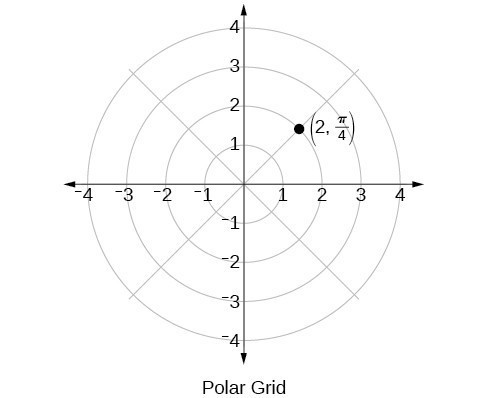
Here’s what that setup looks like geometrically. Focus on the point labeled (2,π/4)(2, \pi/4) and the right triangle it forms with the axes.
Study guide illustration

Polar grid with point (2,π/4)(2, \pi/4)

That right triangle is why x=rcos⁡θx = r\cos\theta and y=rsin⁡θy = r\sin\theta.

2. Derivatives with Respect to θ

Suppose r=f(θ)r = f(\theta).

drdθ \frac{dr}{d\theta}

Differentiate normally.

This tells you how fast the distance from the origin is changing.

  • Set drdθ=0 \frac{dr}{d\theta} = 0 to find possible closest or farthest points from the origin.
  • Always compare rr-values (and check endpoints if there’s an interval).

Example:
If r=3+2cos⁡θr = 3 + 2\cos\theta, then
drdθ=−2sin⁡θ \frac{dr}{d\theta} = -2\sin\theta Set equal to 0 → sin⁡θ=0\sin\theta = 0.

dxdθ \frac{dx}{d\theta} and dydθ \frac{dy}{d\theta}

Now use product rule.

Since
x=rcos⁡θx = r\cos\theta,
y=rsin⁡θy = r\sin\theta,

dxdθ=drdθcos⁡θ−rsin⁡θ \frac{dx}{d\theta} = \frac{dr}{d\theta}\cos\theta - r\sin\theta

dydθ=drdθsin⁡θ+rcos⁡θ \frac{dy}{d\theta} = \frac{dr}{d\theta}\sin\theta + r\cos\theta

These describe the tangent vector.

If both derivatives equal 0 at the same θ\theta, the curve may have a cusp or special behavior.

This is exactly what you’d do with parametrics using tt. Nothing new - just θ\theta.

3. Slope of the Tangent Line dydx \frac{dy}{dx}

Since the curve is parametric in θ\theta,

dydx=dy/dθdx/dθ \frac{dy}{dx} = \frac{dy/d\theta}{dx/d\theta}

Substitute the formulas above:

dydx=drdθsin⁡θ+rcos⁡θdrdθcos⁡θ−rsin⁡θ \frac{dy}{dx} = \frac{ \frac{dr}{d\theta}\sin\theta + r\cos\theta }{ \frac{dr}{d\theta}\cos\theta - r\sin\theta }

You don’t have to memorize this monster. Many students just:

  1. Find dr/dθdr/d\theta
  2. Find dx/dθdx/d\theta and dy/dθdy/d\theta
  3. Divide

That’s often safer on an FRQ.

Tangent Line Procedure

If asked for the equation of the tangent line at θ=θ0\theta = \theta_0:

  1. Compute r(θ0)r(\theta_0)
  2. Convert to Cartesian:
    • x=rcos⁡θx = r\cos\theta
    • y=rsin⁡θy = r\sin\theta
  3. Compute slope using dydx \frac{dy}{dx}
  4. Use point-slope form
    y−y0=m(x−x0) y - y_0 = m(x - x_0)

Students often forget step 2. The tangent line must be written in x and y, not in terms of θ\theta.

Horizontal and Vertical Tangents

Think parametric logic.

Type Condition
Horizontal dydθ=0 \frac{dy}{d\theta} = 0 and dxdθ≠0 \frac{dx}{d\theta} \neq 0
Vertical dxdθ=0 \frac{dx}{d\theta} = 0 and dydθ≠0 \frac{dy}{d\theta} \neq 0

If both are 0, you investigate further.

This shows up a lot in multiple choice where they want you to reason quickly without fully simplifying.

4. Second Derivative d2ydx2 \frac{d^2y}{dx^2}

Same idea as parametrics:

d2ydx2=ddθ(dydx)÷dxdθ \frac{d^2y}{dx^2} = \frac{d}{d\theta}\left(\frac{dy}{dx}\right) \div \frac{dx}{d\theta}

So you:

  1. Differentiate dydx \frac{dy}{dx} with respect to θ\theta
  2. Divide by dx/dθ dx/d\theta

Used for:

  • Concavity
  • Inflection behavior

Algebra gets messy fast. Keep work organized.

5. When These Derivatives Matter

  • Closest/farthest from origin → solve dr/dθ=0 dr/d\theta = 0
  • Slope of tangent line → compute dy/dx dy/dx
  • Horizontal/vertical tangents → check numerator/denominator separately
  • Concavity → use second derivative

On tests, they love mixing concepts. For example, finding where the curve is closest to the origin and also has a horizontal tangent. That forces you to understand what each derivative actually represents.

Key Takeaways

Treat r=f(θ)r = f(\theta) as parametric with x=rcos⁡θx = r\cos\theta, y=rsin⁡θy = r\sin\theta.
dr/dθ=0dr/d\theta = 0 finds possible closest or farthest points from the origin.
dydx=dy/dθdx/dθ \frac{dy}{dx} = \frac{dy/d\theta}{dx/d\theta} , just like parametric curves.
Horizontal tangents happen when dy/dθ=0dy/d\theta = 0 and dx/dθ≠0dx/d\theta \neq 0.
Always convert to Cartesian coordinates before writing a tangent line equation.

AP® is a trademark registered by the College Board, which is not affiliated with, and does not endorse this website.

Notes

1 credit used · 5/5 remaining