Topic 6.6 Notes – Applying Properties of Definite Integrals
1. What a Definite Integral Represents
This is a number. It represents the net (signed) area between the graph of and the x-axis from to .
- Area above the x-axis → positive
- Area below the x-axis → negative
- If → no width → value is 0
Here’s the picture you should always have in mind as you think about a definite integral:
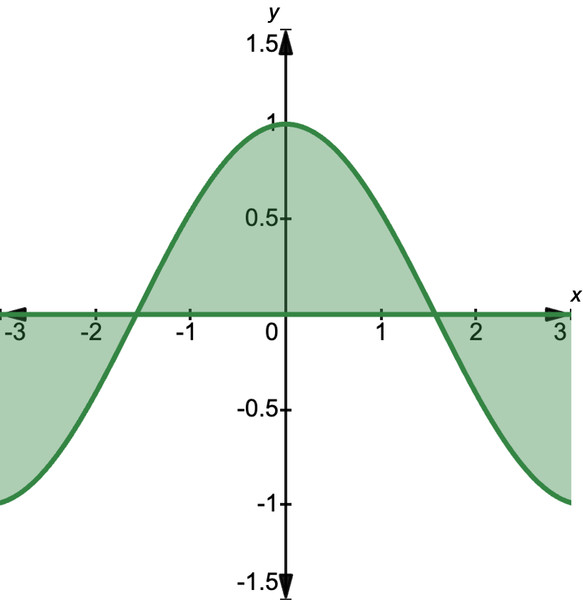
Signed (net) area under a curve
Quick reminder. By the Fundamental Theorem of Calculus,
if .
But in this section, the point is that sometimes you don’t need . You can treat integrals like pieces of area and manipulate them directly.
2. The Core Properties of Definite Integrals
These are algebra rules for definite integrals. Know them cold.
Constant Multiple Rule
A constant just scales the area.
Sum and Difference Rule
You can split integrals apart term by term.
Reversing Limits
Switching bounds flips the sign. This shows up constantly on MCQs.
Zero Rule
No interval length means no accumulated area.
Additivity Over Adjacent Intervals
If ,
This is the most tested property.
Visually, you’re just gluing areas together. The summary below also lists this property (called decomposition in the table) along with the others on this page.
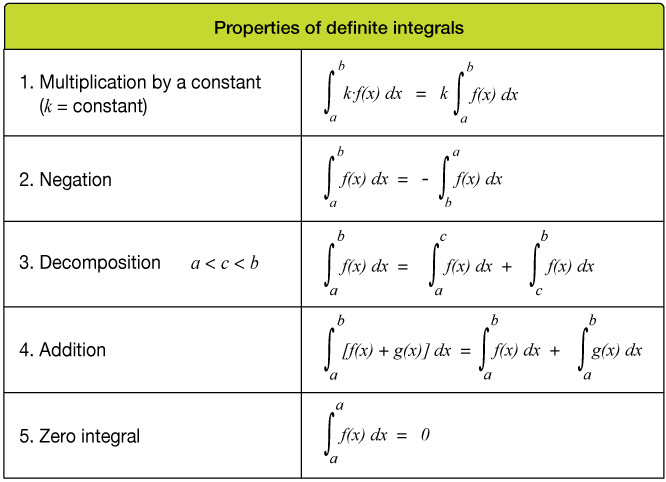
Summary table of definite integral properties
You can also rearrange it. For example,
That subtraction setup is very common on FRQs.
3. Using Geometry to Evaluate Definite Integrals
If the graph forms basic shapes, skip antiderivatives.
Common shapes:
- Rectangle →
- Triangle →
- Trapezoid →
- Semicircle →
For example, suppose a graph from to forms a triangle above the axis with height 3. Then
If that triangle were below the x-axis, the value would be .
Huge distinction:
- Net area counts signs.
- Total area would add absolute values.
If a question says “total area,” you must manually make everything positive.
Calculator-active questions sometimes give piecewise linear graphs. Those are almost always geometry problems disguised as integrals.
4. Strategy for Manipulating Given Integrals
You’ll often be given values like
and ,
and asked for .
Think number line.
Step-by-step mindset:
- Rewrite any reversed integrals first.
- Sketch or imagine the intervals in order.
- Add or subtract pieces so the endpoints match.
- Substitute values and keep track of signs.
Using the example above:
Common trap: subtracting when intervals don’t line up correctly. The endpoints must connect exactly.
5. Discontinuities and When the Definition Still Works
A definite integral can exist even if the function is not continuous everywhere.
It still works with:
- Removable discontinuities (holes)
- Jump discontinuities
Why? Because the definite integral is defined as a limit of Riemann sums. A single missing point or finite jump does not change accumulated area.
That means:
- A hole at one point does not affect .
- A function can be integrable without being continuous everywhere.
On AP questions, if they show a graph with an open circle, don’t panic. The integral can still be computed from the graph.
6. Common Mistakes to Avoid
- Forgetting to flip the sign when reversing limits.
- Mixing up net area and total area.
- Adding integrals whose intervals don’t actually connect.
- Trying to find an antiderivative when geometry is faster.
- Dropping a negative value that was already built into a given integral.
Think in terms of areas on a number line, not symbolic manipulation.
