Topic 8.4 Notes – Finding the Area Between Curves Expressed as Functions of x
What the Area Between Two Curves Is
Picture two functions, both written as and .
At a single -value:
- The vertical distance between them is
Over an interval , you add up all those tiny vertical slices using a definite integral:
This only works if:
- is the top function
- is the bottom function
Each thin rectangle has:
- width
- height
So the integral accumulates all those rectangle areas.
Here’s what that region looks like visually:
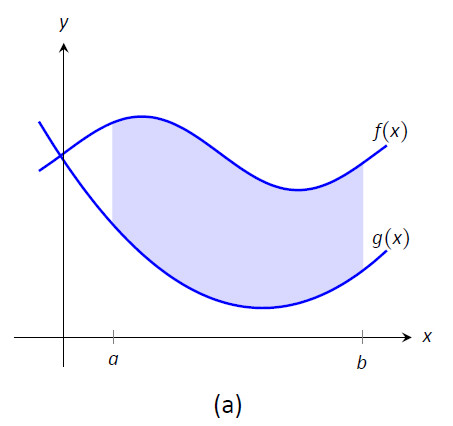
Area between and from to
In the diagram, is the upper curve and is the lower curve on , so each vertical slice has height .
Notice something important:
This is not area relative to the x-axis. The x-axis doesn’t matter unless it’s one of the functions.
How to Find the Area Step by Step
When you’re given equations, the process is always the same.
1. Find intersection points
Solve:
Those -values usually become your limits of integration (unless the interval is already given).
- Algebraically if possible
- With a calculator if needed (very common on calculator-active problems)
2. Determine which function is on top
Between the intersection points:
- Plug in a test value of
- Compare and
The bigger y-value is the top.
This step matters a lot. If you subtract in the wrong order, your answer will be negative.
3. Set up and evaluate the integral
Then:
- Find an antiderivative
- Apply
- Report a positive area
Quick Example
Find the area between and .
Step 1: Intersections
Solve:
So and .
Step 2: Who’s on top?
Try :
So is on top.
Step 3: Integrate
Antiderivative:
Evaluate:
That gives:
That’s the enclosed area.
When the Top Function Changes
Sometimes the graphs cross inside the interval. That means the top function switches.
The lower diagram below shows this situation. Notice how the shaded region is split into two pieces because the curves intersect in the middle of the interval.
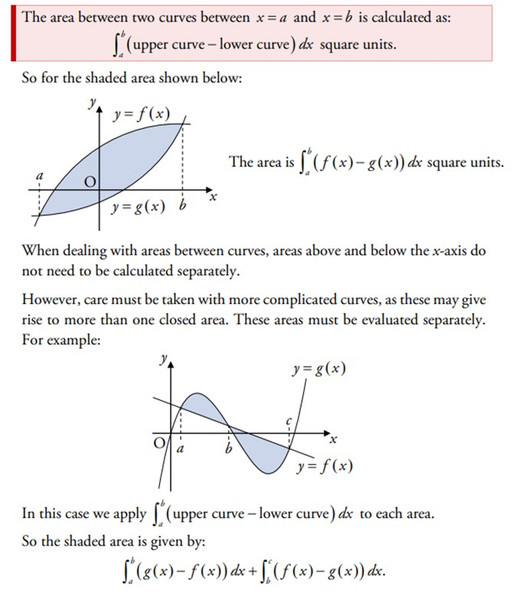
Area between curves when the top function changes
If that happens:
- Find all intersection points.
- Break the interval at each crossing.
- Write separate integrals.
- Add them.
On FRQs, this is where students lose points. If you try one big integral, parts cancel and you get the wrong area.
AP readers expect you to split it.
Graph-Based Questions
If they give you just a graph:
- Identify intersection points (often labeled or calculator-found).
- Check which curve is higher.
- Set up .
Even if both curves are below the x-axis, nothing changes. You’re subtracting functions from each other, not from zero.
On calculator sections, store intersection values instead of rounding early. Rounding too soon can cost accuracy points.
Common Confusions
- → signed area from x-axis
- → area between curves
Completely different ideas.
Also, AP expects correct subtraction and splitting intervals. They do not want unless explicitly told.
