Topic 8.2 Notes – Connecting Position, Velocity, and Acceleration of Functions Using Integrals
Position, Velocity, and Acceleration in Rectilinear Motion
We are in one-dimensional motion, meaning everything happens along a line. All functions depend on time .
- Position → where the particle is
- Velocity → rate of change of position
- Acceleration → rate of change of velocity
These derivative relationships go backward with integrals:
Graph connections are huge on tests:
- Slope of position graph → velocity
- Slope of velocity graph → acceleration
- Area under velocity graph → displacement
- Area under acceleration graph → change in velocity
Everything in this topic comes from interpreting slope and area correctly.
Displacement from Velocity
The definite integral of velocity gives displacement, which is net change in position.
Key ideas:
- Displacement is signed.
- Area above the -axis adds.
- Area below subtracts.
- If the integral is 0, the particle ended where it started.
Think of displacement as the signed area under a velocity graph.
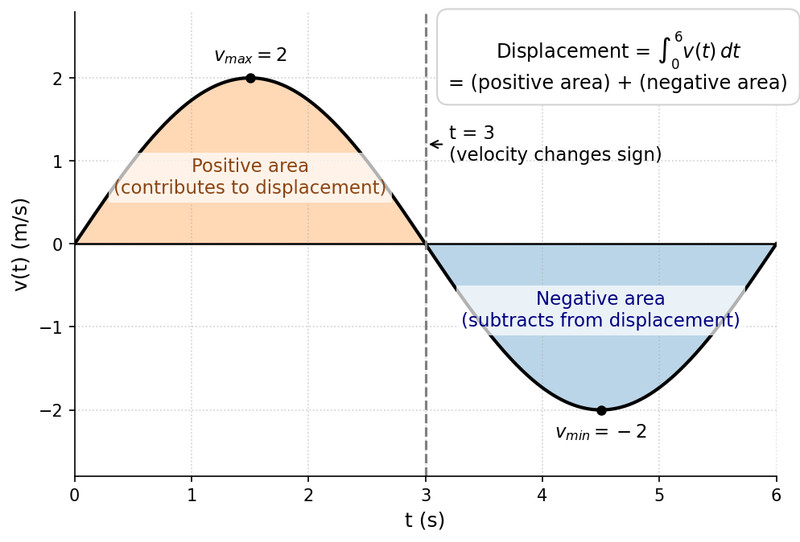
In this example, velocity is positive from to and negative from to . The area above the axis increases displacement, and the area below decreases it.
If the positive and negative areas cancel, displacement can be small even if the particle moved a lot.
That brings us to the distinction students mix up all the time.
Distance Traveled
Distance measures total movement, ignoring direction.
That absolute value changes everything.
If velocity changes sign:
- Find where .
- Split the interval there.
- Make each integral positive.
- Add them.
If velocity never changes sign, then distance equals .
On FRQs, students often compute displacement when the question asked for total distance. The grader will not give that point back. Always read carefully.
Using Integrals to Recover Position and Velocity
From Velocity to Position
If velocity is given and you know an initial position :
The definite integral gives change in position, not the actual position. You must add the initial value.
Example idea:
If and ,
That setup is usually what earns most of the points.
From Acceleration to Velocity
Same structure:
Area under acceleration → change in velocity.
Then integrate velocity again to get position.
Flow of information:
Each step requires an initial condition.
On calculator sections, you may see acceleration in a table and be asked for velocity at a time. That’s a numerical definite integral plus the initial velocity.
Reading Motion from Graphs
Graph interpretation is common on both MCQs and FRQs.
If you’re given a velocity graph:
- → moving right
- → moving left
- Velocity changes sign → direction changes
- Area gives displacement
- Absolute area gives distance
If you’re given an acceleration graph:
Look at the acceleration graph below. The shaded regions show how signed area over each time interval changes the velocity.
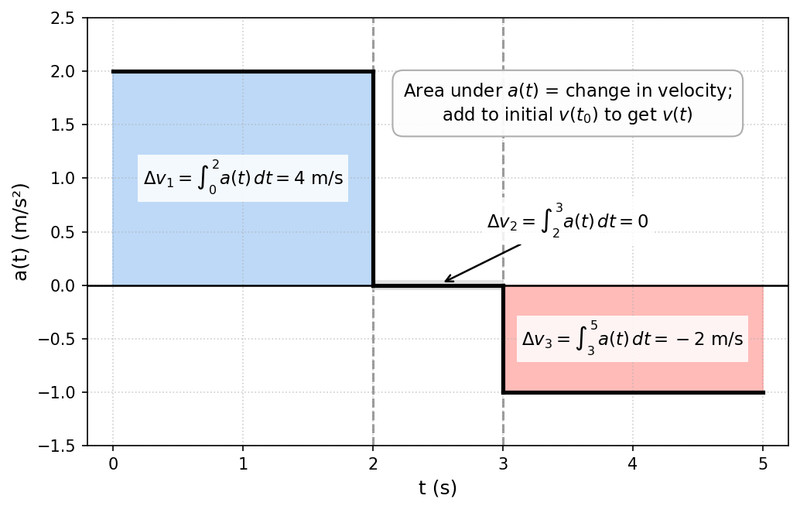
Piecewise constant acceleration and change in velocity
- Area → change in velocity
- Add initial velocity to get the actual velocity function
- Then integrate velocity (or compute area under it) for position
Students often forget that a horizontal velocity graph means acceleration is zero, but the particle is still moving.
