Topic 3.3 Notes – Differentiating Inverse Functions
What the Derivative of an Inverse Function Is
Suppose is differentiable and one-to-one (so it has an inverse). Let . Then
or equivalently
Where this comes from
If two functions are inverses, then
Differentiate both sides using the chain rule:
Solve for and you get the formula above. The chain rule is doing all the work.
Geometric Meaning
If , then:
- is on
- is on
The graphs reflect across the line , and their slopes at corresponding points are reciprocals.
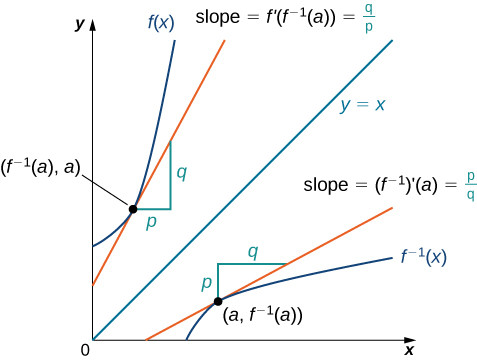
Function and inverse reflected across
In the diagram, notice how the tangent line to at has slope , while the tangent line to at has slope . They are reciprocals, exactly as the formula predicts.
Important conditions:
- must be one-to-one (so the inverse exists).
- . If the slope of is 0, the inverse has a vertical tangent there and its derivative does not exist.
How to Find in Practice
Most problems ask for the derivative at a specific number, not the full formula.
If you’re asked for , use:
Here’s the process you’ll use over and over:
- Find
Solve .
This gives the input where the original function outputs . - Evaluate at that input.
- Take the reciprocal.
That’s it.
Example Idea (Formula Given)
Suppose . Find .
First solve :
.
works. So .Compute derivative:
Evaluate at 1:
Take reciprocal:
Notice we never found the actual inverse formula.
Table Setup (Very Common on FRQs)
You might get a table of and .
To find :
- Look for where .
- Use that row’s .
- Take the reciprocal.
Students often plug directly into . That’s wrong. You must match the input that produces .
Tangent Line to an Inverse Function
If you need the tangent line to at :
- The point is .
- The slope is .
- Use point-slope form:
Careful with coordinates. If , then:
- On :
- On :
AP graders look closely at this swap.
Inverse Trigonometric Derivatives
These come directly from the inverse rule. You are expected to know them:
And if there’s an inner function, use the chain rule:
The negative on is a common mistake.
