Topic 10.5 Notes – Harmonic Series and p-Series
Harmonic Series and p-Series
A p-series has the form
where is a constant.
All terms are positive, so this is a positive-term series. The only question is whether the infinite sum converges or diverges.
The p-Series Rule
That’s the entire test. No partial sums. No derivatives. Just identify .
The Harmonic Series
This is the p-series with .
Since , it diverges.
This one matters a lot. It’s the classic example that shows:
- Even if ,
- The series can still diverge.
On quizzes and the AP exam, you’re expected to recognize this instantly.
Why the Value Is the Boundary
Here’s the key behavior. Compare the graphs of and :
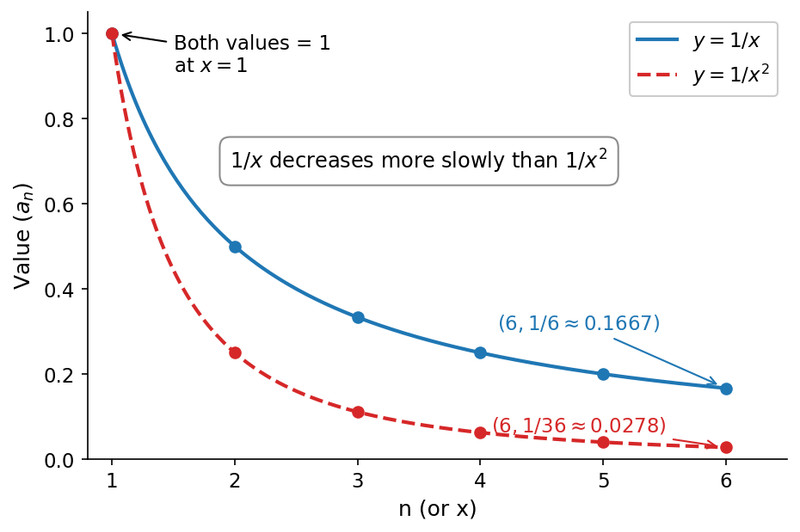
Graphs of and
Both functions go to 0 as .
- decreases slowly → harmonic series diverges
- decreases faster → converges
The exponent controls how fast the terms shrink. If they don’t shrink fast enough, the total sum keeps growing without bound.
That’s the intuition behind the rule.
How to Recognize a p-Series
Most mistakes happen because students don’t simplify first.
You must rewrite the general term so it looks exactly like:
Simplifying Correctly
Common rewrites:
Example:
Rewrite as:
Here , so it converges.
Another example:
Simplify:
That’s the harmonic series → diverges.
Always simplify completely before deciding.
The Cases You Should Instantly Recognize
✔️ → Converges
Even works.
❌ → Harmonic → Diverges
This shows up constantly in comparison tests later.
❌ → Diverges
The terms go to zero, just not fast enough.
❌
Examples:
These terms don’t even approach 0. By the nth-term test, they diverge immediately.
How This Appears on Tests
You’ll usually see one of three things:
Straight recognition
Determine convergence or divergence.
Simplify → identify → apply rule → state conclusion.
Disguised p-series
Expressions with radicals, negative exponents, or rational powers. The work is in the algebra.
Used as a benchmark
Later in comparison tests, you’ll compare to:
- (diverges)
- (converges)
If you don’t instantly know those two, comparison problems get harder.
Common Errors
- Seeing and thinking . It becomes , so .
- Ignoring the numerator in rational expressions.
- Believing “terms go to 0” guarantees convergence.
- Forgetting that diverges.
