Topic 5.2 Notes – Extreme Value Theorem, Global Versus Local Extrema, and Critical Points
1. The Extreme Value Theorem
Here’s the formal statement you’re expected to recognize and use:
In plain language:
If f is continuous on a closed interval [a, b], then
- f has at least one absolute maximum,
- f has at least one absolute minimum,
- and both happen somewhere in [a, b] (possibly at endpoints).
Why the Conditions Matter
You need both:
- ✔️ Closed interval
- ✔️ Continuity everywhere on that interval
If either fails, no guarantee.
- Open interval → function might approach a highest value but never reach it.
- Discontinuity → function might “break” before reaching an extreme.
The theorem only guarantees existence, not location. It tells you extrema are there. It does not tell you where.
What This Looks Like
Here are two typical situations that satisfy the theorem. Notice that the absolute maximum or minimum can occur either at an interior point or at an endpoint.
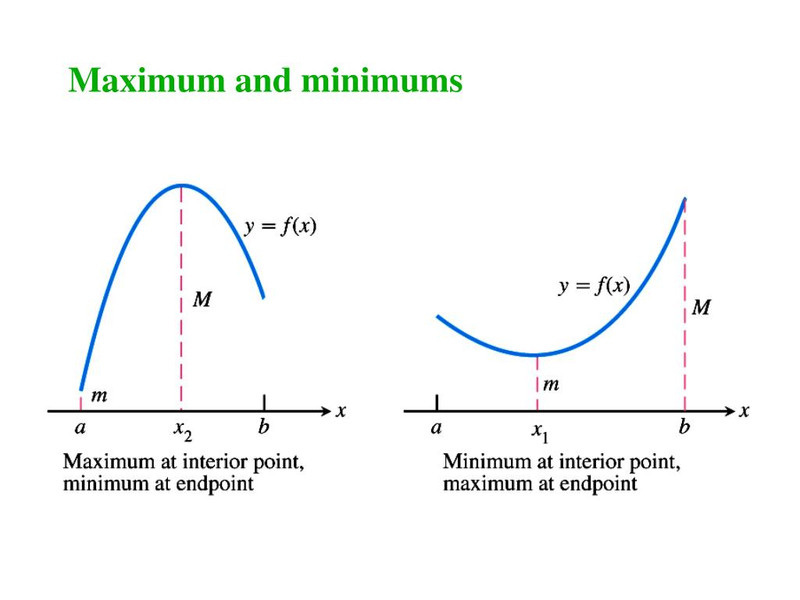
On a quiz or FRQ, if you’re told “f is continuous on [2, 7],” you can confidently write:
Since f is continuous on the closed interval [2,7], by the Extreme Value Theorem, f has both an absolute maximum and an absolute minimum on [2,7].
If continuity is not stated or cannot be verified, you cannot claim the theorem applies.
2. Global vs Local Extrema
Before finding extrema, you need to know what type you’re looking at.
Types of Extrema
- Absolute (Global) Maximum
Highest value on the entire interval. - Absolute (Global) Minimum
Lowest value on the entire interval. - Local (Relative) Maximum
Higher than nearby points. - Local (Relative) Minimum
Lower than nearby points.
Quick Comparison
| Local Extrema | Absolute Extrema |
|---|---|
| Compared to nearby points only | Compared to entire interval |
| Usually interior points | Can occur at endpoints |
| Not guaranteed by EVT | Guaranteed by EVT (if conditions met) |
A point can be both local and absolute. For example, if the highest point overall also happens inside the interval, it’s both.
Important detail students forget: Endpoints can be absolute extrema, even though they’re usually not local extrema (no points on one side).
3. Critical Points
A critical point occurs at (in the domain) where:
- , or
- does not exist.
These are the only places local extrema can occur.
That gives you two big truths:
- ✔️ Every local extremum is a critical point.
- ❌ Not every critical point is a local extremum.
Here’s what that can look like on a graph of :
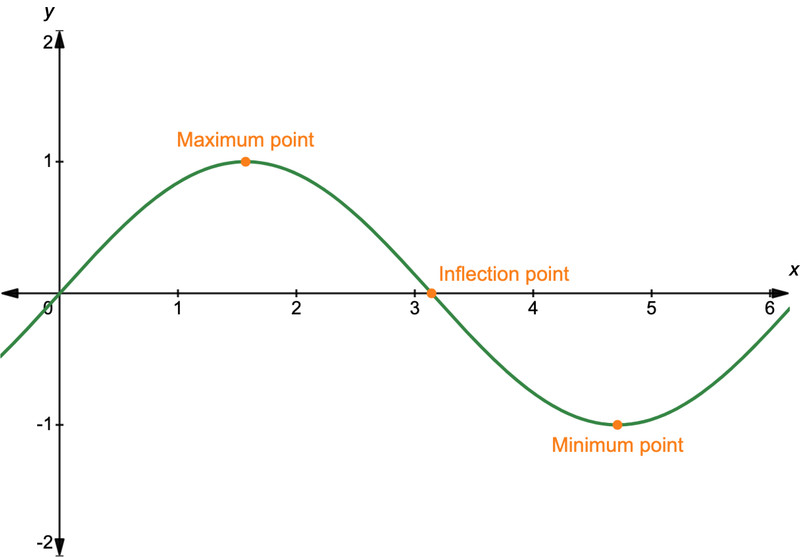
Local maximum, inflection point, and local minimum
The maximum and minimum are local extrema, so they’re critical points. The middle point has a horizontal tangent, but the function keeps decreasing through it. That means , yet there is no direction change.
That middle point with a horizontal tangent but no direction change is a classic AP trap. Derivative equals zero, but no max or min.
If you’re given a graph of , critical points of occur where:
- (x-intercepts), or
- is undefined.
4. Finding Absolute Extrema on a Closed Interval
This is the standard procedure you’ll use constantly:
- Compute .
- Find critical points inside .
- Evaluate at:
- Each critical point
- Compare all values.
- Largest → absolute max. Smallest → absolute min.
You must check endpoints. Many absolute extrema happen there, especially on FRQs where they design the function that way.
5. Common Exam Setups and Mistakes
If You’re Given a Graph of f
- Local extrema = visible peaks and valleys.
- Absolute extrema = highest and lowest y-values on the interval.
- Always look at endpoints carefully.
If You’re Given a Graph of f′
- Critical points of f occur where or undefined.
- Then think about whether the sign of changes to determine if it’s actually an extremum (you’ll study this more in the next topic).
Justification with EVT
If the problem asks whether a function is guaranteed a max/min:
- Continuous + closed interval → yes.
- Missing either condition → no guarantee.
Common Mistakes
- Forgetting endpoints when finding absolute extrema.
- Assuming every critical point is an extremum.
- Claiming a function “has a maximum” without verifying EVT conditions.
- Mixing up local and absolute language.
