Topic 7.7 Notes – Finding Particular Solutions Using Initial Conditions and Separation of Variables
General solution vs particular solution
When you solve a differential equation, you usually get a general solution.
Example:
If
then integrating gives
That means:
- There are infinitely many solution curves.
- Each value of gives a different graph.
- All of them satisfy the differential equation.
On a slope field, this shows up as many different curves following the same pattern of line segments.
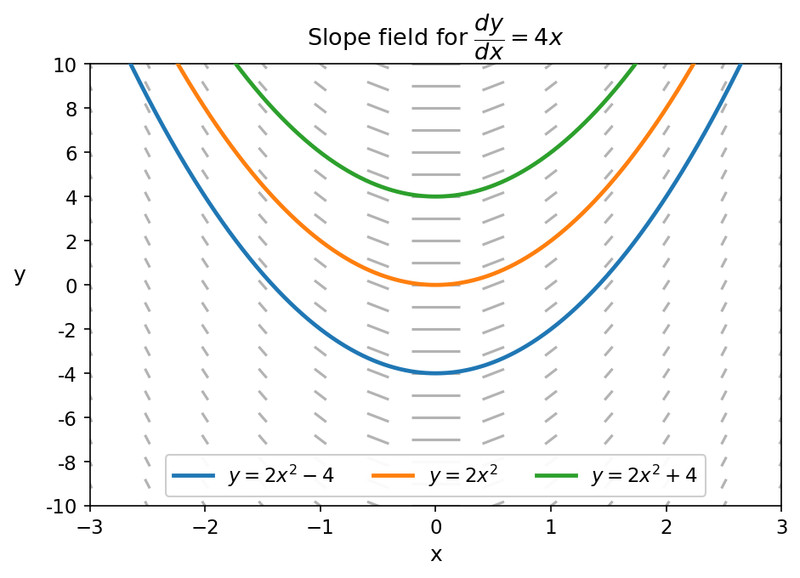
Slope field and several solutions to
Each parabola shown corresponds to a different value of , but they all match the same slope field.
Now suppose you’re given an initial condition, like .
Plug into the general solution:
So the particular solution is
Key idea:
- A general solution describes a whole family.
- A particular solution is the one curve that passes through a specific point.
- For a given point , there is exactly one solution curve through that point.
That uniqueness is something the AP expects you to understand conceptually.
Writing a particular solution with an integral
When the differential equation is
you can write the particular solution satisfying as
Why this works:
- By the Fundamental Theorem of Calculus,
. - When , the integral is 0, so
.
This form:
- Automatically builds in the initial condition.
- Avoids solving for .
- Often appears on FRQs that say “write an expression for the solution.”
Notice the variable inside the integral is , not . That prevents confusion with the upper limit.
Separation of variables with an initial condition
This is the most common skill tested here.
Suppose you’re given
Step-by-step logic
Separate variables
Integrate both sides
Solve for
(The constant absorbs the ± from exponentiating.)
That’s the general solution.
Now use an initial condition, say :
So the particular solution is
Algebra matters a lot here. Common trouble spots:
- Forgetting absolute values in .
- Losing the constant when exponentiating.
- Plugging in the initial condition before integrating.
On FRQs, even correct separation can earn credit, so show that step clearly.
Domain restrictions of solutions
Not every solution works for all .
Restrictions happen because of:
- Division by zero (denominators).
- Logarithms (argument must be positive).
- Even roots (radicand ≥ 0).
- Context (time can’t be negative in many models).
Example:
If your solution ends up as
then .
If an initial condition is given, the solution is valid on the interval containing that point without crossing a discontinuity.
This matters on the AP. A correct formula with the wrong domain can cost you.
