Topic 10.6 Notes – Comparison Tests for Convergence
What comparison tests do
Comparison tests apply to series with nonnegative terms (they can be eventually positive). The logic only works when terms don’t change sign.
You compare your series to a benchmark series you already understand:
- p-series
Converges if , diverges if - Geometric series
Converges if
The whole game is this question:
For large , what does behave like?
Lower-degree terms and constants do not affect convergence.
Direct Comparison Test
This test uses inequalities.
Suppose .
- If converges, then converges.
- If diverges, then diverges.
So:
- To prove convergence, compare to something bigger that converges.
- To prove divergence, compare to something smaller that diverges.
Why this makes sense
If a bigger positive series has a finite sum, a smaller one can’t suddenly blow up.
If a smaller positive series already diverges, anything bigger must also diverge.
Example idea
Consider
For large , , so
And is a -series with , so it converges.
Since our series is smaller than a convergent series, it also converges.
Notice what we did:
- Ignored the constant 5.
- Focused only on the dominant term.
- Compared to a clean .
When direct comparison works best
- Rational functions where you can drop smaller terms.
- Trig expressions using bounds like .
- Situations where inequalities are obvious.
If the inequality feels messy, switch to limit comparison.
Limit Comparison Test
This is usually cleaner for rational expressions.
Given positive-term series and , compute
If , then the two series either both converge or both diverge.
If or , the test gives no conclusion.
Why this works
If the ratio approaches a positive constant, then for large ,
is basically a constant multiple of . Same growth rate → same convergence behavior.
Here’s the idea visually:
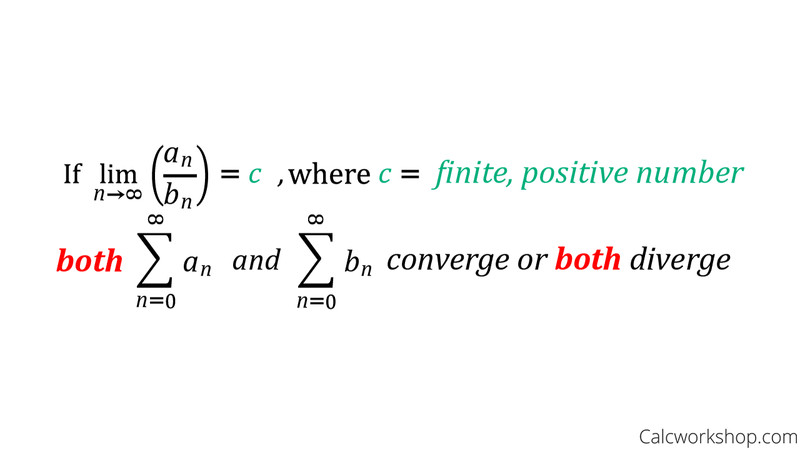
Limit Comparison Test outcomes based on
Focus on the middle case where the limit is a finite, positive number. That is the only time you can conclude the two series behave the same.
How to choose
Match the dominant behavior:
Always match the highest power or fastest-growing term.
Quick example
Determine convergence of
Dominant terms give
Compare to .
Compute:
Since , both series behave the same.
diverges (harmonic series), so the original series diverges.
No L’Hôpital needed. Just dominant powers.
Direct vs Limit Comparison
| Direct Comparison | Limit Comparison |
|---|---|
| Uses inequalities | Uses a limit of a ratio |
| Good when bounds are obvious | Good for rational/exponential expressions |
| Must match direction carefully | Only need |
On AP problems, limit comparison is often faster for polynomial ratios.
Common AP mistakes
- Using comparison when terms aren’t positive.
- Picking the wrong power when identifying dominant terms.
- Concluding something when or .
- Forgetting to name the comparison series in your final sentence.
When you justify convergence on an FRQ, always state:
- What you’re comparing to.
- The limit (if using limit comparison).
- Why the benchmark converges or diverges.
