Topic 5.11 Notes – Solving Optimization Problems
1. What an Optimization Problem Is
An optimization problem asks you to find the maximum or minimum value of a function in a real situation.
You are not just solving . You are:
- Building a function from a word problem
- Using derivatives to locate possible extrema
- Deciding which value truly gives the max or min
- Explaining what that value means (with units)
From earlier topics, remember:
A function can have extrema at
- Critical points where or undefined
- Endpoints of a closed interval
Optimization problems use that exact idea, just inside a real-world scenario.
And the AP cares a lot about interpretation. A number alone is not a complete answer.
2. The Full Optimization Strategy
Everything fits into this structure.
Step 1: Define Variables
Let variables represent quantities that can change.
State what each one means and include units.
If you define a variable that doesn’t connect to what you’re optimizing, you’ll box yourself in later.
Step 2: Write the Objective Function
This is what you're maximizing or minimizing.
Common examples:
- Area
- Volume
- Surface area
- Profit
- Distance
- Time
Write it as a function of one variable.
If two variables appear, you’re not ready to differentiate yet.
Step 3: Use the Constraint
There is almost always a restriction:
- Fixed perimeter
- Fixed volume
- Budget limit
- Total material available
Use that equation to eliminate one variable so your objective function depends on only one variable.
This is where most mistakes happen. Students differentiate too early.
Step 4: Find Critical Points
- Differentiate.
- Set derivative equal to zero.
- Solve.
- Check where derivative might be undefined.
These values are candidates.
Step 5: Decide Maximum or Minimum
Use:
- First derivative test (sign chart)
- Second derivative test
- Or compare values if endpoints exist
If the problem has physical limits like radius , only consider realistic values.
Step 6: Interpret in Context
This is what FUN‑4.C is about.
Do not stop at “.”
Say what that means:
- Include units.
- State what quantity is being maximized or minimized.
- Make it a sentence.
On FRQs, this interpretation is often a separate scoring point.
3. Common Structures of Optimization Problems
They look different on the surface but follow the same structure.
Geometry Optimization
Very common.
You’ll use formulas like:
- Rectangle area
- Cylinder volume
- Surface area
Here’s a classic setup visually, where a rectangle has a fixed perimeter and we try to maximize its area.
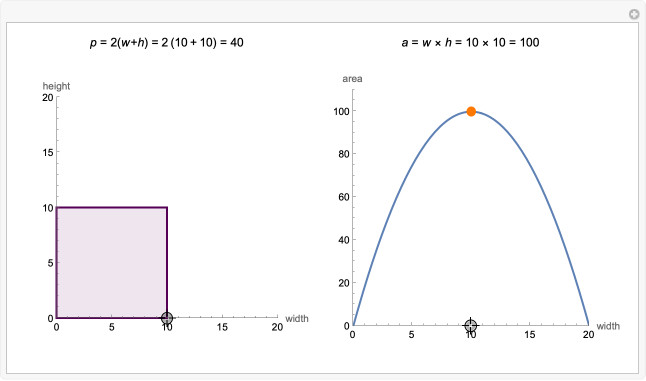
Maximizing the area of a rectangle with fixed perimeter
On the right, notice how area as a function of width forms a downward-opening parabola. That shape tells you there is a maximum at the vertex.
Typical flow:
- Write perimeter (constraint)
- Solve for one variable
- Substitute into area formula
- Differentiate
If you get a quadratic opening downward, the vertex gives a maximum.
Business Optimization
- Revenue
- Cost
- Profit
If asked to maximize profit, differentiate , not revenue alone.
A common trap is maximizing revenue when the question asks for maximum profit.
Physical or Distance Problems
These often involve:
- Distance formula
- Pythagorean Theorem
- Time as a function of position
Here’s a typical geometric setup where distances and angles are used to build a function.
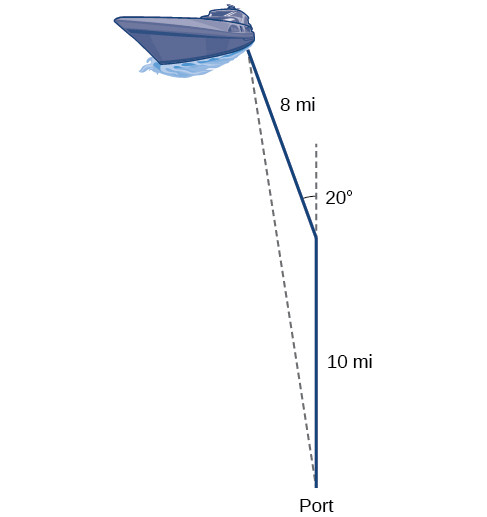
Boat-to-port distance optimization setup
Sketching something like this helps you see which lengths depend on your variable.
These problems feel different but follow the same pattern: build the function → reduce to one variable → differentiate.
4. When Endpoints Matter
If the domain is restricted, you must compare:
- Critical values
- Endpoints
For example:
- Interval given explicitly
- Physical limits like
- Limited budget or material
Sometimes the maximum happens at an endpoint, not a critical point.
On calculator-active multiple choice, they love giving you a table and asking which input gives the largest value. That’s endpoint comparison in disguise.
5. Common Mistakes to Avoid
- Differentiating before reducing to one variable
- Forgetting to use the constraint
- Reporting the wrong quantity (finding when they asked for area)
- Ignoring realistic restrictions
- Leaving off units
- Not explaining what the maximum or minimum represents
Optimization is modeling first, calculus second.
