Topic 1.7 Notes – Selecting Procedures for Determining Limits
The Core Question Behind Every Limit
Every limit question is asking:
What value does approach as approaches some number (or )?
Before doing any algebra, quickly classify what you’re looking at:
- A graph
- A table
- An algebraic expression where substitution works
- An expression that gives or
- A composite function
- A limit involving oscillation or bounding
Your first instinct should always be:
Plug it in.
- If you get a real number → you’re done.
- If you get or → you need algebra.
- If it’s graphical or numerical → use the representation.
That habit alone saves time on quizzes and the no‑calculator MC section.
The Full Set of Limit Procedures
Here’s the complete toolbox. The skill is matching the tool to the structure.
Graphical Evaluation
When a graph is given, you’re reading behavior.
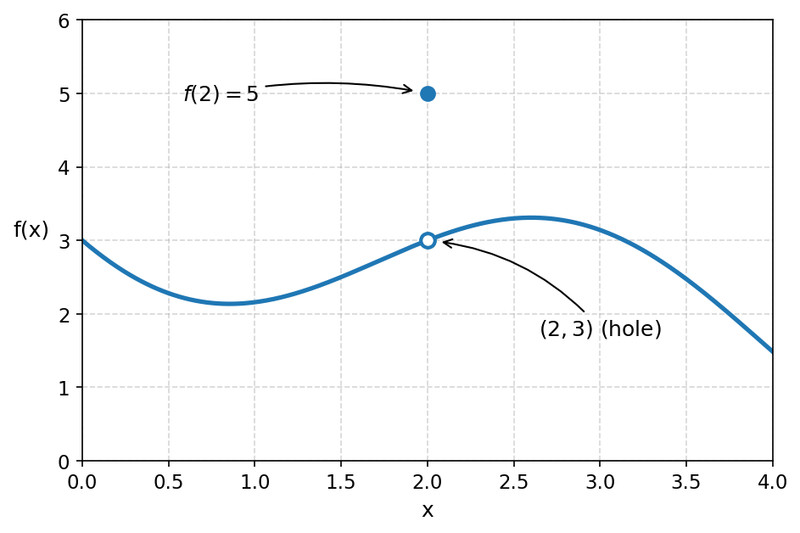
Limit from a graph: hole at x = 2, filled value at (2, 5)
From a graph, check:
- Do the left-hand and right-hand limits match?
- Is there a hole (limit exists)?
- Is there a jump (limit does not exist)?
- What happens as ?
In the graph above, , even though .
That distinction shows up constantly on tests.
Numerical Evaluation from a Table
If you’re given values near a point, look for patterns.
- Are values from the left and right approaching the same number?
- Are they blowing up positively or negatively?
Tables suggest a limit but don’t prove it algebraically. On FRQs, if you’re given a table, you’re expected to justify your answer using the data provided, not invent algebra.
Limit Laws and Direct Substitution
If the function is continuous at the point, substitution works immediately.
You can rely on:
- Sum, difference, product laws
- Quotient law (denominator limit ≠ 0)
- Power and root laws
For composite functions like :
- Find .
- Plug that result into .
Example:
Direct substitution gives . No extra work needed.
If nothing becomes undefined, don’t overthink it.
Algebraic Manipulation When Substitution Fails
If substitution gives , that’s not the answer. It means “simplify me.”
Common moves:
Factoring and canceling
Factor numerator → .
Cancel → limit becomes .
Substitute → answer is 2.Multiply by the conjugate (for radicals)
Simplify complex fractions
L’Hôpital’s Rule (BC only)
If you still have or :
Differentiate top and bottom → .
Evaluate → 1.
Only use L’Hôpital for indeterminate forms. Using it when the form isn’t indeterminate costs points.
Squeeze Theorem
This is for functions that oscillate but are trapped.
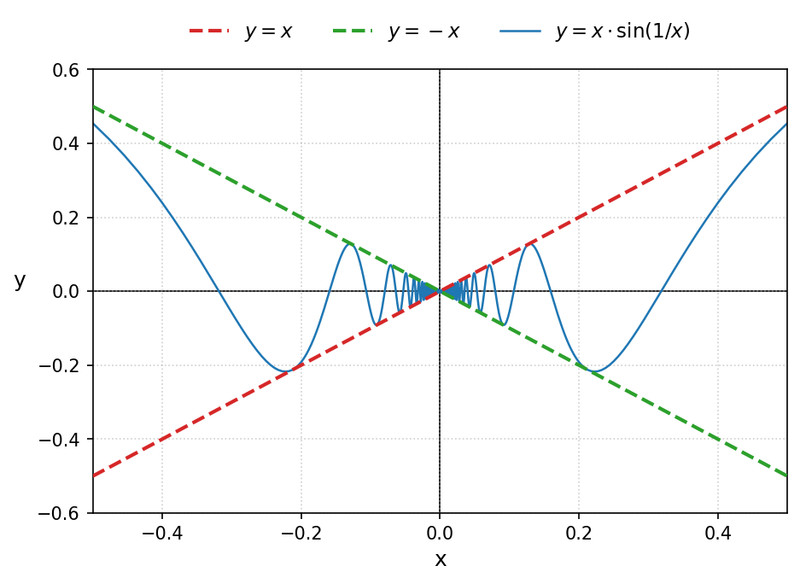
Squeeze Theorem: near 0
If
and
then
Classic use: as .
The oscillation disappears because it’s squeezed to 0.
If you see a bounded trig function multiplied by something going to 0, think squeeze.
A Fast Decision Process
When you see a limit:
- Plug it in immediately.
- If you get a number, stop.
- If you get , factor or use conjugates.
- If you get , consider L’Hôpital (BC) or compare highest powers.
- If it oscillates but is bounded, consider Squeeze.
- If it’s a graph or table, use what’s given.
Most Unit 1 limits are either direct substitution or factor‑and‑cancel. The test often hides something simple inside something that looks messy.
