Topic 5.5 Notes – Using the Candidates Test to Determine Absolute (Global) Extrema
What Absolute Extrema Are
An absolute maximum is the greatest value takes on a given interval.
An absolute minimum is the smallest value takes on that interval.
This is about the whole interval, not just what happens near a point. That’s the difference from local extrema, which only compare nearby values.
A quick reminder about critical points:
- A critical point occurs where
- , or
- does not exist (but is defined).
Here’s the key fact that makes everything work:
On a closed interval , absolute extrema can only occur at
• critical points inside , or
• the endpoints or .
This comes from the Extreme Value Theorem. If a function is continuous on a closed interval, it must have both an absolute max and min somewhere on that interval.
The Candidates Test
When you’re asked for absolute max/min on a closed interval, this is the procedure.
Step-by-step
- Find critical points in
- Compute .
- Solve .
- Find where is undefined.
- Keep only the x-values inside the interval.
- Evaluate the function at each critical point
Plug into . These give candidate values. - Evaluate the endpoints
Compute and . - Compare all the function values
- Largest value → absolute maximum
- Smallest value → absolute minimum
You are comparing actual -values. That’s the whole point.
What This Looks Like Graphically
Imagine a curve on a closed interval from to :
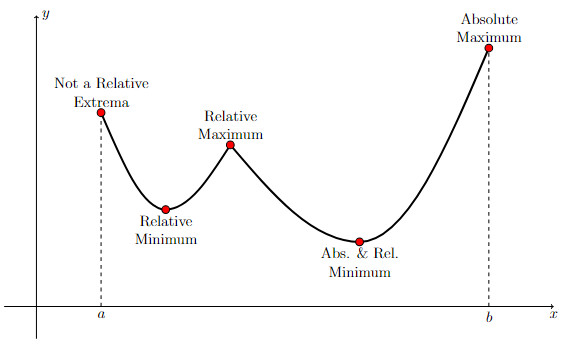
Absolute and relative extrema on a closed interval
Notice what’s happening. There are critical points inside the interval, including a relative maximum and a relative minimum. One interior point is both a relative and absolute minimum. The absolute maximum happens at the right endpoint.
This is exactly why you must test critical points and endpoints. You don’t know where the highest or lowest value occurs until you compare the actual function values.
Why Only Critical Points or Endpoints?
This is where derivative reasoning comes in.
If the highest or lowest value happens inside the interval and the function is differentiable there, then the tangent line must be horizontal. That means .
If the derivative doesn’t exist there, it’s still a critical point.
If the extreme happens at the boundary, it must be at or .
So if a point is not:
- a critical point, and
- not an endpoint
it cannot be an absolute extreme value.
That justification is exactly what your teacher (and AP graders) want when they ask you to explain your reasoning using derivatives.
Closed vs. Open Intervals
This method applies cleanly to closed intervals like .
If the interval is open, like :
- Endpoints are not included.
- An absolute max or min might not exist.
For example, if the function keeps increasing toward an endpoint that isn’t included, there is no absolute maximum.
AP multiple choice questions sometimes test this subtlety.
Common Mistakes I See Every Year
- Forgetting endpoints. This is the #1 error.
- Keeping critical points outside the interval. Always check bounds.
- Using only a sign chart. First Derivative Test tells you local behavior, not absolute size.
- Not stating both the x-value and the function value. On FRQs, you usually need both.
If the question asks “where,” they want the x-value.
If it asks for “the maximum value,” they want the y-value.
