Topic 8.5 Notes – Finding the Area Between Curves Expressed as Functions of y
Horizontal Slices and Integrating with Respect to y
You already know that with vertical slices we use:
Now imagine turning those rectangles sideways.
When curves are written like
each small rectangle stretches from left to right.
So the formula becomes:
Key differences:
- Rectangles are horizontal
- Width =
- Height =
- Bounds are y-values
Here’s what that looks like visually. In the graph below, the region between the two parabolas is shaded, and a single horizontal slice shows how the width is measured from the left curve to the right curve.
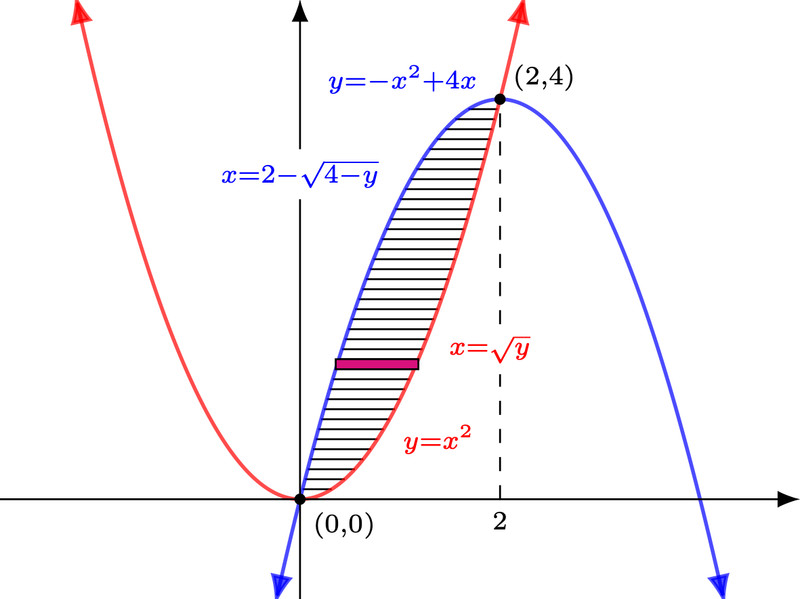
Horizontal slices for integrating with respect to
Same accumulation idea as before. Just rotated 90 degrees.
When You Should Use dy
Sometimes you have to switch perspective.
You’ll use horizontal slices when:
- The equations are already written as
- The region is bounded cleanly left/right
- Using vertical slices would force you to split into multiple integrals
- A curve fails the vertical line test but works horizontally (like sideways parabolas)
For example, consider this region bounded by two sideways parabolas:
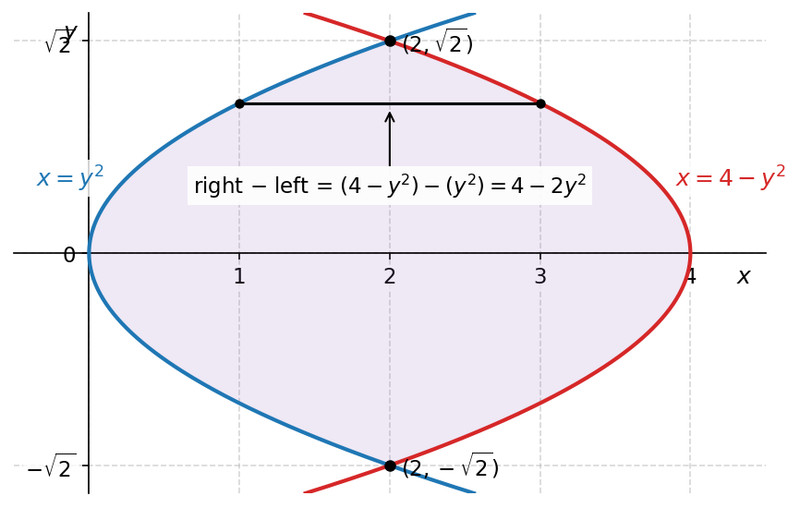
Region between and
Here, describing the region as top minus bottom would be messy. Right minus left is natural.
On tests, this often appears when one equation looks like or . That’s your cue.
Setting Up the Integral Correctly
Most point deductions happen in setup, not integration.
Here’s the clean process.
1. Find intersection points
Set the two equations equal:
Solve for y.
These solutions become your limits of integration.
2. Decide which curve is right and which is left
Pick a test value of between the bounds.
- The equation giving the larger x-value is the right curve.
- The smaller x-value is the left curve.
Do not guess based only on how the graph looks. A quick plug-in avoids sign mistakes.
3. Write the integral
If you subtract correctly, you don’t need absolute value.
4. Integrate and evaluate
Integrate with respect to .
Plug in upper minus lower bound.
Area must come out positive.
Vertical vs Horizontal Slices
It helps to see them side by side.
| Vertical Slices | Horizontal Slices |
|---|---|
| Integrate | Integrate |
| Top − Bottom | Right − Left |
| x-bounds | y-bounds |
| Rectangles are vertical | Rectangles are horizontal |
If you ever write but subtract top minus bottom, that’s a red flag.
Calculator Situations
On calculator sections, you might need a decimal answer.
- Graph both equations in terms of as functions of
- Use the intersection feature to find y-values
- Enter:
Common slip-ups:
- Using x-bounds by accident
- Forgetting parentheses around the left function
- Rounding too early
On free response, they care much more about the correct setup than the final number.
When the Region Must Be Split
Sometimes the right and left curves switch roles inside the interval.
If that happens:
- Find the y-value where they switch.
- Split into two integrals.
- Each integral uses its own right − left.
If you don’t split, you’ll accidentally subtract in the wrong order for part of the region.
