5m left·0%
Reading Time: 5 min
Last Updated: March 19, 2026
Main Ideas: 7
Reading Time: 5 min
Last Updated: March 19, 2026
Main Ideas: 7

Topic 9.2 Notes – Second Derivatives of Parametric Equations

Verified for 2027 AP® Calculus BC Exam
Read aloud
Second derivatives of parametric equations tell you how the slope of a parametric curve is changing with respect to xx. Since both xx and yy are written in terms of a parameter tt, you can’t just differentiate twice the usual way. This topic is about using the chain rule correctly to get d2ydx2 \frac{d^2y}{dx^2} and interpret concavity.

Second Derivatives of Parametric Equations

You’re given:

x=x(t),y=y(t) x = x(t), \quad y = y(t)

Both coordinates depend on tt (often time).

From 9.1, you already know:

dydx=dydtdxdt,as long as dxdt≠0 \frac{dy}{dx} = \frac{\frac{dy}{dt}}{\frac{dx}{dt}}, \quad \text{as long as } \frac{dx}{dt} \ne 0

That gives the slope of the tangent line in the xyxy-plane.

Now we want the second derivative:

d2ydx2=ddx ⁣(dydx) \frac{d^2y}{dx^2} = \frac{d}{dx}\!\left(\frac{dy}{dx}\right)

Since everything is still written in terms of tt, we apply the chain rule and get the formula you need to memorize:

d2ydx2=ddt(dydx)dxdt \boxed{ \frac{d^2y}{dx^2} = \frac{\frac{d}{dt}\left(\frac{dy}{dx}\right)}{\frac{dx}{dt}} }

That’s the entire skill for this topic.

What the Formula Means

Think about what’s happening:

  • First derivative: slope dydx \frac{dy}{dx}
  • Second derivative: how that slope changes as xx changes

But we don’t have yy as a function of xx. We only have everything in terms of tt. So we:

  1. Differenti​ate the slope with respect to tt
  2. Convert that rate into a rate with respect to xx by dividing by dx/dtdx/dt

It’s chain rule logic:

ddx=1dx/dtddt \frac{d}{dx} = \frac{1}{dx/dt}\frac{d}{dt}

Step-by-Step Process

Every problem follows this same structure.

  1. Find dx/dtdx/dt and dy/dtdy/dt
  2. Compute the first derivative

    dydx=dy/dtdx/dt \frac{dy}{dx} = \frac{dy/dt}{dx/dt}

    Simplify here if possible.

  3. Differentiate dy/dxdy/dx with respect to tt

    Use product or quotient rule if needed.

  4. Divide by dx/dtdx/dt

    d2ydx2=ddt(dy/dx)dx/dt \frac{d^2y}{dx^2} = \frac{\frac{d}{dt}(dy/dx)}{dx/dt}

If you forget the final division step, you haven’t finished.

Quick Example

Let

x=t2+1,y=t3−t x = t^2 + 1, \quad y = t^3 - t

Step 1: First derivatives

dxdt=2t,dydt=3t2−1 \frac{dx}{dt} = 2t, \quad \frac{dy}{dt} = 3t^2 - 1

Step 2: First derivative

dydx=3t2−12t \frac{dy}{dx} = \frac{3t^2 - 1}{2t}

Step 3: Differentiate with respect to tt
Use quotient rule:

ddt ⁣(3t2−12t)=(6t)(2t)−(3t2−1)(2)(2t)2=12t2−6t2+24t2=6t2+24t2 \frac{d}{dt}\!\left(\frac{3t^2 - 1}{2t}\right) = \frac{(6t)(2t) - (3t^2 -1)(2)}{(2t)^2} = \frac{12t^2 - 6t^2 + 2}{4t^2} = \frac{6t^2 + 2}{4t^2}

Step 4: Divide by dx/dt=2tdx/dt = 2t

d2ydx2=6t2+24t22t=6t2+28t3 \frac{d^2y}{dx^2} = \frac{\frac{6t^2 + 2}{4t^2}}{2t} = \frac{6t^2 + 2}{8t^3}

Done.

On an FRQ, every one of those steps needs to be visible.

Concavity of Parametric Curves

The second derivative still controls concavity in the xyxy-plane.

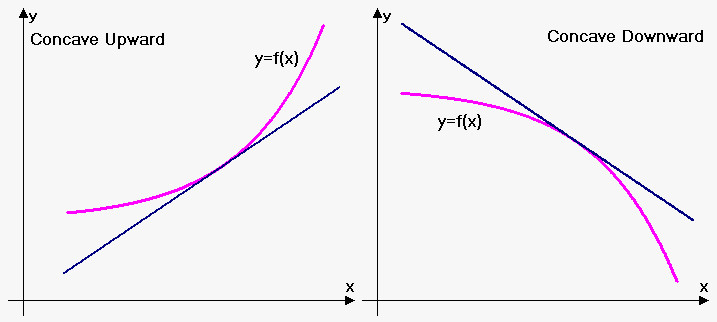
  • d2ydx2>0 \frac{d^2y}{dx^2} > 0 → concave up
  • d2ydx2<0 \frac{d^2y}{dx^2} < 0 → concave down

Even though you’re calculating in terms of tt, the interpretation is about the graph in xx and yy.

Here’s a quick visual reminder of what concave up and concave down look like in the xyxy-plane:

Study guide illustration

Concave up and concave down (with tangent lines)

When slope increases as xx increases, the graph cups upward. When slope decreases as xx increases, it bends downward.

Important Conditions

When dx/dt=0dx/dt = 0

The formula only works when dx/dt≠0dx/dt \ne 0.

If dx/dt=0dx/dt = 0:

  • dy/dxdy/dx is undefined
  • You likely have a vertical tangent
  • The second derivative formula also breaks there

AP questions sometimes sneak this in and ask about behavior at that value of tt. Always check before plugging in.

Common Errors

  • Stopping too early. Many students compute ddt(dy/dx) \frac{d}{dt}(dy/dx) and forget to divide by dx/dtdx/dt.
  • Finding d2y/dt2d^2y/dt^2 instead. That is not the same thing.
  • Not simplifying dy/dxdy/dx first. Algebra gets messy fast.
  • Plugging in a tt-value before finishing the formula. Keep everything symbolic until the end.

On multiple choice, wrong answers often come from skipping the final division step.

Key Takeaways

The formula to remember is d2ydx2=ddt(dy/dx)dx/dt \frac{d^2y}{dx^2} = \frac{\frac{d}{dt}(dy/dx)}{dx/dt} .
You must divide by dx/dtdx/dt at the very end.
Concavity is determined by the sign of d2ydx2 \frac{d^2y}{dx^2} , even though it’s written in terms of tt.
The formula only works where dx/dt≠0dx/dt \ne 0.
d2ydt2 \frac{d^2y}{dt^2} and d2ydx2 \frac{d^2y}{dx^2} measure completely different things.

AP® is a trademark registered by the College Board, which is not affiliated with, and does not endorse this website.

Notes

1 credit used · 5/5 remaining