Topic 1.13 Notes – Removing Discontinuities
1. Removable Discontinuities and How to Fix Them
A removable discontinuity happens at when:
- exists,
- but either is undefined or .
If the limit exists, you can “fix” the function by defining
That’s it. You fill the hole with the limit value.
Quick reminder about continuity at :
- is defined
- exists
- They are equal
If any one fails, the function is not continuous there.
If the limit does not exist (like a jump or vertical asymptote), redefining one point will not help.
Here’s what a removable discontinuity looks like:
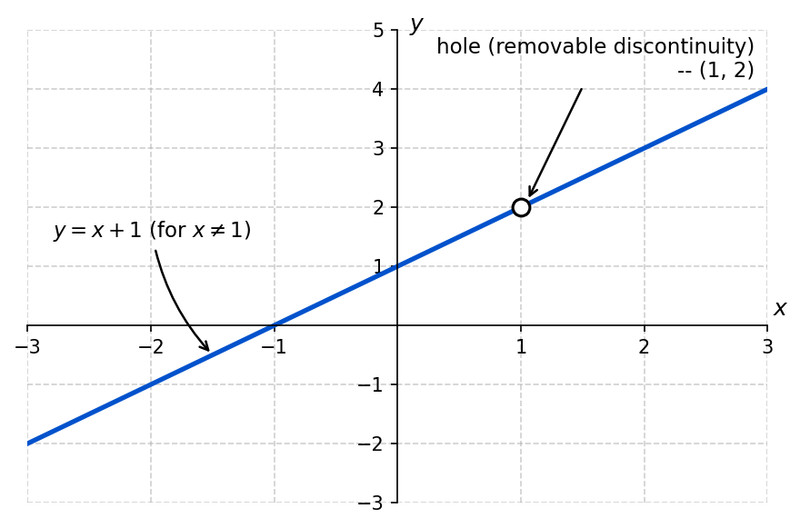
Removable discontinuity (hole) at
The graph follows a straight line, but there’s an open circle at . If we define , the graph becomes continuous.
2. Algebraic Holes in Rational Functions
Most removable discontinuities on tests come from rational functions.
They usually show up when:
- Plugging in gives
- The numerator and denominator share a factor like
That shared factor causes the hole.
Example
Factor the numerator:
So for ,
The simplified function tells you the limit.
To remove the discontinuity, define .
What They Like to Ask
- “Find the value of that makes the function continuous at .”
- “Determine whether the discontinuity is removable.”
- “Redefine the function so it is continuous.”
If you see , think factor and cancel.
Be careful:
- Only cancel factors, not individual terms.
- A non-canceling zero in the denominator means vertical asymptote, not a hole.
3. Making Piecewise Functions Continuous at a Boundary
Now think about piecewise functions.
The trouble spot is where the formula changes, say at .
For continuity there, you must have:
All three values must match.
What That Means Practically
- Evaluate the left expression at
- Evaluate the right expression at
- Set them equal
- Make sure that equals the defined value at
Example
Left-hand limit at 4:
Right-hand expression at 4:
Set them equal:
Now the left limit, right limit, and all equal 9.
Common mistake on quizzes: students only match one side to and forget to match both sides to each other.
4. When You Cannot Remove a Discontinuity
You cannot remove:
Jump Discontinuities
Left and right limits exist but are different.
Infinite Discontinuities
The function approaches .
This usually happens when a denominator is zero and nothing cancels.
If the limit is not a finite number, redefining one point won’t fix it.
5. Graph Thinking and Recognition
Fast mental checklist:
- Rational function + → likely removable.
- Denominator zero but no cancellation → vertical asymptote.
- Piecewise boundary → compare left, right, and function value.
- Parameter in the problem → you’re solving for continuity.
On no-calculator multiple choice, factoring quickly is key. On FRQs, show the limit reasoning clearly. The graders want to see that you understand why redefining the function works.
