Topic 9.4 Notes – Defining and Differentiating Vector-Valued Functions
What a Vector-Valued Function Is
A vector-valued function gives a vector as its output. In two dimensions, we write it as
Here’s what that means:
- and are ordinary real-valued functions.
- For each value of , you get a point .
- That point can also be viewed as a vector from the origin to .
So this is just parametrics written in vector form.
In the graph below, the curve is traced out by , and for each value of , the vector runs from the origin to a point on that curve.
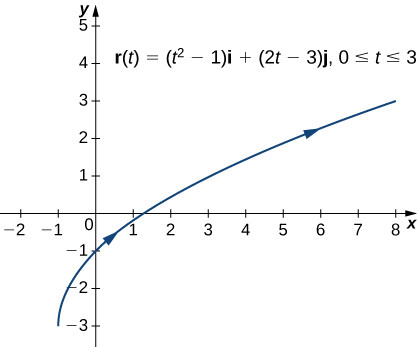
A parametric curve defined by a vector-valued function
Quick reminder about vectors:
- A vector has magnitude
- In motion problems:
- = position
- = velocity
- = acceleration
Everything you already know about derivatives still works. You just apply it to each component.
Differentiating Vector-Valued Functions
If
then
That’s the whole rule. Differentiate component-by-component.
All familiar derivative rules still apply inside each component:
- Power rule
- Product rule
- Quotient rule
- Chain rule
- Trig, exponential, and log derivatives
You are not inventing new rules. You are just doing two regular derivatives at the same time.
Example
Let
Differentiate each component:
- First component:
- Second component (product rule):
So
Notice how all the work happens inside each slot.
If asked for , differentiate first, then plug in .
Velocity and Acceleration
Velocity
Velocity tells you:
- Direction of motion
- How fast position is changing in each coordinate
Geometrically, velocity is tangent to the path. In the figure below, the blue vector represents the velocity at a point on the curve.
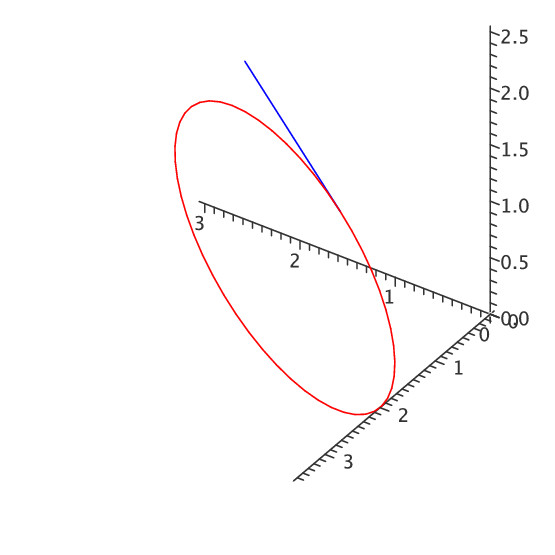
Velocity vector tangent to a space curve
Acceleration
Acceleration is just the derivative of velocity. Again, differentiate each component.
Students often overthink this. It’s literally “differentiate again.”
Speed vs. Velocity
This is tested constantly.
- Velocity is a vector.
- Speed is the magnitude of velocity.
Speed is always nonnegative.
If the question says “how fast is the particle moving,” they want the magnitude.
Evaluating at a Specific Time
When you see something like :
- Find .
- Plug in .
- Simplify both components.
Do not plug in before differentiating. That turns the function into constants and kills the derivative.
On FRQs, clarity matters. Write the derivative symbolically first. Then evaluate.
Common Errors That Cost Points
- Forgetting the chain rule inside trig or exponentials
Example pattern: , - Mixing up speed and velocity
- Dropping one component in your final answer
- Trying to apply derivative rules across the entire vector instead of inside each component
If you can differentiate messy real-valued functions cleanly, this topic is procedural.
