Topic 5.3 Notes – Determining Intervals on Which a Function Is Increasing or Decreasing
How the First Derivative Controls Increasing and Decreasing
Remember what the derivative represents.
is the instantaneous rate of change, which is the slope of the tangent line to .
That slope tells you everything about direction:
- If → slope positive → function increasing
- If → slope negative → function decreasing
- If → horizontal tangent (possible turning point)
Think of it like driving:
- Positive slope = driving uphill → graph going up.
- Negative slope = driving downhill → graph going down.
Here’s how that looks on a sign diagram and the corresponding graph.
On the number line, the plus and minus signs show where is positive or negative. On the graph, those same intervals match where the function rises or falls.
Notice: we don’t look at whether itself is positive or negative. Only the sign of matters.
Critical Numbers and Where Behavior Can Change
A function can only switch from increasing to decreasing (or vice versa) at specific x-values.
Those are critical numbers, defined as values in the domain of where:
- does not exist
Important detail: the value must be in the domain of to count as a critical number.
Also, if the function itself is undefined at some point, that still splits the number line into intervals. Behavior can’t “flow through” a discontinuity.
These special x-values divide the number line into intervals. On each interval, the derivative cannot change sign unless you cross one of these points.
That’s why testing one point per interval works.
The Sign Chart Method
This is the standard justification method you’ll use on quizzes and FRQs.
Step 1: Find
Differentiate carefully. Algebra mistakes here ruin everything.
Step 2: Find critical numbers
Solve:
and determine where is undefined (while exists).
Step 3: Split the number line
Use those x-values (and any discontinuities of ) to form intervals.
Step 4: Test one value in each interval
Plug test values into , not .
Example:
Let
Critical numbers: ,
Intervals:
Test signs:
- Pick : → increasing
- Pick : → decreasing
- Pick : → increasing
So:
- Increasing on
- Decreasing on
On a free-response question, you must explicitly connect sign to conclusion: “Since on (a,b), is increasing on (a,b).”
Reading Behavior from a Graph of
Sometimes you’re given the graph of the derivative instead of a formula.
Here’s how to read it:
- Above x-axis → → increasing
- Below x-axis → → decreasing
- Where crosses x-axis → possible change in direction
In the graph below, is positive for , negative on , and positive again for . That means is increasing, then decreasing, then increasing.
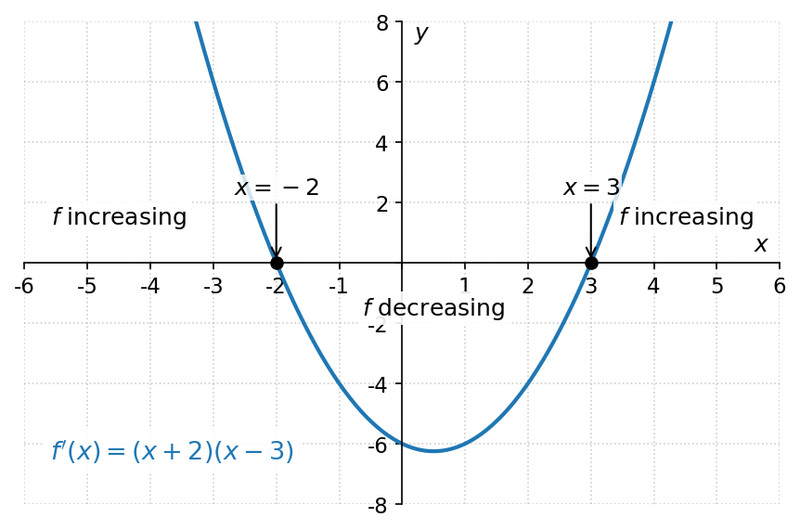
If touches zero but does not change sign, the function does not change direction there. That shows up a lot in multiple-choice questions.
Common Mistakes I See Every Year
- Plugging test points into instead of
- Forgetting to consider where the function is undefined
- Calling every critical number a max or min (you need a sign change)
- Giving single x-values instead of interval notation
The AP graders care about justification. The phrase “because is positive” is what earns the point.
