Topic 5.10 Notes – Introduction to Optimization Problems
What an Optimization Problem Is
An optimization problem asks you to maximize or minimize a quantity such as area, volume, cost, distance, or surface area.
Calculus enters because:
- A maximum or minimum occurs at a critical point where or is undefined.
- On a closed interval, you must also check endpoints.
- You justify max/min using the First Derivative Test or Second Derivative Test.
In applied settings, you almost always:
- Build a function from the situation.
- Rewrite it in terms of one variable.
- Use derivatives to find and verify the extreme value.
That middle step is where most mistakes happen.
The Optimization Strategy
Think of this as a consistent pattern. The structure rarely changes.
Step 1: Define Variables and Sketch
Assign variables to the changing quantities.
If geometry is involved, draw a quick labeled sketch. For example, a rectangle with fixed perimeter:
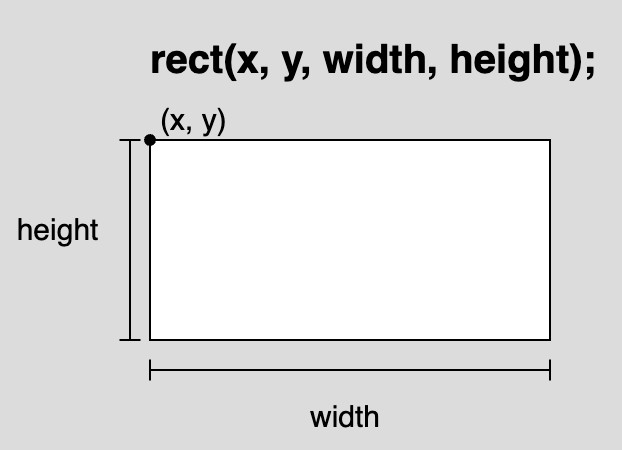
Rectangle with labeled width and height
Seeing the width and height labeled makes the algebra much cleaner.
Be clear about:
- What are you optimizing?
- What equation connects the variables? (This is the constraint.)
Step 2: Write the Constraint Equation
The constraint is the relationship that ties variables together.
Examples:
- Fixed perimeter:
- Fixed volume:
- Given product:
This equation is what allows you to eliminate a variable.
Step 3: Reduce to One Variable
Solve the constraint for one variable and substitute.
Example:
If , then .
If area is , substitute:
Now it’s a single-variable function. Only now are you ready to differentiate.
If two variables are still present, you’re not finished setting it up.
Step 4: Differentiate and Find Critical Points
Take the derivative.
For the example:
Set equal to zero:
Always consider domain restrictions. Lengths must be positive.
Step 5: Verify Max or Min
Use one of these:
- First Derivative Test
Check if changes from positive to negative (max) or negative to positive (min). - Second Derivative Test
If , local minimum.
If , local maximum.
On AP free-response, you must justify your conclusion. Just finding is not enough.
Step 6: Answer What Was Asked
Common trap: solving for but the question asks for area, volume, or another variable.
Go back and compute the actual quantity being optimized. Include units.
Common Optimization Types
Most problems fall into these patterns:
Area Problems
- Rectangles with fixed perimeter
- Fencing problems
- Paper with margins
You’re usually maximizing area under a perimeter constraint.
Volume Problems
- Open-top boxes
- Cylinders with fixed surface area
Be careful with missing faces. An open-top box does not include the top in surface area.
Surface Area Problems
- Minimize material cost
- Compare closed vs open containers
Always write the full surface area formula before substituting.
Algebraic Constraints
If given something like :
Then you’ll often optimize expressions like:
These almost always produce one critical point that gives the extremum.
First vs Second Derivative Test
- The First Derivative Test always works and is great when sign changes are easy to see.
- The Second Derivative Test is faster when is simple.
- If , it tells you nothing.
On AP problems, either method earns credit if justified clearly.
Common Mistakes
- Differentiating before eliminating a variable.
- Forgetting to check endpoints on a closed interval.
- Ignoring domain restrictions (negative lengths).
- Dropping a squared term when substituting.
- Stopping at the critical point without stating max/min.
Optimization is mostly algebra discipline. The calculus part is often the easy step.
