Topic 9.8 Notes – Find the Area of a Polar Region or the Area Bounded by a Single Polar Curve
The Area Formula in Polar Coordinates
If a curve is given by , the area swept out from to is
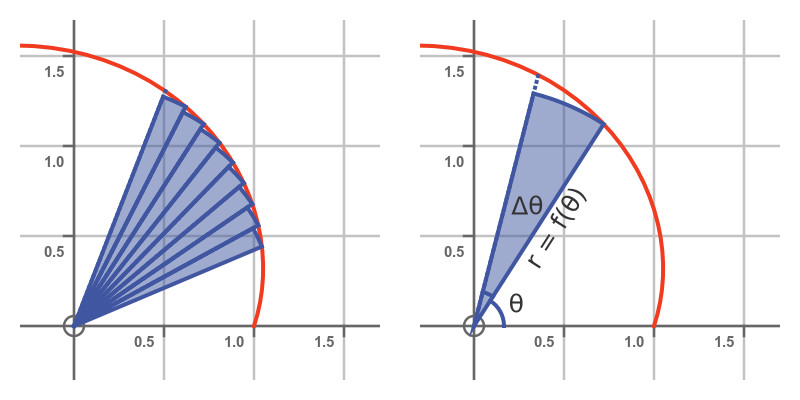
This comes from the area of a tiny sector.
A sector with radius and small angle has area approximately
Add up infinitely many of those from to , and you get the formula above.
Here’s the geometric idea. The left panel shows many thin sectors building the region, and the right panel zooms in on one small wedge with radius and angle .
A few things that matter:
- must be in radians
- The integrand is , not just
- The is part of the formula - don’t lose it
- Because of the square, area is positive even if is negative
In rectangular coordinates, you add vertical strips.
In polar, you add rotating wedges.
When This Formula Applies
Use this formula when the region is:
- Inside a single polar curve
- Traced as moves from to
- Described as “area enclosed by the curve,” “area inside,” or “area of one loop/petal”
If the curve is traced exactly once over an interval, integrate over that interval.
If it retraces itself, you must adjust the bounds or you’ll double-count area.
That’s the part students miss most often.
Choosing the Correct θ-Interval
Before you integrate, figure out what portion of the graph you’re actually finding.
a. Entire Enclosed Curve
Many curves are traced once from to .
Examples include certain limacons and cardioids.
But don’t assume. Some curves finish tracing earlier than .
On a test, they love giving you a curve that completes itself before . If you blindly integrate to , you’ll double the area and never know why your answer is off by a factor of 2.
b. One Petal or One Loop
For rose curves like , you usually want one petal.
To find that interval:
- Solve
- Find consecutive θ-values where this happens
- Integrate between them
That gives exactly one petal.
For example, with , solving gives consecutive zeros at and . Integrating between those bounds captures exactly one petal, as shown below.
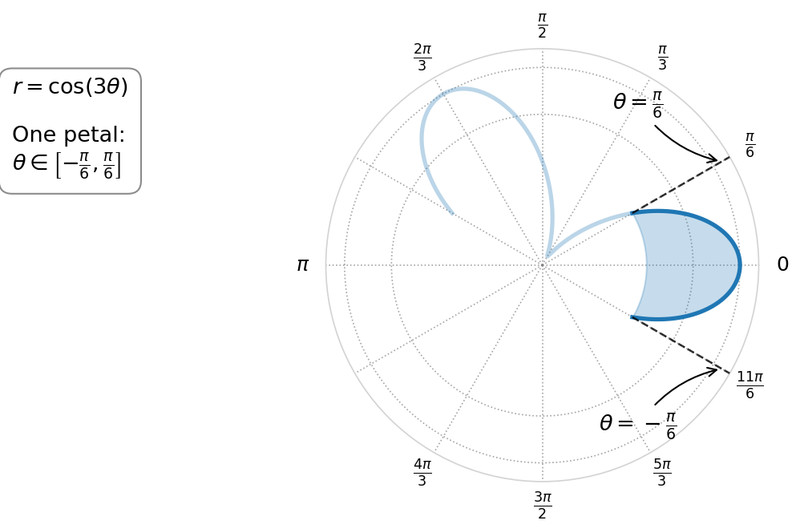
One petal of
If symmetry exists, you can compute one piece and multiply. Just be sure the piece really represents equal parts.
c. Using Symmetry
Polar graphs often have symmetry about:
- The x-axis
- The y-axis
- The origin
If half the area is easier, compute half and multiply. But confirm visually or algebraically. Guessing symmetry is risky.
The Procedure for Finding Polar Area
When you sit down with a problem, this is the flow:
- Understand the region
- Whole curve?
- One loop?
- Symmetric portion?
- Determine θ-bounds
- Given directly, or
- Solve
- Set up
- Simplify before integrating
- Expand squares
- Use trig identities
- Evaluate carefully
Most polar-area integrals are no-calculator friendly. Expect trig identities and clean exact answers on that section of the AP exam.
Common Exam Traps
Forgetting the
This is the most common mistake.
Wrong interval
Too large → double-counting.
Too small → missing area.
Algebra errors when squaring
. Slow down here.
Negative r confusion
Even if becomes negative, the formula still works because you’re squaring it. The issue isn’t negativity - it’s choosing the correct interval.
Big Picture
This is still accumulation.
- Rectangular:
- Polar:
Same idea. Different geometry.
