Topic 6.7 Notes – The Fundamental Theorem of Calculus and Definite Integrals
1. Antiderivatives and What the Fundamental Theorem Connects
An antiderivative of a function is a function such that
If one antiderivative works, then infinitely many do:
That is there because the derivative of a constant is zero.
Now here’s the big connection.
If is continuous and you define a new function
then something amazing happens:
So the function defined by “area from to ” is automatically an antiderivative of .
That’s FTC Part 1.
FTC Part 2 goes the other direction. If , then
So:
- Differentiate an integral → original function
- Integrate a derivative over an interval → net change
The slope of the accumulation function equals the height of the original function.
2. FTC Part 1 and Differentiating Definite Integrals
If
then
You don’t evaluate the integral. You don’t find an antiderivative. You just remove the integral and plug in .
When the upper bound isn’t just
If
then
You:
- Plug the upper bound into the integrand.
- Multiply by the derivative of that upper bound.
Example idea:
If , then
Students almost always forget the . That chain rule factor is where points disappear on FRQs.
If the lower bound is a function, the derivative picks up a negative sign. If both bounds are functions, treat it as:
and differentiate both pieces.
3. FTC Part 2 and Evaluating Definite Integrals
If , then
This is what you use constantly on quizzes and the no-calculator section.
The flow
- Find any antiderivative .
- Plug in the upper bound.
- Plug in the lower bound.
- Subtract.
No . It cancels anyway.
Quick example:
An antiderivative is .
Evaluate:
That number represents net signed area.
4. Net Area, Geometry, and Common Traps
A definite integral gives net accumulation, not total area.
- Above the x-axis → positive
- Below the x-axis → negative
If a graph crosses the axis and the question asks for total area, you must:
- Split at intercepts
- Make each piece positive
- Add
Here’s the sign idea visually.
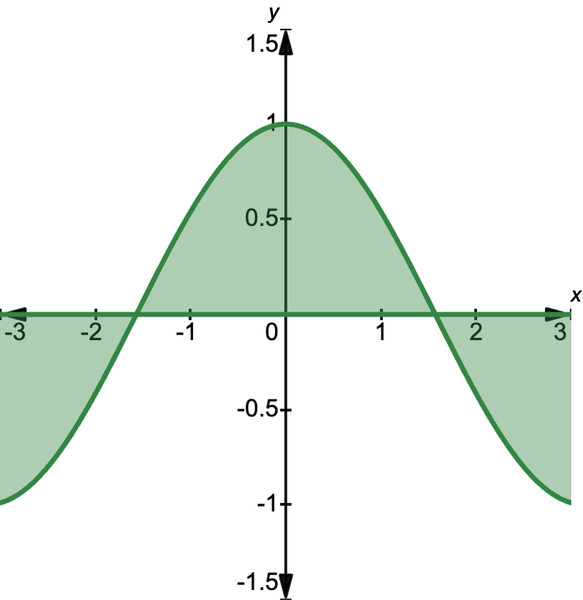
Positive and negative signed area on a graph
The middle shaded region is above the x-axis, so it contributes positive area. The shaded regions on the left and right are below the axis, so they count as negative when you evaluate a definite integral.
Other properties you should know instantly:
If you’re given a graph made of rectangles or triangles, use geometry. The exam loves simple shapes because it tests whether you understand accumulation, not algebra stamina.
