Topic 10.13 Notes – Radius and Interval of Convergence of Power Series
1. What a Power Series Is and What Convergence Means
A power series has the form
- = coefficients (a sequence of numbers)
- = center
- = variable
You can think of it as an infinite polynomial centered at .
How power series behave
If a power series converges, only two things can happen:
- It converges only at one point (just ), or
- It converges on an interval centered at .
That interval always looks like:
where is the radius of convergence.
Inside that open interval:
- The series converges absolutely.
- It acts like a smooth, well-behaved function.
- If , the series is the Taylor series of the function it equals on that interval.
Here’s the geometric picture you should have in your head. The three number lines show the only possible behaviors.
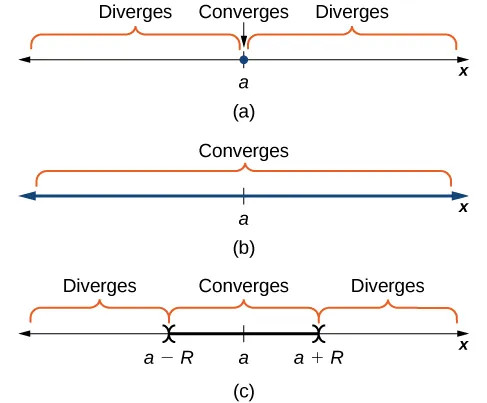
Possible convergence behaviors of a power series
The radius gives you the open interval. The endpoints require extra work.
2. Using the Ratio Test to Find the Radius of Convergence
For almost every power series problem, the Ratio Test is the main tool.
Given
compute
What actually happens algebraically
After canceling powers, you’ll always end up with:
Call that constant . Then:
For convergence, the Ratio Test requires . So:
Solve for :
So the radius is
Special cases
- If the limit becomes 0 → converges for all , so .
- If the limit forces only → .
Common algebra mistake: forgetting to factor out before taking the limit. Keep it separate from the -stuff.
3. Finding the Interval of Convergence
The radius gives you the open interval:
But you are not finished.
You must test:
When you plug those in, the Ratio Test will give . It always fails at endpoints. So now you switch to:
- p-series test
- Alternating Series Test
- Comparison
- Harmonic recognition
- etc.
Each endpoint is tested independently.
Your final answer should clearly state:
- Center:
- Radius:
- Interval: use parentheses or brackets correctly
Example structure:
On AP FRQs, you lose points if you forget to test endpoints or if you give only when the interval is requested.
4. What the Radius Tells You About the Function
If , then on :
- The power series equals its function.
- You can differentiate term-by-term.
- You can integrate term-by-term.
Very important fact:
- Differentiating does not change .
- Integrating does not change .
The endpoints might behave differently after differentiation or integration, but the radius stays the same. That’s because depends on long-term growth of coefficients, and differentiation/integration doesn’t change that growth pattern.
5. Common Exam Mistakes
- Leaving out of the Ratio Test.
- Solving incorrectly.
- Forgetting absolute value when solving.
- Not testing endpoints.
- Using the Ratio Test at endpoints.
- Mixing up center and radius .
If you stay systematic, these problems are very predictable.
