Topic 7.3 Notes – Sketching Slope Fields
What a slope field is
A slope field (also called a direction field) represents a differential equation of the form
At each point , the equation tells you the slope of the solution curve passing through that point.
So you:
- Pick a point .
- Plug it into .
- Draw a short line segment with that slope centered at the point.
Do that for many points on a grid. The result is a “field” of little segments.
Every actual solution curve must:
- Be tangent to those segments at every point.
- Follow the general direction they indicate.
Here’s what that looks like for the differential equation :
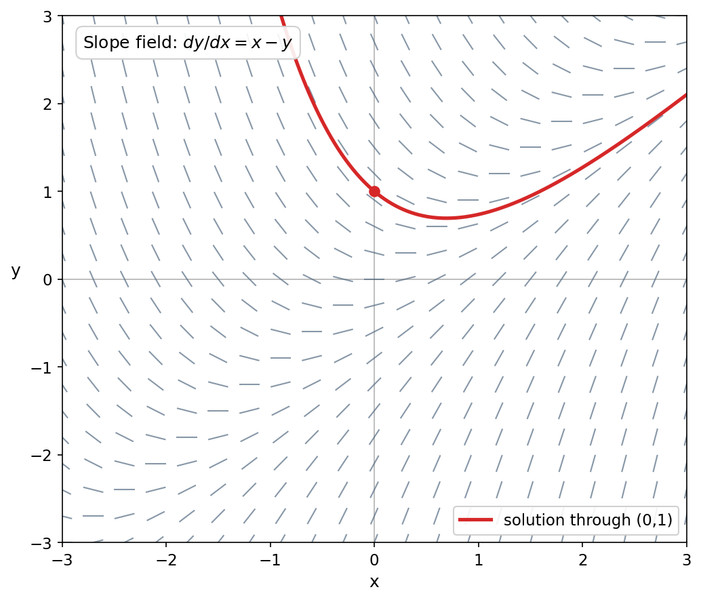
Slope field for with solution through (0,1)
The red curve is one specific solution passing through . Notice how it hugs the tiny line segments everywhere it goes. That’s the whole idea.
How to sketch a slope field
On a quiz, you won’t usually calculate 30 slopes. You look for structure.
Suppose you’re given
Here’s the thinking process:
- Identify the slope formula
The slope at is . - Check for zero slopes first
Set .
Along that line, all segments are horizontal. That line often organizes the whole field. - Plug in a few easy points
- At (0,0): slope = 0
- At (1,0): slope = 2
- At (0,1): slope = -1
- Draw short, consistent-length segments
Only the angle changes, not the length.
Patterns matter more than quantity. A neat, thoughtful sketch scores better than a messy dense one.
Recognizing common patterns
Before computing anything, ask: what does the equation depend on?
When
Slopes depend only on x.
- All points with the same -value have the same slope.
- Slopes form vertical stripes.
Here’s a classic example with . Notice how every vertical line has matching segments.
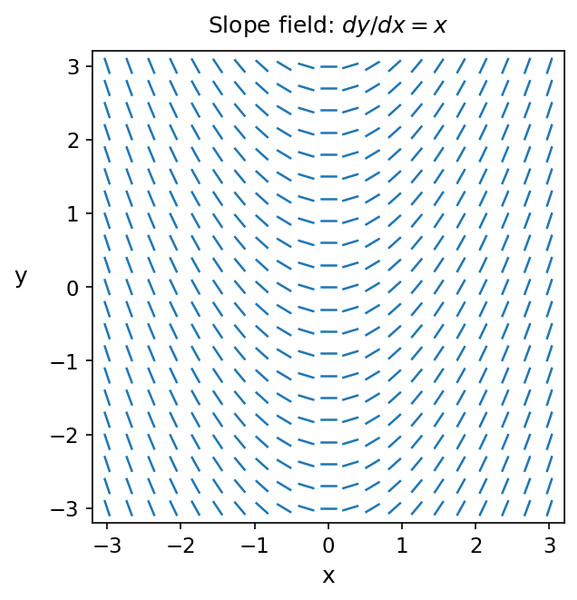
Slope field for
If you see vertical bands of identical segments, the equation probably depends only on .
When
Slopes depend only on y.
- All points with the same -value share the same slope.
- Slopes form horizontal bands.
Now look at . The segments repeat across horizontal lines.
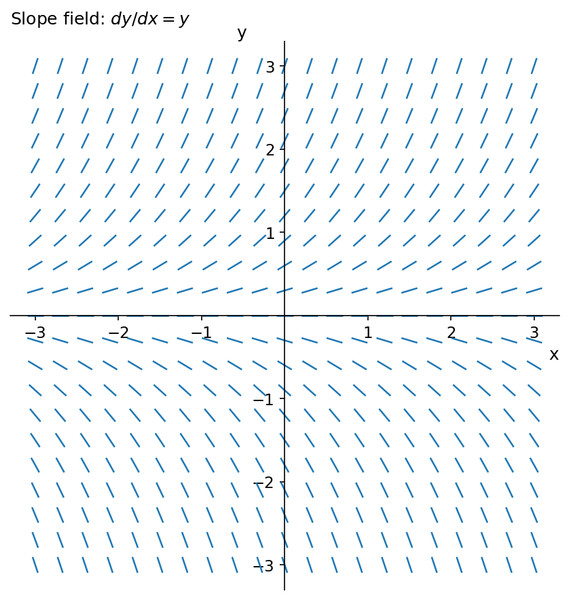
Slope field for
This shows up a lot with growth/decay models.
Zero and undefined slopes
- If , you draw horizontal segments.
- If the slope would be undefined (like when ), you don’t draw a segment there. That line often acts like a boundary.
AP-style multiple choice questions love asking where solutions level off. Look for rows of nearly horizontal segments.
Estimating solution curves
If you’re given an initial condition like :
- Start at the point .
- Follow the direction of nearby segments.
- Draw a smooth curve that stays tangent as it moves.
Important observations you should be able to make from the field:
- Increasing vs decreasing
Positive slopes → curve rises.
Negative slopes → curve falls. - Leveling off
Near zero slopes, solutions flatten. - Solutions don’t cross
Through any single point, there is only one possible slope. So solution curves never intersect each other.
On FRQs, when asked to sketch a particular solution, make sure your curve actually matches the tiny segments. Readers look for tangency.
Why slope fields matter
Some differential equations are hard or impossible to solve explicitly. A slope field still tells you:
- Long-term behavior
- Stability near certain lines
- Whether solutions increase, decrease, or approach a boundary
You’re learning to understand behavior without solving algebraically. That modeling mindset is the point of Unit 7.
