Topic 10.1 Notes – Defining Convergent and Divergent Infinite Series
1. Sequences and Their Limits
An infinite sequence is a list of numbers written as
Each term depends on . We care about what happens as .
Convergent vs Divergent Sequences
A sequence is convergent if
for some finite number .
It is divergent if:
- The limit does not exist (for example, it oscillates), or
- The limit is or .
Some patterns you should recognize quickly:
- Rational expressions: compare highest powers. Example: → limit is .
- Alternating terms like : often oscillate.
- Exponentials vs powers: grows much faster than .
For example, look at the sequence below.
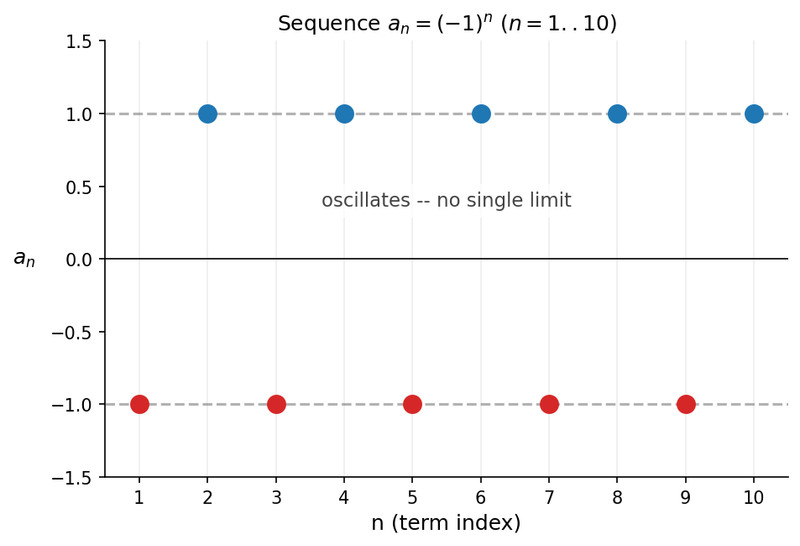
Sequence
The terms jump between −1 and 1 and never approach a single value. This sequence does not settle down, so it diverges.
Monotonic and Bounded
Two quick reminders:
- Monotonic means always increasing or always decreasing.
- Bounded means the terms stay between fixed upper and lower numbers.
The important theorem:
If a sequence is monotonic and bounded, then it converges.
This is more conceptual support than a main computational tool on the AP exam, but it explains why some sequences must settle down.
2. What an Infinite Series Is
A series is the sum of the terms of a sequence.
If you have a sequence , the corresponding series is
But we never literally add infinitely many numbers. Instead, we define a new sequence called the partial sums.
Partial Sums
The nth partial sum is
That’s just the sum of the first terms.
An infinite series is defined as:
So a series is really a limit of partial sums.
In other words, we keep adding terms to form and then take the limit as .
3. Convergent and Divergent Series
Now the key idea.
A series converges if
for some finite number . We call the sum of the series.
A series diverges if:
- The limit of does not exist, or
- The limit is infinite.
This is the mindset shift:
- A sequence converges if its terms approach a number.
- A series converges if its running totals approach a number.
You’re asking: do the totals level off?
4. Using the Definition to Determine Convergence
At this point in the unit, you use the definition directly.
General Process
- Write an expression for .
- Simplify it.
- Compute .
- Decide finite or not.
Telescoping Example
Suppose
Write out a few terms:
Most middle terms cancel. What survives are the first couple and the last couple.
After cancellation, you get something like:
Now take the limit. The last two terms go to 0, so the series converges.
On FRQs, they often want to see the cancellation written out. Don’t skip that step.
5. Properties of Convergent Series
If both
and converge, and is a constant:
- converges.
- converges.
These only apply if the original series already converge. You cannot use them to prove convergence from scratch.
6. Common Mistakes
- Mixing up and . They are different objects.
- Thinking “” guarantees convergence. It doesn’t. That becomes a major theme soon.
- Forgetting that divergence includes limits of or oscillation.
- On tests, not clearly stating that you evaluated . The definition language matters in written responses.
