Topic 10.3 Notes – The nth Term Test for Divergence
1. What the nth Term Test for Divergence Says
Start with a series:
This series is built from the sequence of terms . The nth Term Test looks only at those terms.
The Core Fact
If
then
That’s it.
Why this must be true
A convergent series means the partial sums level off to a finite number. That can only happen if the pieces you’re adding get smaller and smaller, eventually shrinking to 0.
If the terms don’t approach 0, you’re still adding a noticeable amount forever. The total cannot settle down.
Here’s the key logical structure you need to remember:
- Terms do not go to 0 → series diverges
- Terms go to 0 → we don’t know yet
Zero is required for convergence. But zero alone does not guarantee convergence.
2. How to Apply the Test
When you’re handed a series on a quiz or MCQ, this should be your first mental check.
Step 1
Write the limit of the terms:
You are not finding the sum. Just the limit of the sequence.
Step 2
Evaluate the limit using standard limit tools:
- Compare highest powers (rational functions)
- Use end behavior rules
- Recognize known limits (like trig, log, exponential behavior)
- Look for horizontal asymptotes
Step 3
Make your conclusion clearly.
- Limit ≠ 0 → diverges
- Limit does not exist → diverges
- Limit = 0 → test is inconclusive
On an FRQ, you must state the reason:
Since , the series diverges by the nth term test.
They want the name of the test.
3. Common Types of Limits You’ll See
Rational Functions in
If
Compare degrees:
- Same degree → limit is ratio of leading coefficients → nonzero → diverges
- Numerator degree bigger → limit = ±∞ → diverges
- Denominator degree bigger → limit = 0 → inconclusive
Example idea:
Highest powers match → limit = → series diverges immediately.
This shows up constantly on no-calculator multiple choice.
Functions with Known End Behavior
Some expressions level off at a constant that is not zero.
For example:
The graph makes the end behavior clear:
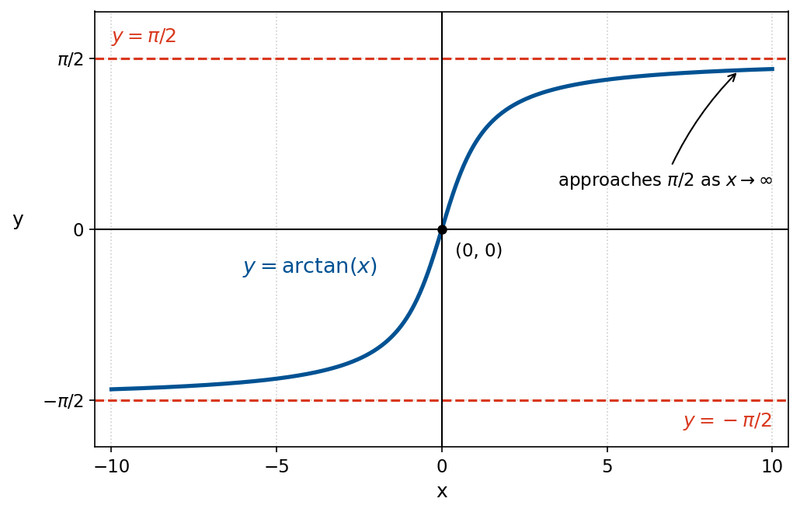
Graph of
As , , which is not zero.
So
diverges.
Other common ones:
If the limit is anything other than 0, you’re done.
Oscillating Sequences
If the terms bounce around and don’t settle at 0, the series diverges.
Example:
This alternates between 1 and -1. The limit does not exist → divergence.
But be careful:
Now the magnitude shrinks to 0.
The limit equals 0 → nth term test tells you nothing.
This is a classic trap. Students stop too early.
4. What This Test Cannot Do
If
you are not finished.
You must move to another test such as:
- Geometric series
- p-series
- Integral test
- Comparison tests
- Alternating Series Test
- Ratio or Root test (coming later)
Classic example:
Since , students often say it converges.
It actually diverges.
Terms going to zero is necessary, not sufficient.
5. Fast Exam Mindset
When a series appears:
- Check .
- If it’s not zero, stop immediately and conclude divergence.
- If it is zero, switch to a stronger test.
Strong students always do this first. It saves time and prevents overthinking.
On timed MCQs, this can eliminate answers in seconds.
