Topic 8.9 Notes – Volume with Disc Method: Revolving Around the x- or y-Axis
What the Disc Method Is
Imagine a region under a curve. When you rotate it around an axis, it sweeps out a 3D solid. If the region touches the axis of rotation, every cross-section perpendicular to that axis is a solid circle (a disc).
Each thin slice has:
- Radius = distance from the curve to the axis
- Thickness = or
- Volume ≈
Adding infinitely many of these slices gives a definite integral.
This builds directly on:
- Area of a circle
- Definite integrals as accumulation
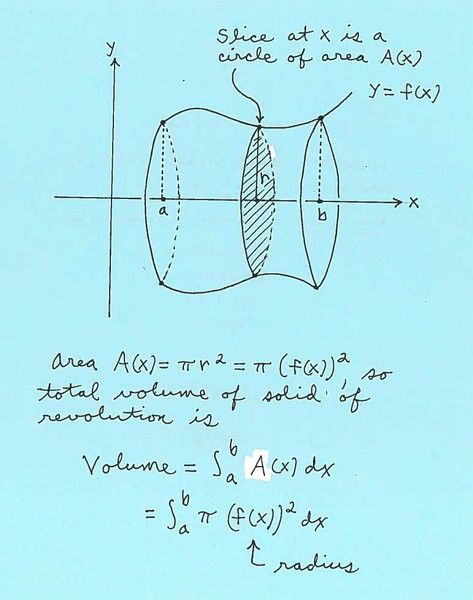
Here’s the geometric idea when rotating around the x-axis:
Disc method: rotating about the x-axis
The vertical slice at a typical -value spins around the x-axis and becomes a circular disc with radius . That is why the cross-sectional area is , and adding them from to gives the volume.
The Two Disc Formulas
There are only two setups you need.
Rotating Around the x-Axis
You use this when:
- The axis of rotation is the x-axis
- The function is written
- You integrate with respect to x
- Radius =
- Bounds = x-values
- Slice direction = vertical slices (thickness )
Example (quick setup):
Region under from to , rotated about the x-axis:
The square applies to the entire function.
Rotating Around the y-Axis
You use this when:
- The axis is the y-axis
- The function is written
- You integrate with respect to y
- Radius =
- Bounds = y-values
- Slice direction = horizontal slices (thickness )
If you're given and rotating around the y-axis, rewrite it:
Then the radius becomes , not .
Quick Comparison
| Axis of Rotation | Integrate With | Radius | Bounds |
|---|---|---|---|
| x-axis | x-values | ||
| y-axis | y-values |
A fast check before writing anything:
Axis tells you the variable.
How to Set Up a Disc Problem
When you see one on a quiz or FRQ, walk through this mentally.
Identify the axis.
That determines or .Sketch the region.
Even rough. It helps you see:- Where it touches the axis
- The correct bounds
Find the radius.
Radius = distance to the axis.- Around x-axis → radius is a y-value
- Around y-axis → radius is an x-value
Match bounds to your variable.
If integrating in , your limits must be y-values.Write the integral.
Always:Evaluate carefully.
Algebra mistakes cost easy points.
On FRQs, setup often earns most of the credit. If your integral is correct but arithmetic slips, you usually still get the majority of points.
When Disc Method Applies
The disc method works when:
- The region touches the axis
- There is only one boundary curve
- There is no hole in the middle
If there’s a gap between the curve and the axis, the cross-sections are rings, not solid circles. That’s the washer method and comes next in the unit.
Students often lose points by automatically writing whenever they see rotation. Always check whether the region actually touches the axis.
